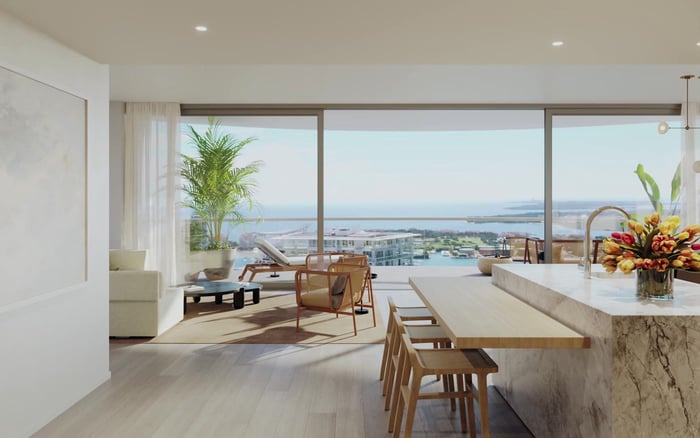
A refined penthouse is judged not only by its view, plan, and finishes, but by the grace with which important pieces arrive. Better furniture craning protects architecture, artful interiors, privacy, and long-term value in South Florida’s high-rise market.

In a South Florida penthouse, furniture craning is rarely discussed with the same enthusiasm as stone selection, millwork, lighting, or the line of the terrace. Yet the arrival of a large sofa, a custom dining table, a sculptural bed, or a single piece of collectible design can reveal the true quality of a residence. Quiet luxury is not only what a room looks like when the doors open. It is how calmly the room comes together.
For the owner, craning should feel like private choreography rather than an event. At its best, it is measured, insured, pre-cleared, and nearly invisible to neighbors. At its worst, it turns a refined interior into logistical improvisation, with delayed crews, exposed finishes, uncertain access, and building staff pushed into emergency decision-making. In the ultra-premium tier, that difference matters.
South Florida buyers are increasingly fluent in the details of high-rise living. They study views, elevator privacy, ceiling heights, service corridors, and the relationship between indoor volumes and outdoor rooms. Furniture craning belongs in that same conversation. It is not an afterthought. It is part of the ownership experience.
The right time to discuss furniture craning is before the purchase order for the statement piece, before the renovation schedule is locked, and ideally before the final furniture plan is approved. A room may appear generous on paper, but the path into that room is its own architecture. Elevator dimensions, corridor turns, door clearances, balcony access, garage staging, loading protocols, and building rules all determine whether a piece can arrive without compromise.
This is especially relevant for high floors, where the romance of altitude often meets the discipline of logistics. A panoramic residence can support large-scale design beautifully, but the higher the home, the more carefully the delivery must be staged. A client may fall in love with a monumental sectional or an oversized dining table, only to discover that the intended path is not realistic. Better planning protects the design intent rather than shrinking it late in the process.
A craning review should be treated as a professional coordination item, not a panic call. Designers, owners’ representatives, building management, installers, and crane specialists need a shared understanding of the piece, the route, the timing, and the conditions for proceeding. When that alignment happens early, the owner preserves optionality. When it happens late, the owner pays for urgency.
True discretion begins with respect for the building. In a luxury condominium, the residence is private, but the delivery touches shared systems. Service elevators, loading areas, parking ramps, staffing, security desks, and common corridors all become part of the experience. A well-managed crane operation reduces disruption and signals seriousness to everyone involved.
The building should not be surprised. Management will often expect documentation, scheduling, insurance verification, protection plans, and clear communication about what is moving and when. Even when the actual lift is brief, the preparation should be exacting. That preparation protects more than the owner’s furniture. It protects relationships with staff and neighbors, among the invisible privileges of high-end condominium living.
The same principle applies inside the home. Finished flooring, plaster walls, stone thresholds, custom doors, glass railings, and integrated lighting deserve a delivery strategy that treats them as finished assets, not obstacles. The most elegant installation is one in which no one is asking, at the last minute, whether a corner can be forced or a panel can be temporarily removed.
South Florida adds its own layer of discipline. The climate rewards outdoor living, but it also demands respect for timing and exposure. A balcony or terrace may be the access point that makes a difficult piece possible, yet that same opening requires careful protection and coordination. A lift that depends on exterior access should be planned around conditions that support safety, privacy, and control.
Visibility matters as well. A crane at a luxury tower draws attention, even when the task is routine. For owners who value privacy, the goal is not theatrical arrival. It is compressed activity, clear staging, minimal waiting, and a crew that understands discretion. Quiet luxury prefers competence over spectacle.
In Brickell, the conversation often includes density, timing, and street-level coordination. In oceanfront settings, exposure and building protocol can become more central. In both cases, the owner benefits from a single person responsible for aligning the designer’s ambition with the building’s operational realities. The result is a delivery that feels considered rather than conspicuous.
Furniture craning is not merely a service cost. It is a form of risk management and, in the right hands, a value-preservation exercise. Ultra-premium interiors are composed of decisions that cannot be judged independently. The table, sofa, bed, console, or art plinth must be considered alongside flooring, walls, views, millwork, and circulation. If arrival damages the setting, the object has failed its own purpose.
There is also an investment dimension. A well-kept residence retains the story of careful ownership. Scuffed corridors, stressed thresholds, delayed installations, and unresolved repairs all diminish the sense that a home has been managed at the level its price implies. Buyers may not ask about a past crane lift, but they recognize interiors that feel protected from the beginning.
The best owners understand that logistics are part of stewardship. They do not reduce design to acquisition. They ask how each piece will enter, how it will be handled, who will supervise it, what approvals are needed, and how the residence will be restored to calm immediately afterward. This is not fussy. It is disciplined.
Before commissioning or purchasing oversized furniture, owners should ask for a delivery feasibility review. The review does not need to be theatrical. It should answer a simple set of questions: Can the piece fit through normal access? If not, what exterior access is possible? What permissions are required? What weather or timing conditions matter? Who protects the interior? Who communicates with the building? Who has final authority to stop the operation if conditions are not right?
The answer should not be a vague assurance. It should be a plan. In luxury real estate, ambiguity is expensive because it transfers risk to the most delicate moment: when the piece is already on site. Better craning replaces hope with sequence.
Owners should also ask whether the design team has considered modularity without compromising the room. Sometimes a piece can be fabricated in sections and assembled beautifully on site. Sometimes the integrity of a design depends on a single form, and craning is the more appropriate route. Neither answer is inherently superior. The luxury lies in choosing deliberately.
A finished penthouse should not bear evidence of its own difficulty. Guests see the room, the view, the art, the texture of the upholstery, the proportion of the table, and the way evening light moves across the floor. They should not sense the logistical tension behind any of it.
That is the quiet luxury case for better furniture craning. It is a refusal to let a great residence be compromised by an ordinary delivery mindset. It honors the architecture, the designer, the building staff, the neighbors, and the owner’s privacy. Most of all, it understands that in South Florida’s finest homes, elegance is often measured by what never becomes visible.
Why should penthouse owners think about furniture craning early? Early planning helps confirm whether important pieces can enter cleanly, safely, and without compromising finished interiors.
Is craning only for unusually large furniture? Not always. It can also apply to delicate, rigid, valuable, or custom pieces that should not be forced through standard access.
Who should coordinate a crane delivery? A designated lead should align the owner, designer, building management, installers, and crane team before anything arrives.
Does building approval matter for a private residence? Yes. Even private installations often touch shared areas, staffing, loading zones, exterior access, and insurance requirements.
Can craning protect interior finishes? Yes. A planned lift can reduce stress on walls, doors, elevators, floors, railings, and custom architectural details.
Is weather a major consideration in South Florida? Yes. Exterior lifts should be scheduled with conditions, exposure, and safety thresholds firmly in mind.
Should furniture be redesigned to avoid craning? Sometimes modular construction is wise, but the decision should support the design rather than weaken it.
How does craning affect privacy? A discreet plan reduces idle time, unnecessary visibility, and confusion that can draw attention inside a luxury building.
What is the biggest mistake owners make? The most common mistake is treating delivery as a final detail instead of a central part of the design plan.
Does better craning add to the ownership experience? Yes. It creates a calmer installation and reinforces the sense that the residence is being managed with care.
When you're ready to tour or underwrite the options, connect with MILLION.
If branded residences are on your mind — as a home or as an allocation — we would be glad to share what we are seeing, privately.
Begin a quiet conversation