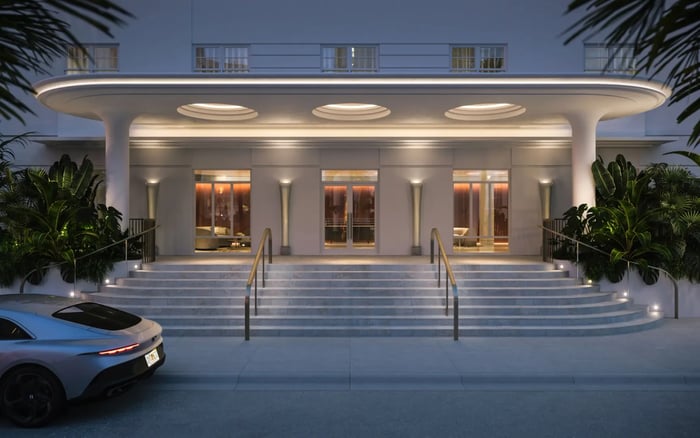
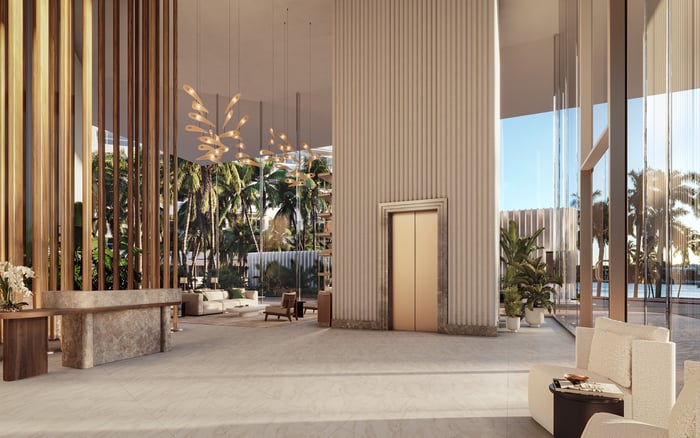
On Miami Beach’s storied Collins Avenue, The Perigon is positioning itself as a new kind of oceanfront address: architecture-forward, privacy-led, and intentionally resident-centric. Planned for 5333 Collins Avenue in the Mid-Beach corridor often called Millionaires’ Row, the 17-story, 73-residence tower brings together Office for Metropolitan Architecture (OMA) with interiors by Tara Bernerd & Partners and landscape architecture by Gustafson Porter + Bowman. With dual-water frontage between the Atlantic Ocean and Indian Creek, and an amenity program that emphasizes private hospitality, The Perigon reflects where today’s ultra-prime buyer is headed: fewer residences, more discretion, and design that reads as a long-term asset, not a trend.
Luxury along Collins Avenue is increasingly defined by restraint. Buyers who can choose between hotel-branded living, boutique beachfront condominiums, and legacy trophy buildings are often less persuaded by the loudest amenity deck and more by the most seamless day-to-day experience.
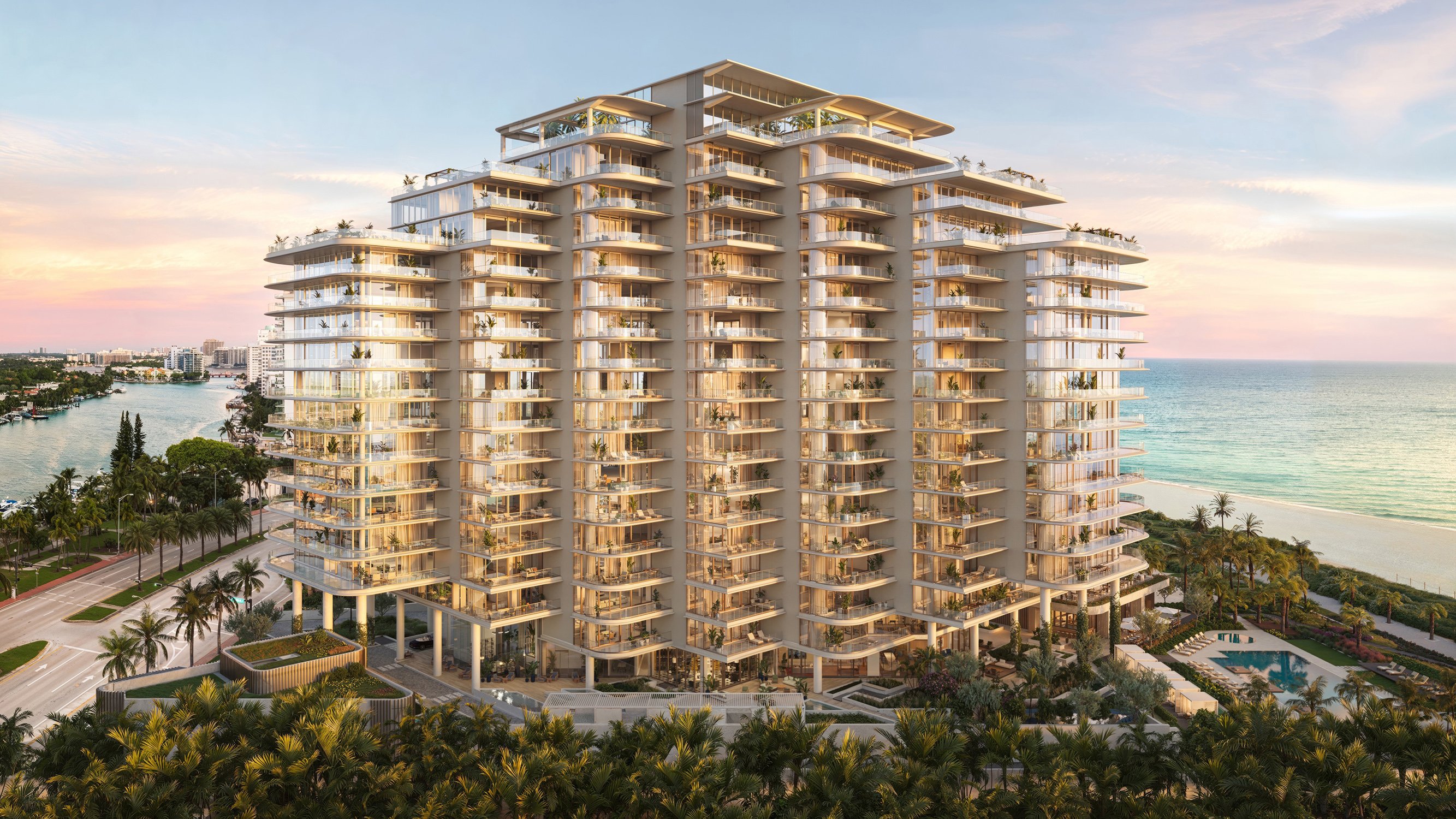
The Perigon Miami Beach enters that landscape with an intentionally edited profile: an oceanfront condominium planned for 5333 Collins Avenue in the Mid-Beach corridor commonly known as Millionaires’ Row. Public materials describe a 17-story tower with 73 residences, a scale that signals scarcity in a way seasoned buyers immediately recognize. Fewer residences typically means fewer neighbors, more controlled circulation, and a greater chance that design intent is carried through without compromise.
For buyers tracking Miami Beach new construction, the differentiator here is not “more of everything.” The pitch is more considered architecture, more discretion, and a more residential cadence.
Oceanfront buildings routinely sell the promise of the Atlantic. Far fewer sites meaningfully engage water on both sides. The Perigon’s parcel is widely covered as spanning between Indian Creek to the west and the Atlantic Ocean to the east, a planning reality with real lifestyle consequences.
Dual-water exposure can expand view corridors and soften the sense of urban density. It also supports the emotional logic of beachfront living: sunrise over the ocean, warmer evening light toward the creek, and a building that feels oriented to water rather than traffic.
This helps explain why Mid-Beach continues to attract second-home and full-time buyers. It remains connected to South Beach’s cultural energy while often delivering a quieter daily rhythm. The Perigon’s placement at 5333 Collins positions it within that balance.
Office for Metropolitan Architecture (OMA), led by Rem Koolhaas, is publicly identified as the architect. The concept is described as a rotated, diamond-like geometry. In practical terms, the form is intended to open views while reducing direct sightlines between neighboring buildings and residences.
That objective goes beyond aesthetics. In ultra-luxury, privacy is not a perk. It is a baseline requirement. Geometry that subtly angles terraces and glazing can make a home feel less observed without resorting to heavy screening or overly tinted glass.
The massing is also described as lifted on columns above the ground plane. This approach is positioned as improving flood resilience while preserving visual openness from Collins Avenue toward the ocean. For buyers thinking in decades, the combination of elevated planning and a calmer arrival sequence can read as stewardship rather than styling.
Interiors are publicly attributed to London-based Tara Bernerd & Partners, a signal that the design language is likely to prioritize layered materials and residential warmth over stark minimalism. For many high-net-worth buyers arriving from New York, London, or the West Coast, a Miami residence is not supposed to feel like a showroom. It should feel composed, quiet, and ready to live in from day one.
Landscape architecture is credited to Gustafson Porter + Bowman, a firm known for outdoor environments that read as intentional destinations rather than leftover perimeter space. On an oceanfront site, that distinction matters. The most convincing beachfront living is not simply a pool near the sand; it is a sequence of outdoor rooms that feel private, shaded, and scaled to the building.
The publicly reported residence mix includes 2- to 4-bedroom layouts, with approximate interior sizes ranging from about 2,100 to 6,700 square feet, plus penthouse offerings. That spectrum suggests true full-time viability, not just weekend use.
Privacy cues are embedded in how the homes are marketed. Private elevator entry with direct access into a private foyer is highlighted for discretion, a detail that tends to resonate most with buyers already accustomed to serviced buildings and controlled access.
Marketing also emphasizes expansive terraces and floor-to-ceiling glazing to maximize ocean and skyline views. In Miami Beach, outdoor living is not seasonal. Terraces function as meaningful square footage, and the strongest projects treat them as extensions of the interior rather than add-ons.
Pricing, as publicly marketed, is presented as starting in the low-$4M range and moving upward depending on layout and floor. One publicly circulated reference point is “Penthouse West,” marketed at $37 million. Even with shifting availability over time, those figures place The Perigon squarely within Miami Beach’s modern ultra-prime tier.
The amenity program is positioned as private and resident-focused, including a beachfront pool and hospitality-style services. That framing is notable in a market crowded with amenity-forward towers. What remains rarer is a building that consistently makes the resident the primary client, not an accessory to a public-facing social scene.
Culinary is part of the narrative as well. Offerings have been publicly described as including chef Shaun Hergatt’s oceanfront restaurant, “Nota,” and a speakeasy called “Fifty Three,” characterized as resident-only concepts. For the right buyer, this is status expressed through access, not exposure.
Sustainability is also incorporated into the project’s positioning, with promotion targeting LEED Gold certification. A certification is not the full story of performance, but the signal is clear: the project is presenting itself as forward-looking in systems and planning, not only in visual language.
Developers are publicly identified as Mast Capital and Starwood Capital Group. In January 2025, market coverage reported a $390 million construction loan provided by Eldridge Real Estate Credit.
Construction-era reporting in early 2025 also described the project as roughly 75% pre-sold. In this tier, pre-sales matter because they function as a proxy for buyer conviction in the underlying thesis: boutique scale, design authorship, and Mid-Beach beachfront scarcity.
As with most developments, delivery timing can vary across public-facing sources. Buyers should rely on current developer disclosures and contractual documentation rather than broad market chatter.
The typical buyer journey in high-end pre-construction includes staged deposits. Public buyer guidance for this development has referenced an initial deposit level such as 20% at contract plus additional installments at construction milestones. Terms can evolve, so the key is less the headline percentage and more how the schedule aligns with your liquidity plan.
At this level, diligence is as much operational as it is aesthetic. Beyond reviewing plans, specifications, and finish narratives, sophisticated buyers often focus on:
If you are evaluating The Perigon Miami Beach specifically, it can be useful to compare it with other Miami Beach offerings to calibrate your priorities. For a more intimate oceanfront profile, 57 Ocean Miami Beach is a relevant point of reference within the broader market conversation. For buyers who prioritize a legacy resort setting with private ownership, Shore Club Private Collections Miami Beach presents a different expression of service and social energy. And for those drawn to established, hospitality-oriented living, Setai Residences Miami Beach remains an instructive benchmark in the Miami Beach luxury ecosystem.
The Perigon is compelling because it treats oceanfront living as both an architectural and operational discipline: crafted views, reduced sightlines, controlled access, and a resident-first amenity posture.
For buyers who want to follow the project closely, the most direct overview is The Perigon Miami Beach.
Where is The Perigon Miami Beach located? It is planned for 5333 Collins Avenue in Miami Beach’s Mid-Beach area, within the corridor often called Millionaires’ Row.
How large is the building? It is widely described as a 17-story tower with 73 residences.
Who is the architect? Office for Metropolitan Architecture (OMA), led by Rem Koolhaas, is publicly identified as the architect.
What is distinctive about the building’s shape? Public descriptions note rotated, diamond-like geometry intended to open views and reduce direct sightlines.
Does the site have water on both sides? Yes. The site is described as spanning between Indian Creek to the west and the Atlantic Ocean to the east.
Who is designing the interiors and landscape? Interiors are attributed to Tara Bernerd & Partners, and landscape architecture to Gustafson Porter + Bowman.
What residence layouts and sizes have been reported? Market coverage has cited 2- to 4-bedroom layouts, roughly 2,100 to 6,700 interior square feet, plus penthouse offerings.
What are the privacy features mentioned in marketing? Private elevator entry with direct access into a private foyer has been highlighted.
What pricing has been publicly marketed? Available residences have been marketed starting in the low-$4M range, with a publicly circulated penthouse listing at $37 million.
What deposit structure should buyers expect? Buyer guidance has referenced staged deposits, such as 20% at contract plus additional installments tied to construction milestones, subject to the specific contract terms.
To privately discuss Miami Beach oceanfront new-construction options, connect with MILLION Luxury.
If branded residences are on your mind — as a home or as an allocation — we would be glad to share what we are seeing, privately.
Begin a quiet conversation