Two high-profile branded towers are redefining the luxury conversation in Downtown Miami: a supertall hotel-and-residences landmark and a culture-forward riverfront twin-tower plan.
In today’s ultra-luxury market, a brand is no longer a finishing touch. For many buyers, it signals service culture, design discipline, and an everyday standard that feels predictable from one global city to the next. Downtown Miami is where that expectation is being packaged most clearly, with mixed-use and residential towers positioned for international ownership: discreet living, hospitality-grade staffing, and a resale story that is easy to understand.
That shift also raises the bar on execution. In a pre-construction purchase, you are not only selecting a view and a floor plan. You are also underwriting delivery risk, the credibility of the development team, and the operational promise behind the name on the building.
Downtown Miami is currently anchored by two distinct, equally ambitious narratives.
The first is a vertical headline: a planned 1,049-foot supertall with a stacked-cubes silhouette, pairing hotel keys with condominium residences under a legacy hospitality name. The second is a cultural statement: twin towers planned along the Miami River, connected by a signature skybridge positioned as a substantial elevated program, not a simple amenity deck.
For buyers choosing between them, the real decision is rarely “Which is better?” It is “Which lifestyle and risk profile matches how I use Miami?”
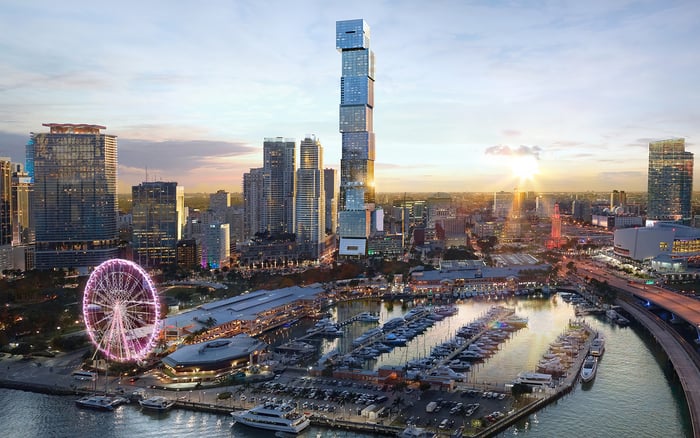
Waldorf Astoria Hotel & Residences Miami is widely reported as a planned 1,049-foot supertall with a distinctive stacked-cubes design that will be instantly legible on the skyline. It is positioned as a mixed-use project combining condominium residences and a hotel under the Waldorf Astoria brand, and it is publicly associated with 300 Biscayne Boulevard in Downtown Miami.
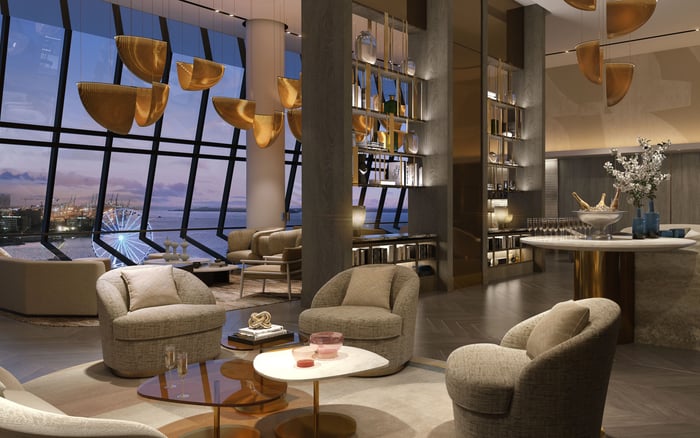
For many buyers, two factors drive the evaluation: the hotel component and the pace of construction. Marketed materials commonly describe 387 condominium residences alongside 205 hotel rooms or keys. That mix can be compelling if you want on-demand services and a staffed arrival experience that reads like a five-star property, rather than a traditional condominium.
Progress has become part of the value proposition. Groundbreaking was publicly announced for October 27, 2022, and reporting in December 2025 said the superstructure had passed the 50th floor. For risk-aware buyers, visible advancement often lands differently than a plan still defined primarily by renderings.
In market conversations, delivery is commonly cited around 2028, often framed as mid-year. Timelines should always be verified at the contract level, but the combination of branding, mixed-use programming, and documented milestones is why Waldorf Astoria Residences Downtown Miami is frequently discussed as a cornerstone Downtown address for the next cycle.
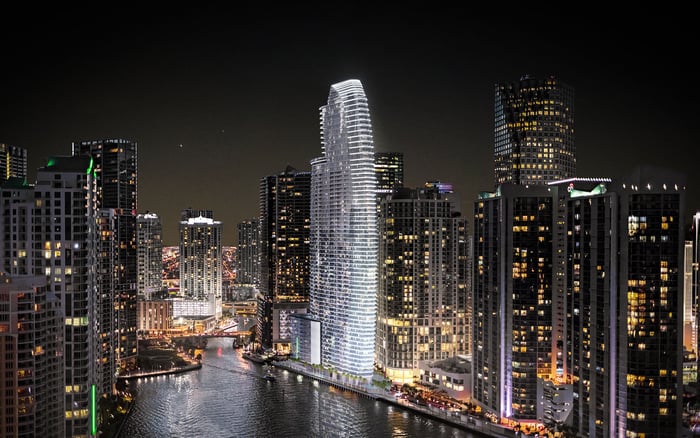
Faena Residences Miami River is planned as a luxury condominium development on the Miami River, publicly associated with the area near 90 SW 3rd Street. Instead of a single-tower statement, it is presented as twin 68-story towers connected by a signature skybridge.
That connection is positioned as more than an architectural gesture. It is marketed as roughly 45,000 square feet of elevated amenities and programming, suggesting a private-world approach where owners can spend meaningful time within a curated ecosystem. The plan is also marketed for 440 total residences, a scale that can support deeper staffing, multiple amenity zones, and layered operations that luxury buyers increasingly expect.
At this level, authorship matters. Coverage around the launch identified KAR Properties and Fortune International Group as leading the project, with Rafael Viñoly Architects publicly named as architect. In terms of early market response, November 2025 reporting cited nearly 100 units presold for about $300 million, a signal of demand from buyers who understand brand-driven premiums.
Completion is commonly marketed for 2029, often cited as Q2. For buyers who see the Miami River as an emerging luxury corridor, not a secondary address, Faena Residences Miami Downtown Miami is positioned as a long-view bet on lifestyle, design, and neighborhood maturation.
In ultra-luxury pre-construction, deposit structure is more than a calendar. It shows how a developer stages risk, and how much optionality a buyer keeps as the project advances.
For Waldorf Astoria Residences Miami, the deposit structure is typically described in market materials as 10% at contract, 10% around six months later, 10% at groundbreaking, 10% one year after groundbreaking, and the remaining 60% at closing. It is often summarized as 40% total pre-closing. The practical takeaway is straightforward: most capital is scheduled for closing, but a meaningful portion is committed early.
Faena Residences’ marketed schedule is often described as 5% to reserve, 5% at contract, 10% at roughly 120 days, 10% at groundbreaking, 10% 12 months after groundbreaking, 10% at top-off or last residential level, and 50% at closing, commonly described as 50% total pre-closing. Marketing has also indicated First American Title as escrow holder.
These are reported, marketed structures, and they should be evaluated against the executed contract and condominium documents. Still, the contrast is useful: some buyers prefer a more front-loaded commitment that secures positioning early, while others prioritize a lighter start, even if choice and leverage narrow later.
Even when shopping Downtown, global buyers often sanity-check “true luxury living” against Miami-beach addresses where service and daily experience have been refined over years.
If your reference point is hospitality-forward living, an established option like Setai Residences Miami Beach helps define what fully staffed, arrival-driven living feels like at maturity. If you prefer a quieter, residential-first interpretation of branded living, The Ritz-Carlton Residences® Miami Beach is frequently part of the comparison set.
For buyers anchored to the ocean, the calculus can change. Proximity, light, and the ritual of beach access may matter more than skyline drama. In those conversations, boutique oceanfront living such as 57 Ocean Miami Beach is a useful reminder that “luxury” is not always synonymous with height.
The practical takeaway: Downtown towers now compete not only with each other, but with a broader South Florida lifestyle portfolio. The right choice is the one aligned with how you actually live, whether that is lock-and-leave service, a design-led social ecosystem, or an ocean-oriented routine.
Sophisticated buyers treat process as part of the asset. In Florida, pre-construction condominium purchases are generally governed by a statutory rescission period, commonly described as 15 days after the buyer receives the required condominium documents. That window matters, particularly when documents arrive after the initial momentum of a reservation.
Deposits are also commonly required to be held in escrow, with specific handling rules depending on deposit amounts and contract terms. This is where experienced counsel earns their fee: not as a formality, but as a way to understand how funds are held, when they can be released, and what protections exist if timelines or scope shift.
For an ultra-premium audience, the baseline is simple: treat every marketing schedule as a starting point, then verify the terms that govern your capital.
“Investment” can be misused in luxury real estate, but it remains relevant when framed correctly. Branded, design-forward towers can command a scarcity premium when they deliver a coherent story: a recognizable name, an architecturally legible silhouette, and an operational experience that supports resale.
From that lens, Downtown presents two clear narratives. A supertall, mixed-use hotel-and-residences tower can benefit from global brand recognition and the visibility of a skyline icon. A riverfront, culture-driven plan can benefit from placemaking, especially when amenities are conceived as programming rather than a checklist.
Neither path is automatic. The sharper approach is to match the asset to your intended use, then allow value to follow lifestyle: primary residence versus seasonal occupancy, privacy tolerance, service expectations, and patience for a longer delivery horizon.
What makes a branded residence different from a standard condo? A branded residence is typically positioned around hospitality-grade service standards, design direction, and operational consistency associated with the brand.
Is Waldorf Astoria Hotel & Residences Miami a mixed-use building? Yes. It is publicly described as combining hotel keys and condominium residences under the Waldorf Astoria brand.
How tall is the planned Waldorf Astoria tower in Downtown? It is widely reported as planned at 1,049 feet with a stacked-cubes design.
Where is Waldorf Astoria Residences Miami located? It is publicly associated with 300 Biscayne Boulevard in Downtown Miami.
What is the reported construction progress for Waldorf Astoria? Coverage reported that the superstructure passed the 50th floor in December 2025.
Where is Faena Residences Miami River planned? It is publicly associated with the Miami River area near 90 SW 3rd Street.
What is distinctive about the Faena plan? It is marketed as twin 68-story towers connected by a signature skybridge, with the skybridge promoted as roughly 45,000 square feet of amenities and programming.
How do deposit schedules typically work in pre-construction purchases? They are often staged over time, with a series of deposits before closing. The exact timing and total pre-closing percentage depend on the contract.
Do Florida buyers have a cancellation window after receiving condo documents? Florida purchasers generally have a statutory rescission period, commonly described as 15 days after receiving the required condominium documents.
Where can I get discreet guidance on Downtown versus Miami-beach options? For current inventory and strategic guidance, connect with MILLION Luxury.
If branded residences are on your mind — as a home or as an allocation — we would be glad to share what we are seeing, privately.
Begin a quiet conversation