A buyer-oriented blueprint for planning a South Florida multi-generational compound, from governance and privacy to resiliency, staffing, and long-term adaptability.
A multi-generational family compound is often framed in emotional terms: legacy, togetherness, continuity. In reality, it succeeds or fails on logistics-not deliveries and moving boxes, but the systems that allow distinct households to live side by side with dignity: decision-making, privacy, security, staffing, circulation, and the quiet mechanics of daily life.
In South Florida, those mechanics matter even more. The climate encourages outdoor living and year-round hosting, while coastal conditions make resiliency a design requirement, not a bonus. The aim isn’t to build bigger; it’s to build clearer: clear boundaries, clear routes, clear responsibilities, and clear ways for the property to evolve without turning into a permanent construction zone.
Before an architect draws a line, families are best served by a “compound brief” that reads more like a charter than a wish list. It should define who the compound serves today, who it may need to serve later, and how the property operates when life gets complicated.
Key questions to settle early:
Household structure: independent homes on one site, or one building with discrete wings and entries?
Hosting rhythm: frequent weekends, a seasonal influx, or occasional reunions that require surge capacity?
Privacy expectations: what is shared by default, and what is accessed by invitation only?
Financial governance: operating budgets, capital reserves, and who approves what.
This is where projects either become peaceful or politicized. If the compound is meant to endure, align on decision rights now: who can remodel, who can add a suite, how common areas are scheduled, and what happens if someone wants out. Architecture can solve for movement and sightlines. It cannot solve for unresolved governance.
A compound is less about square footage than choreography. The best properties separate “arrival,” “life,” and “service” into distinct layers.
Arrival should feel calm and unambiguous. When multiple generations keep different schedules, multiple drop-off moments can prevent friction: a formal arrival for guests, a private family arrival, and a discrete service arrival that never collides with entertaining.
Life zones are where the compound earns its name. Think in neighborhoods: a grandparents’ wing with quiet outdoor space, a primary family wing oriented toward activity, and flexible guest suites positioned so visitors don’t become roommates. Outdoor rooms can act as buffers-courtyards, loggias, garden corridors, and pool terraces that connect spaces without forcing togetherness.
Service is the invisible backbone. Deliveries, waste, catering, landscaping, pool maintenance, and household staff need routes that don’t cut through family space. When service circulation is an afterthought, the home feels perpetually “in use.” When it’s planned, the compound reads as effortless.
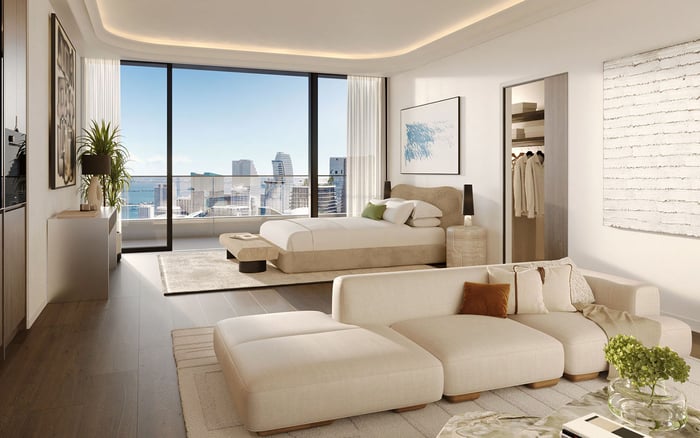
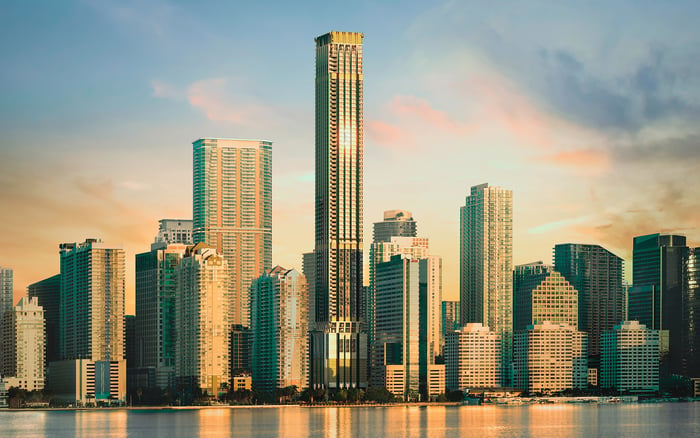
For buyers who want a lock-and-leave lifestyle with layered amenities rather than a standalone estate, a “vertical compound” can offer similar independence: separate residences plus shared wellness, dining, and security infrastructure. In Brickell, 2200 Brickell and Una Residences Brickell show the appeal of privacy paired with managed services-often a priority when travel is frequent.
Multi-generational living demands a more technical definition of privacy than “a door that closes.” Plan for privacy across four dimensions.
Visual privacy:
Use offsets, courtyards, landscape screening, and window placement to prevent direct sightlines into private suites. Bathrooms and primary bedrooms deserve particular precision, especially where outdoor showers, terraces, and pool decks come into play.
Acoustic privacy:
Sound is the stealth conflict. Materials, insulation, door specifications, and HVAC design all matter. Keeping family lounges or media rooms away from sleep zones reduces the need for constant behavioral negotiation.
Schedule privacy:
Different time zones and routines are normal. Reduce choke points by duplicating essentials: more than one coffee station, more than one laundry, more than one truly quiet work area. This isn’t indulgence; it’s decongestion.
Digital privacy:
Network segmentation is increasingly part of estate design. Many families prefer separate Wi-Fi networks for different households, staff, and guests, with strong coverage that extends outdoors.
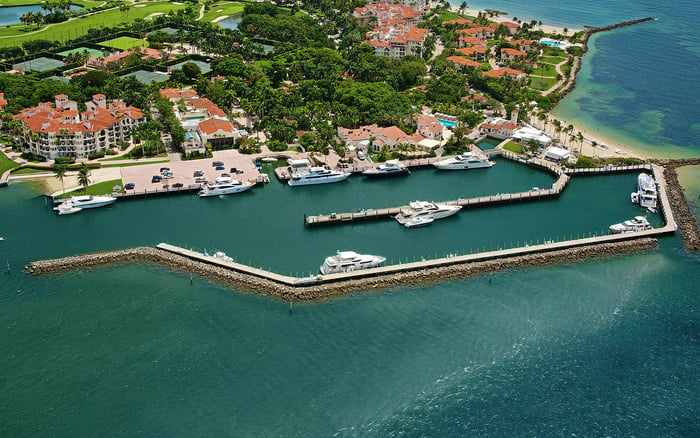
If your vision is coastal and walkable, Miami Beach and Surfside offer a different model: generations can live near one another with strong privacy, then gather in shared outdoor settings. Buildings such as 57 Ocean Miami Beach and The Delmore Surfside suit families who want beach adjacency and a refined amenity ecosystem while keeping each generation’s home fully self-contained.
In a multi-generational compound, kitchens are less about appliances and more about throughput. The difference between a gracious home and a chaotic one is often a back-of-house plan that anticipates real use.
Practical considerations:
A “show kitchen” for entertaining plus a working kitchen, or at minimum a service pantry that can handle plating, cleanup, and catering.
Cold storage and dry storage sized for seasonal occupancy spikes.
Multiple dishwashers and strategic sink placement to prevent bottlenecks.
Beverage zones that keep traffic out of the main kitchen during gatherings.
For families who host often, catering logistics should be mapped like a system: where food arrives, where staff stages, and how trash and recycling exit without crossing the party. A compound should feel like a private residence-not a venue-but it needs to perform like one when required.
Multi-generational doesn’t automatically mean “aging in place,” but the strongest compounds anticipate mobility shifts without advertising them. Subtle universal design pays off.
Step-free routes from parking to key living areas.
Wider corridors and door openings in at least one primary suite.
Curbless showers with discreet linear drains.
Provisioning for an elevator or lift, even if not installed immediately.
The principle is optionality: a home that can support a parent after surgery, a grandparent in later years, or a visiting friend who needs accessibility-without feeling institutional.
True luxury isn’t only beauty; it’s continuity. In South Florida, resiliency planning is often prioritized to keep the compound functioning through disruption while maintaining a composed atmosphere.
A buyer-oriented resiliency checklist typically includes:
Backup power strategy sized for priorities, not fantasy. Decide what must stay on: refrigeration, critical HVAC zones, security, select lighting, communications, and possibly one kitchen.
Water management, including drainage planning and practical storage for emergencies.
Impact-rated openings and protected outdoor furniture/storage solutions.
Security works best when it’s layered rather than theatrical: perimeter awareness, controlled access points, lighting that supports visibility without glare, and camera placement that respects private outdoor rooms. The best systems recede into architecture and landscape.
In managed luxury towers, much of this layering is built into daily life. For example, families exploring a condominium-based compound across generations often value the operational consistency and staffing environment found in properties like Four Seasons Residences Coconut Grove, where day-to-day service standards can reduce the friction of running multiple households.
A compound is a living organism. Staffing isn’t simply hiring-it’s designing roles around the property’s weekly rhythms.
Start by separating:
Household support (daily tidying, laundry, provisioning)
Property operations (landscape, pool, systems, preventative maintenance)
Event support (hosting, security coordination, valet planning)
Even with minimal staff, the property needs a maintenance calendar. The most expensive compounds are often the ones without routines: deferred upkeep becomes emergency work, and emergency work disrupts family life.
Design can make staffing lighter. Materials that wear elegantly, landscaping that delivers impact without constant intervention, and mechanical systems that can be serviced without opening walls aren’t glamorous choices-but they protect weekends.
“Compound” can mean different things from one neighborhood to the next. Clarify what’s permissible early, before design momentum locks in.
Considerations that often shape direction:
Whether the site can accommodate multiple structures, guest houses, or separate entries.
Setbacks, lot coverage, height limitations, and pool placement constraints.
Parking requirements and how they interact with landscaping and privacy.
Noise and lighting expectations, especially when outdoor living is central.
Even when a property can technically support multiple generations, the surrounding context still governs how well it works in practice. A compound should elevate a neighborhood, not fight it.
The defining challenge of multi-generational living is that needs change faster than buildings. The best compounds are designed like portfolios: a few fixed anchors and several flexible components.
Ways to embed flexibility:
Suites that can convert between guest, caregiver, and independent adult child use.
Bonus rooms sized to become a second office, study hall, or wellness room.
Outdoor rooms that can shift from play space to dining terrace to quiet garden.
Infrastructure for future expansion: conduits, capped plumbing lines, and zones in electrical and mechanical systems.
Think in terms of “phaseability.” If the compound needs a suite later, it should be possible to add it without tearing through core living areas.
The most overlooked logistics are human. A compound thrives when it supports both community and autonomy.
Shared spaces should be unmistakably inviting, but never unavoidable. A central outdoor hearth, a shaded courtyard, or a casual lounge can become the property’s gravitational center. At the same time, each household needs a retreat that feels complete: its own entry sequence, its own morning routine, and at least one private outdoor moment.
Families who get this right often adopt simple rituals: a weekly dinner, a Sunday pool hour, or a seasonal gathering that uses the compound intentionally. Architecture provides the stage. Logistics provides the script.
What makes a property truly “multi-generational” rather than just large? Independent routines are the test: separate entries, privacy layers, and duplicated essentials.
Should each generation have a full kitchen? Not always, but each household should have a credible daily setup to avoid friction.
How do we prevent constant overlap in common areas? Create multiple destinations: more than one lounge zone, outdoor room, and work space.
Is it better to build separate structures or one unified home? Separate structures increase privacy; one home can simplify systems and staffing.
What is the biggest design mistake in compounds? Treating back-of-house circulation as secondary, which makes service feel intrusive.
How can we plan for aging without making the home feel clinical? Use subtle universal design: step-free routes, curbless showers, and future-ready framing.
How do we handle guests without disrupting family privacy? Place guest suites with their own path to outdoors and a clear boundary from bedrooms.
What should we prioritize first: interiors or infrastructure? Infrastructure first; power, HVAC zoning, drainage, and networking protect everything else.
Can a condo lifestyle still support a multi-generational “compound” idea? Yes, when residences are near each other and amenities handle wellness, dining, and security.
How do we keep the compound from becoming a permanent renovation project? Build flexibility into the plan and stage future expansions with pre-planned infrastructure.
If you'd like a private walkthrough and a curated shortlist, connect with MILLION Luxury.
If branded residences are on your mind — as a home or as an allocation — we would be glad to share what we are seeing, privately.
Begin a quiet conversation