A buyer-focused underwriting guide comparing The Links Estates at Fisher Island with Tula Residences North Bay Village through the lenses of beach access, coastal exposure, seasonal crowding, reserves, liquidity, and exit discipline.
The comparison between The Links Estates at Fisher Island and Tula Residences North Bay Village is best understood as a study in control. Both belong in the broader South Florida luxury conversation, yet neither should be placed into a generic waterfront category. For a serious buyer, the question is not simply which address feels more glamorous. It is which ownership model better protects privacy, absorbs seasonal pressure, and carries coastal risk acceptably across a full hold period.
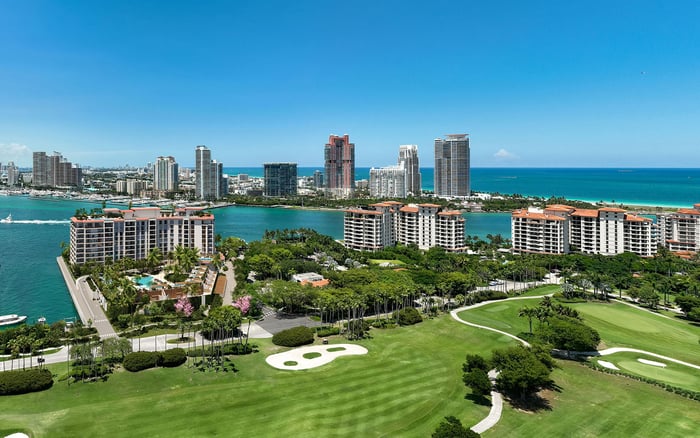
The Links Estates at Fisher Island should be underwritten as an ultra-luxury Fisher Island asset, not as conventional Miami waterfront condominium exposure. Its value proposition is anchored in private-island positioning, controlled access, and a buyer pool that prizes seclusion. That creates a premium, but also a narrower market. The same feature that makes the asset rare can constrain liquidity if the next buyer universe becomes more selective.
For Tula Residences North Bay Village, the prudent approach is to treat the comparison as a diligence framework rather than a direct equivalency. A North Bay Village residence can appeal to buyers who want bayfront living with a different relationship to the city, but the buyer should verify access, exposure, association structure, and operating assumptions before assigning the same scarcity premium associated with Fisher Island.
In underwriting shorthand, this is a Fisher Island versus North Bay Village exercise, where beach access, exclusive-area positioning, and investment discipline must be separated rather than blended. The Links Estates at Fisher Island belongs in that discussion because the asset is defined as much by who can reach it as by what surrounds it.
Beach access is often priced too literally. Buyers focus on proximity to sand, view angle, or the convenience of a morning walk. Those details matter, but at the top of the market, control can matter more. At The Links Estates, the underwriting emphasis should be exclusivity, privacy, and the managed nature of the island environment. The point is not only that a resident can reach the beach. It is that the experience is materially insulated from the public rhythm of the mainland.
That distinction affects value. Public beach adjacency can deliver energy, convenience, and visibility, but it also introduces variables owners cannot control. Parking pressure, visitor volume, service congestion, and seasonal noise can all shape the lived experience. Fisher Island shifts the analysis toward access control and island operations. The beach-access premium is therefore tied to a curated environment, not merely coastal proximity.
For Tula Residences North Bay Village, a buyer should ask a different set of questions. What is the actual path to beach use? How much of the daily lifestyle depends on driving, boating, or crossing into nearby beach districts? Are the views and water adjacency being priced as if they offer the same experiential scarcity as a private-island setting? The answer may still support a compelling purchase, but it should rest on verified lifestyle logistics rather than assumed equivalence.
The luxury buyer may begin with privacy, architecture, and service, but the underwriter must end with the envelope, insurance, and reserves. Wind and storm exposure should be a core diligence item for The Links Estates because island waterfront assets can carry distinct coastal implications. The issue is not whether a residence is desirable. It is whether the total cost of ownership has been modeled with sufficient humility.
At this level, storm underwriting should include exterior-envelope maintenance, coastal hardening, insurance-cost sensitivity, and capital reserves. A buyer should understand how association governance anticipates major maintenance, how insurance changes could affect carrying costs, and how future buyers may react if storm-risk assumptions become more conservative. The best acquisitions do not ignore exposure. They recognize it, price it, and manage it.
Tula Residences North Bay Village should be tested with similar discipline. Even without assigning project-specific conclusions, the same broad questions apply to any bayfront luxury purchase: What is the wind exposure? How does the building address waterfront maintenance? What reserves are being contemplated? How sensitive is the ownership case to insurance repricing? These are not secondary issues. In South Florida, they sit at the center of the long-term balance sheet.
Peak season reveals the true difference between a protected luxury environment and a merely well-located one. For The Links Estates, crowding risk is primarily an access-control and island-operations question. The owner is not underwriting a conventional public-beach congestion profile. The friction points are more likely to involve how the island manages arrivals, services, staffing, guests, club activity, and daily logistics during the busiest months.
That is an important advantage, but it still deserves scrutiny. Ultra-exclusive environments depend on smooth operations. Ferry logistics, service access, vendor movement, hospitality expectations, and resident arrival patterns all shape the lived experience. If the island performs well under seasonal demand, the privacy premium is reinforced. If operations feel strained, the premium becomes less durable.
For North Bay Village, peak-season analysis should be more urban and connective. A buyer should consider bridge movement, traffic timing, access to Miami Beach and mainland districts, restaurant and marina activity, and the cadence of high-season visitors. None of those factors automatically diminishes value. They create a different lifestyle profile from Fisher Island. One is defined by seclusion and controlled access. The other may be defined by visibility, mobility, and proximity to multiple urban nodes.
The Links Estates benefits from Fisher Island scarcity, but scarcity is not the same as immediate liquidity. A private-island residence commands attention from a very specific ultra-luxury buyer: one who values privacy enough to accept a more selective access model. That distinction can support pricing power in strong markets, especially when buyers are seeking sanctuary. It can also narrow the exit funnel if sentiment changes or carrying costs rise.
The underwriting should therefore include two parallel assumptions. First, the asset deserves a seclusion premium compared with more publicly accessible coastal neighborhoods. Second, exit pricing should be stress-tested under higher insurance, storm-risk, or reserve scenarios. A buyer who models only the premium and ignores the sensitivity is not underwriting the full asset.
For Tula Residences North Bay Village, liquidity may be driven by a different set of motivations. Buyers may prioritize bay views, centrality, design, or access to Miami Beach and mainland destinations. Those qualities can widen the audience, but they may not replicate Fisher Island’s privacy premium. The right comparison is not which asset is universally superior. It is which one has the clearer buyer thesis for the next owner.
The strongest buyer analysis starts by refusing to flatten the market. The Links Estates at Fisher Island is a privacy-led, access-controlled, ultra-luxury asset with coastal-risk considerations that must be taken seriously. Its premium is rooted in seclusion, not merely waterfront status. Its risks sit in the same place as its advantages: exclusivity, operations, insurance sensitivity, reserve planning, and a narrower resale audience.
Tula Residences North Bay Village should be underwritten through a parallel but distinct lens. The buyer should evaluate whether the residence is being priced for bayfront convenience, lifestyle access, design, or a scarcity story. If the pricing assumes Fisher Island-style privacy without the same access-control model, that assumption needs to be tested. If the pricing reflects a different, more connected form of luxury, the thesis may be valid on its own terms.
For sophisticated South Florida buyers, the answer is rarely found in a single amenity. It is found in the relationship between access, exposure, operations, and exit. The better acquisition is the one where the lifestyle premium remains credible after the insurance model, reserve schedule, and peak-season experience have all been examined.
Is The Links Estates at Fisher Island comparable to a typical waterfront condo? No. It should be underwritten as an ultra-luxury Fisher Island asset with a privacy-led value proposition and controlled-access dynamics.
What is the main beach-access question for The Links Estates? The key issue is not only proximity to sand, but the exclusivity, privacy, and control surrounding the beach experience.
How should buyers view Tula Residences North Bay Village in this comparison? Buyers should evaluate it as a distinct North Bay Village opportunity and verify its access, exposure, operating, and pricing assumptions directly.
Does Fisher Island reduce peak-season crowding risk? It changes the nature of the risk. The focus shifts from public-beach congestion to access control, island operations, and seasonal logistics.
Why is wind exposure central to this underwriting? Waterfront and island assets can carry meaningful insurance, reserve, and exterior-maintenance implications that affect long-term ownership cost.
What reserves should a buyer examine at The Links Estates? A disciplined review should include coastal hardening, exterior-envelope maintenance, insurance sensitivity, and broader capital planning.
Is exclusivity always positive for resale? Not automatically. Exclusivity can support a premium, but it can also narrow the buyer pool when it is time to exit.
What should be stress-tested before buying? Buyers should stress-test insurance increases, storm-risk assumptions, reserve needs, operating friction, and future buyer appetite.
Can a North Bay Village asset offer a stronger liquidity profile? It may appeal to a broader buyer set if priced around connectivity and bayfront lifestyle rather than private-island scarcity.
What is the practical underwriting conclusion? Treat Fisher Island privacy as a premium, then test whether the total ownership model still works under conservative coastal-risk assumptions.
For a tailored shortlist and next-step guidance, connect with MILLION.
If branded residences are on your mind — as a home or as an allocation — we would be glad to share what we are seeing, privately.
Begin a quiet conversation