A discreet buyer’s guide to evaluating collector-grade art storage in West Palm Beach, with practical questions around climate stability, UV exposure, security, access, insurance, and future resale value.
For a serious collector, a West Palm Beach residence is never evaluated by views and finishes alone. The deeper question is whether the home can function as a disciplined environment for objects that may be sensitive to light, humidity, vibration, access, and time. A painting, work on paper, textile, sculpture, or photographic edition does not care that a room is glamorous. It responds to conditions.
That is why collector-grade art storage belongs in the conversation before contract, not after closing. It is a lifestyle issue, a risk issue, and a resale issue. A residence that can elegantly support a collection may appeal to a narrower, more sophisticated buyer pool in the future, particularly in West Palm Beach, where proximity to Palm Beach cultural life often intersects with a highly private residential mindset.
The aim is not to turn a home into a warehouse. It is to understand whether the building, unit plan, and service culture can accommodate stewardship without compromising the ease of living.
Buyers often begin by asking whether a residence has enough storage. Collectors should ask a more exacting question: what kind of storage does the collection require? A wine room and an art room are not interchangeable. A linen closet with beautiful millwork is still a closet. A proper holding area for artwork should be evaluated for stability, cleanliness, access control, and separation from household traffic.
Begin with a confidential inventory review, ideally without circulating sensitive valuations. Identify the largest works, the most fragile materials, the pieces that rotate seasonally, and the items that should never sit near exterior glass. This does not require disclosing every detail to a sales team. It does require translating the collection into spatial needs: wall height, crate accommodation, clear turning radius, secure reserve space, and display zones that avoid harsh sunlight.
At residences such as Alba West Palm Beach, the right conversation is less about whether a home looks gallery-like and more about whether its plan can separate daily living from collection management. The most refined homes make that separation feel invisible.
Collector-grade storage is primarily about consistency. Temperature and humidity swings are among the most important issues to evaluate, especially in a coastal South Florida setting where exterior conditions can be intense. Buyers should ask how the residence is conditioned, whether any storage area is separately controllable, and whether mechanical systems can maintain a stable environment when the owner is away.
For new-construction purchases, it is useful to ask early about mechanical flexibility, backup power expectations, equipment access, and how systems are serviced. If a buyer plans to create a dedicated art storage room, the design team should confirm whether the space can support appropriate climate monitoring, filtration, and alarm integration without becoming visually intrusive.
This is where Design & Architecture decisions become technical. Beautiful stone floors, expanses of glass, and sculptural staircases can coexist with a collection, but only if the invisible systems are as carefully considered as the visible ones. In a residence like Forté on Flagler West Palm Beach, buyers should review not only the rooms used for entertaining, but also the secondary spaces where art may rest between installations.
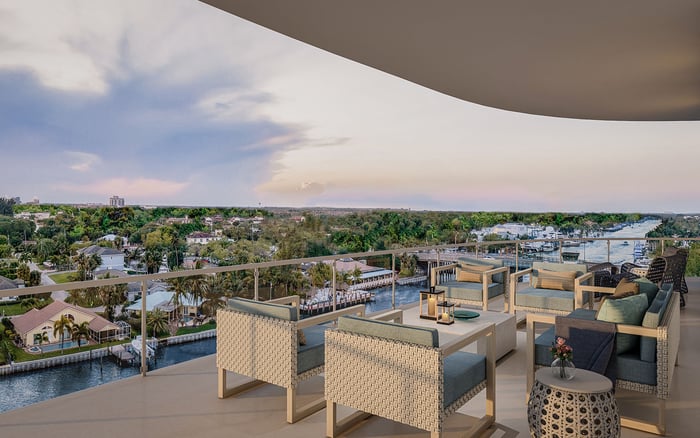
Waterfront living is one of the great emotional draws of West Palm Beach. It also requires discipline for collectors. Expansive glazing can create magnificent rooms, but sunlight and glare can be punishing to sensitive works. A buyer should study the path of light through the residence at different times of day, paying attention to western exposure, reflected light, and the relationship between display walls and windows.
The solution is not necessarily to avoid glass. It is to plan around it. Consider UV-filtering strategies, motorized shade integration, low-glare lighting, and dedicated walls that do not receive direct exposure. Ask whether shade pockets, lighting tracks, wall blocking, and electrical planning can be coordinated before build-out is complete. The earlier these details are addressed, the less likely the owner will need awkward retrofits.
At Shorecrest Flagler Drive West Palm Beach, or any residence with a strong indoor-outdoor sensibility, art placement should be mapped with the same seriousness as furniture. The best installations feel effortless because the risk management happened quietly in advance.
Collectors rarely want their homes to feel fortified. Yet discretion does not mean softness. Buyers should evaluate building entry, elevator control, private vestibules, service access, camera coverage, package protocols, and how vendors are admitted. The concern is not only theft. It is unmonitored movement, accidental damage, and unnecessary visibility.
A strong art environment has layers. The building manages perimeter access. The residence manages private access. The storage area has its own discipline. Staff, installers, designers, and contractors should be able to enter and work without passing through sensitive rooms unless required.
Ask how the building handles large deliveries and whether a certificate of insurance is required from outside vendors. Ask whether the service elevator can accommodate crated works, whether loading hours are restricted, and whether pathways are protected during installation. A magnificent lobby is irrelevant if a large canvas must make an impossible turn between the loading bay and the residence.
Art has physical demands. It arrives in crates. It may require multiple handlers. It may need vertical clearance, wall protection, climate-conscious staging, and a direct route from truck to residence. Before purchasing, buyers should walk the likely art path: loading area, service corridor, elevator, private hallway, residence entry, and final placement.
The exercise can be revealing. A residence may have generous rooms but a tight entry. A storage area may be secure but difficult to reach. An elevator may feel spacious in daily use but be unsuitable for oversized works. These constraints are not always disqualifying, but they affect what can be owned, displayed, stored, or rotated without extraordinary effort.
At Mr. C Residences West Palm Beach, buyers with collections should ask practical questions before focusing solely on finishes: where crates pause, who supervises vendors, and how common areas are protected during installation.
Insurance should be reviewed with the residence in mind. A collector may need clarity on storage conditions, alarm requirements, water-related exclusions, transit coverage, and whether certain works require special handling. Buyers should not assume a standard policy anticipates a serious collection.
Association rules matter as well. Ask about contractor access, elevator reservations, wall penetrations, humidity equipment, renovations, and restrictions on deliveries. If art storage requires custom build-out, confirm whether the association approval process is compatible with the buyer’s timeline and privacy needs.
Discretion is part of the asset protection plan. The fewer people who know what is stored, where it is stored, and when it is moved, the better. A buyer should favor buildings with polished operational discipline, not merely impressive amenity language.
A collector should enter negotiations with a concise diligence checklist. Can the residence support stable climate conditions when unoccupied? Is there a logical room or zone for secure reserve storage? Are display walls protected from direct light? Can heavy or oversized works reach the home without heroic maneuvers? Are building staff trained to coordinate high-value deliveries calmly and privately?
For buyers comparing The Ritz-Carlton Residences® West Palm Beach with other Palm Beach area options, the right decision may come down to operational confidence. Luxury is not only what the residence shows guests. It is what it protects when no one is watching.
Should art storage be evaluated before or after making an offer? Before. Storage, access, climate, and association rules can affect both suitability and negotiation strategy.
Is a large closet enough for collector-grade art storage? Usually not. The buyer should evaluate climate stability, security, cleanliness, and whether the space is separated from daily household use.
Why is climate stability so important in West Palm Beach? South Florida conditions can be demanding, so buyers should focus on consistency, monitoring, and reliable mechanical performance.
Do Waterfront residences create special concerns for art? They can. Buyers should study sunlight, glare, humidity management, and placement options before committing to display walls.
What should I ask about elevators? Ask whether service elevators, corridors, and entries can accommodate crated or oversized works without risky turns or handling.
Can art storage be added after closing? Often, but it may require association approval, design coordination, mechanical planning, and specialized installation.
How does security differ for collectors? Collectors need layered discretion, including controlled access, vendor protocols, secure storage, and careful delivery management.
Should insurance be reviewed during due diligence? Yes. Coverage may depend on storage conditions, alarms, transit procedures, and documentation.
Are New-construction residences easier for art planning? They can be, because lighting, wall support, shades, and mechanical details may be coordinated earlier in the design process.
What is the best way to shortlist comparable options for touring? Start with location fit, delivery status, and daily lifestyle priorities, then compare stacks and elevations to validate views and privacy.
To compare the best-fit options with clarity, connect with MILLION.
If branded residences are on your mind — as a home or as an allocation — we would be glad to share what we are seeing, privately.
Begin a quiet conversation