A discreet buyer guide to hallway exposure, privacy, arrival sequence, service circulation, and resale positioning in South Florida luxury residences.

In South Florida’s luxury condominium market, buyers have long weighed views, ceiling heights, terrace depth, parking, service, and building amenities. A quieter question is now moving into the foreground: what happens before the front door opens?
Hallway exposure measures how visible, audible, and publicly positioned a residence feels from the building’s shared circulation. It is not simply a question of whether a corridor is attractive. It is the daily choreography between elevator, vestibule, service route, neighbors, guests, deliveries, staff, and the private life of the home.
For the 2026 buyer, that choreography feels especially relevant because many affluent purchasers are no longer shopping only for square footage. They are buying calm. They want a home that begins to feel private before they cross the threshold. A refined residence can lose some of its composure when its entry door sits directly opposite an elevator bank, beside a high-traffic service path, or along a corridor where every arrival is visible from multiple doors.
The most sophisticated buyers now read a hallway much as they read a floor plan. They consider the path from car to elevator, the pause at the landing, the angle of the entry, and the distance between shared space and private rooms. In that sequence, privacy is not a feature added at the end. It is embedded from the first step.
Hallway exposure has several dimensions. The first is visual exposure: can someone stepping off the elevator see directly into the residence when the door opens? Is the entry recessed, angled, or flush with the main corridor? Does the layout allow an art wall, foyer, or gallery to soften the transition?
The second is acoustic exposure. A wide, elegant corridor can still carry sound when elevator doors, service rooms, or neighboring entries are close. Buyers sensitive to quiet should stand in the hallway at different moments, not only during a polished tour. The experience of arrival at noon may differ from the evening, when residents, guests, and staff are moving through the building.
The third is traffic exposure. A door near the elevator may be convenient, but it may also receive more foot traffic. A residence near a service elevator may support household operations, but it may also sit closer to deliveries and staff movement. Neither condition is automatically negative. The question is whether the exposure suits the buyer’s lifestyle.
Finally, there is symbolic exposure. In a high-end building, arrival should feel intentional. The best entries create a sense of decompression, moving from public to private with grace. When that transition is abrupt, buyers can feel it before they articulate it.
Privacy in luxury real estate is often discussed through gated drives, private elevators, high floors, waterfront setbacks, and controlled access. Hallway exposure adds a more intimate layer. It asks whether the residence itself has enough breathing room from the building around it.
Private elevator foyers often resolve much of this question, though not all of it. The quality of the foyer, its size, its sightlines, and its separation from service circulation still matter. A private arrival that opens too directly into the main living area can feel less composed than one that begins with a gallery, vestibule, or carefully framed view.
Semi-private corridors can also work beautifully when designed with restraint. A quiet shared landing with few residences, warm lighting, and carefully placed entries can feel more elegant than an oversized but impersonal elevator vestibule. Buyers should focus less on the label and more on the lived experience.
This is where South Florida’s vertical lifestyle becomes nuanced. In Brickell, convenience and energy may be part of the appeal. In Miami Beach, a calmer resort cadence may shape expectations. In Sunny Isles, height and horizon can dominate the conversation. In Surfside, boutique scale may make the entry sequence feel more residential. Buyers often translate these preferences into filters such as flow-through units and high floors, but the hallway still deserves a separate reading.
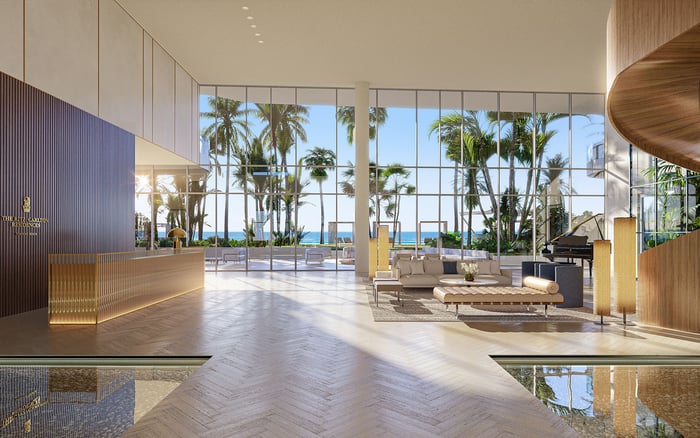
A strong showing should not begin inside the unit. It should begin at the building entrance. Notice the transition from valet or garage to lobby, from lobby to elevator, from elevator to corridor, and from corridor to residence. Each step either supports or weakens the sense of privacy.
When arriving at the residential floor, pause before entering. Look at the door position. Is it centered in a long sightline? Is it tucked away? Are other doors close enough that simultaneous arrivals could feel crowded? Is there space for a guest to stand comfortably without blocking circulation?
Then open the front door and study what is visible from the hall. If the living room, kitchen, or primary view is immediately exposed, the home may rely on interior design to recover privacy. If there is a foyer, gallery, powder room bend, or art wall, the home likely has a more polished arrival sequence.
Also consider how daily operations will unfold. Where will deliveries pause? How will staff enter? Will luggage, flowers, catering, pets, or children’s sports equipment move through the same corridor as guests? In a second-home or full-time residence, these routines influence whether the home feels effortless.
Finally, revisit the corridor emotionally. Luxury buyers often trust their reaction to a view but ignore their reaction to a hallway. The entry sequence should lower the pulse, not raise it.
Hallway exposure does not determine value on its own, but it can influence buyer hesitation. In the resale market, small frictions become negotiation points. A beautiful residence with a front door directly exposed to elevator traffic may require a buyer to rationalize the condition. A comparable home with a quieter entry may feel more complete.
This is especially true among buyers who entertain, travel with staff, maintain art collections, or value discretion. For them, the hallway is not background architecture. It is part of the home’s social and operational infrastructure.
Exposure can also affect the way photography and showings perform. A residence with a gracious foyer photographs and tours differently than one whose first impression is compressed. The buyer experiences a beginning, a reveal, and a sequence. That sense of staging, when achieved architecturally rather than decoratively, is difficult to replace.
None of this means a buyer should reject a residence with more visible hallway placement. A direct entry may be acceptable if the unit has an extraordinary view, strong interior separation, generous scale, or a price position that reflects the tradeoff. The point is to identify the condition early and value it with clarity.
The next luxury buyer is likely to be more exacting about subtle forms of privacy. After years of intense demand for outdoor space, branded amenities, wellness programming, and turnkey design, attention is shifting toward the quieter mechanics of daily life. Hallway exposure belongs to that category.
It is a practical question disguised as an aesthetic one. It touches security, acoustics, discretion, convenience, and resale psychology. It also reveals whether a building was designed merely to stack residences efficiently or to let each home feel individually composed.
For buyers comparing high-end condominiums across South Florida, hallway exposure should sit beside view corridor, terrace usability, elevator service, garage access, and amenity placement. It may not be the headline feature, but it can become the detail that determines whether a residence feels serene after the initial drama fades.
A truly refined home does not announce its privacy. It lets the owner feel it in the first quiet moment outside the door.
What is hallway exposure in a luxury condominium? It refers to how visible, audible, and trafficked a residence entry is from shared corridors, elevators, and service paths.
Why does hallway exposure matter to 2026 buyers? Buyers are placing more value on discretion, quiet arrival, and the feeling of privacy before entering the home.
Is being close to the elevator always a disadvantage? Not always. It can be convenient, but buyers should weigh that convenience against foot traffic, sound, and sightlines.
What is the best hallway condition for privacy? A recessed or private entry with limited sightlines, minimal neighboring doors, and a composed foyer is often preferred.
Can interior design solve hallway exposure? It can soften the issue with screens, art walls, and foyer treatments, but architecture usually has the greater impact.
Should buyers visit the hallway more than once? Yes. Corridors can feel different depending on the time of day, resident movement, deliveries, and building staffing patterns.
Does hallway exposure affect resale value? It can influence buyer perception and negotiation, especially when comparable residences offer a more discreet arrival.
How does a private elevator foyer change the analysis? It usually improves privacy, but the size, sightlines, and connection to living spaces still need careful review.
Is hallway exposure more important in full-time homes or second homes? It matters in both. Full-time owners feel it daily, while second-home owners may value frictionless arrival and discretion.
What should buyers ask during a showing? They should ask how residents, guests, staff, deliveries, and service teams move through the floor in everyday use.
For a confidential assessment and a building-by-building shortlist, connect with MILLION.
If branded residences are on your mind — as a home or as an allocation — we would be glad to share what we are seeing, privately.
Begin a quiet conversation.jpg&width=700&height=438&fit=cover)