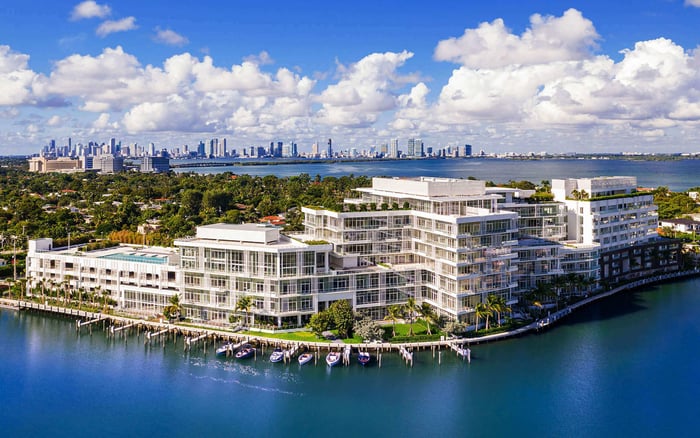
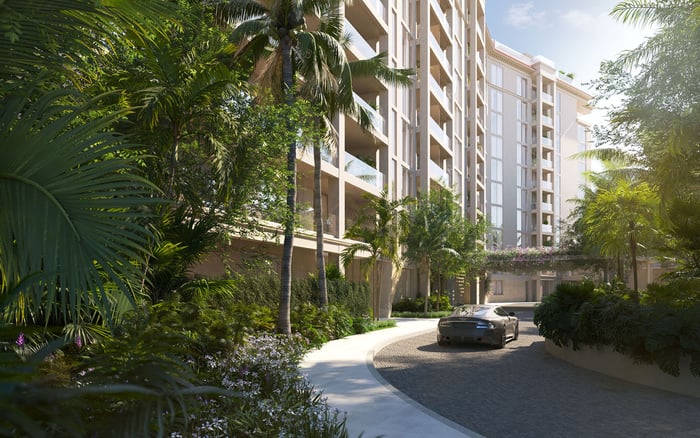
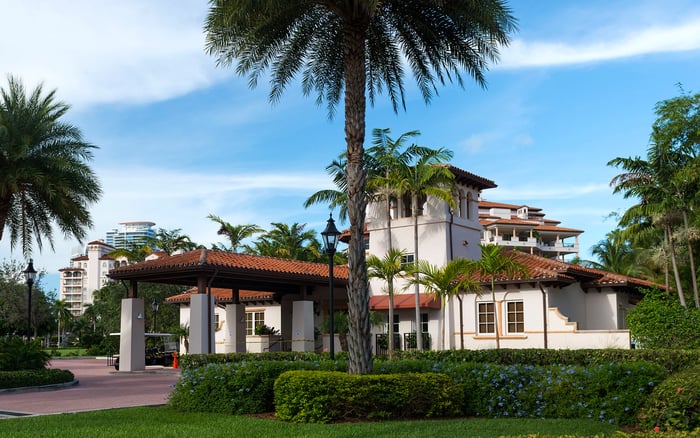
Star Island and Fisher Island sit only minutes apart by water, yet they represent two very different expressions of Miami privacy. One is a road-connected, single-family trophy island with famously scarce inventory; the other operates as a ferry-access, private-club ecosystem with its own ZIP code and national pricing superlatives. For buyers weighing legacy, logistics, and lifestyle, the distinctions matter as much as the views.
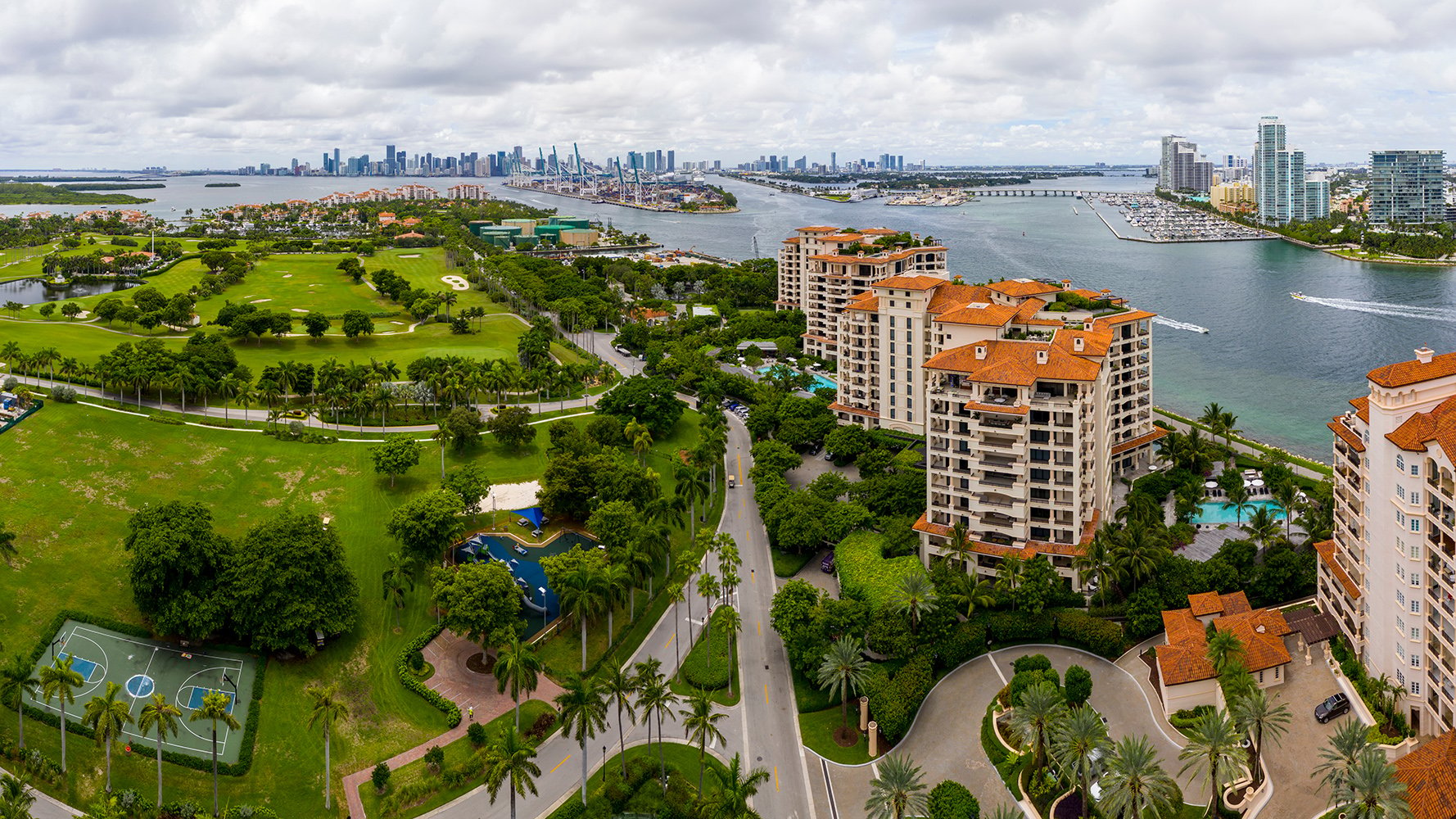
In South Florida, the most enduring luxury is rarely a finish package or a logo. It is scarcity you can quantify: controlled access, limited buildable land, and a neighborhood identity that cannot be replicated at scale. Star Island and Fisher Island are the clearest Miami examples because each is defined by a hard geographic boundary and a finite number of residences.
For buyers, these enclaves are less about “where” and more about “how.” How you arrive. How day-to-day life runs. How reliably privacy holds. And how a market behaves when inventory is measured in handfuls, not hundreds. In that context, Miami Beach becomes a collection of micro-markets, each with its own operating model.
Star Island is a man-made residential island in Biscayne Bay developed in 1922 by Carl G. Fisher. It is primarily single-family and is often described as having about 35 homes. That scale is the core thesis: supply is structurally constrained, so any listing is inherently consequential.
Access is direct by design. Star Island connects to Miami Beach via a single roadway, Star Island Drive. Residents can be in South Beach quickly without relying on a ferry schedule or a marina handoff. That “drive-on, drive-off” convenience is not a footnote. It shapes hosting, staffing, errands, and the way owners use their homes between travel weeks.
Culturally, Star Island carries an unusually public mystique for an ultra-private address. It is widely covered as a high-profile enclave and often characterized as a discreet celebrity playground. For some buyers, that recognition is part of the purchase story. For others, it is exactly why Fisher Island feels like the more insulated alternative.
What matters most is not the headlines, but the mechanics. In a neighborhood with roughly a few dozen homes, each transaction can influence perception. A recent example often cited in local reporting is the $120 million sale of 26 Star Island Drive in 2025, described as a Miami-Dade residential record. Even if your target is far below the trophy tier, record closings can reset expectations for what “peak” pricing looks like nearby.
Fisher Island expresses privacy through a different rulebook. It has its own ZIP code, 33109, and it is frequently cited in national rankings for extreme housing costs. In 2025, reporting that referenced PropertyShark positioned 33109 as the most expensive ZIP code in the United States, with a median sale price of $9.5 million.
The first filter is access. Fisher Island is reachable only by boat. The Fisher Island Club describes entry via its private ferry service from Miami Beach rather than a public road bridge. That single fact achieves what gates and guardhouses can only approximate: it materially reduces casual traffic.
The second filter is the private-club structure. Fisher Island Club positions itself as a full-service private-club lifestyle with amenities integrated into island living, including dining venues under the club umbrella. Membership has real economics. The club’s membership information lists a $250,000 initiation fee for certain options, plus recurring annual dues. In practice, ownership can feel closer to joining a small, tightly managed ecosystem than purchasing in a typical condominium market.
Families also consider education continuity. Fisher Island Day School is an on-island private school serving early learning through grade 8, an uncommon convenience that reinforces the island’s “complete ecosystem” character.
In a traditional neighborhood, buyers triangulate value through a meaningful set of comparables and a steady flow of recent sales. On Star Island, limited inventory and infrequent closings mean the “market” can become a narrative anchored to a small number of transactions. Public trackers that follow Star Island as a distinct neighborhood reinforce the point: sales activity is often limited compared with typical areas.
On Fisher Island, signals are more layered. The island includes multiple residential buildings, and it carries a multi-part cost structure. Median pricing can remain exceptionally high while unit-level conditions vary. Public market dashboards can show shifts in median sale prices and price per square foot over time, but the deeper story often sits in building-by-building fee structures, renovation cycles, and whether buyers prioritize turnkey finishes or legacy layouts.
The conclusion is not to dismiss data. It is to read it precisely. In enclaves where each closing is notable, “average” can be less useful than the specifics: water exposure, privacy, condition, and the practical ease of modernizing without disrupting the neighborhood’s rhythm.
At this level, sophisticated buyers underwrite lifestyle as a line item.
On Fisher Island, the club-centric model can materially change annual carrying costs. Initiation and dues are one layer. Property-level condo or HOA fees add another, and they can vary by building and unit profile. The tradeoff is clarity: the amenity ecosystem is not hypothetical. It is operating, staffed, and designed to be used.
On Star Island, the cost profile concentrates at the estate level: landscaping, security, staffing, and the realities of maintaining waterfront property in a salt-air environment. The “fee structure” is less centralized, but customization is typically greater, especially for owners who treat the home as a private resort.
Both islands share an attribute that matters to legacy-minded buyers: the neighborhood cannot be reproduced nearby. Scarcity is not marketing when the map enforces it.
Star Island’s advantage is immediacy. A single road connection can be the difference between using Miami Beach as a daily city and using it as a weekend destination. If your routine includes frequent dinners, regular meetings on the mainland, or efficient airport runs, road access reduces friction.
Fisher Island’s advantage is separation. The ferry-access model signals, from the start, that the island is a destination with protocols. For many owners, the extra step is not an inconvenience. It is the product.
Both function as gated communities in practice, but they achieve it differently. Star Island gates through controlled road access. Fisher Island gates through geography, reinforced by club culture and a formal community framework supported by its community association.
Not every buyer wants a single-family island estate, even if they can. For some, the ideal is a lock-and-leave residence that still sits within the gravitational pull of Miami Beach dining, wellness, and cultural life.
If your taste leans toward serviced living and a globally recognizable hospitality standard, consider a branded residence approach such as Setai Residences Miami Beach. For buyers who want a refined, residential-first Ritz-Carlton experience in a more intimate setting, The Ritz-Carlton Residences® Miami Beach offers another interpretation of Miami Beach discretion.
For those who prefer a newer, design-forward entry point to the beach corridor, Shore Club Private Collections Miami Beach reflects the continued evolution of luxury product on the sand. And if an oceanfront, boutique-scale feel is the priority, 57 Ocean Miami Beach provides a compelling alternative that keeps you in the same broader Miami Beach lifestyle orbit.
These options are not substitutes for Star Island or Fisher Island. They are adjacent strategies: less land, more service, and often more predictability in building operations.
When the shortlist is Star Island versus Fisher Island, the decision is rarely about prestige. Both are globally legible signals of arrival. The decision is about lived experience.
Choose Star Island if your ideal day involves driving directly home, entertaining in a singular property, and owning a piece of Miami’s storied residential mythology. With so few homes, each address reads as inherently individual, and each listing is a real event.
Choose Fisher Island if you want privacy with systems: ferry access, a self-contained amenity network, and a club model that turns the island into a curated daily environment. For families, the presence of an on-island private school option adds practicality to the romance.
In either case, diligence is less about determining whether the enclave is “good” and more about matching the enclave’s operating model to your personal operating model.
Is Star Island a natural island?
No. Star Island is a man-made residential island in Biscayne Bay developed in 1922.
How many homes are on Star Island?
It is often cited as having about 35 homes, which keeps inventory extremely scarce.
How do you access Star Island?
It is connected to Miami Beach by a single roadway, Star Island Drive.
Why does Star Island get so much attention?
It is widely covered as a high-profile enclave and often associated with celebrity ownership.
Is Fisher Island accessible by car?
No. Access is by boat, and the island is served via a private ferry from Miami Beach.
Why is Fisher Island called the most expensive ZIP code?
Its 33109 ZIP code has been cited in national rankings, including a 2025 report listing a $9.5 million median sale price.
Do you need a club membership to live on Fisher Island?
Many owners participate in the island’s club lifestyle; certain membership options list a $250,000 initiation fee plus annual dues.
Are there schools on Fisher Island?
Yes. Fisher Island Day School serves early learning through grade 8.
Are these enclaves considered a Gated-community?
In effect, yes, but via different mechanisms: Star Island through controlled road access and Fisher Island through ferry-only entry.
Where can I start a private search for Star Island or Fisher Island?
Begin discreetly with MILLION Luxury.
If branded residences are on your mind — as a home or as an allocation — we would be glad to share what we are seeing, privately.
Begin a quiet conversation