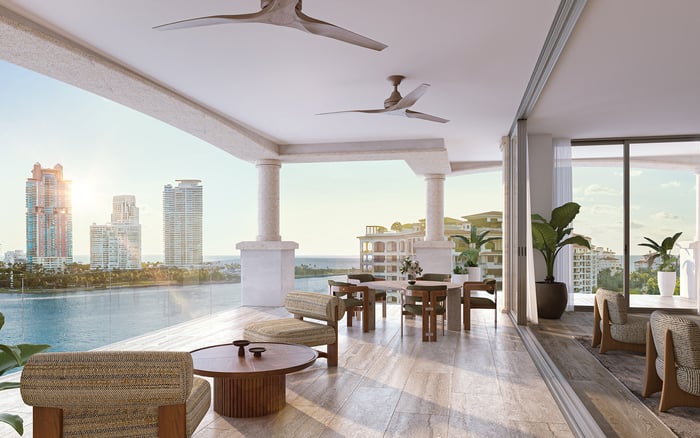
In a market where nine-figure sales can reset expectations overnight, the hardest part of buying or selling a trophy home is often proving the price. Here is how South Florida’s micro-markets, waterfront premiums, and branded condominium benchmarks shape value when traditional comparables fall short.
South Florida’s ultra-luxury market is now substantial enough to stand on its own, not merely as the top sliver of a broader housing cycle. MILLION Luxury reported 262 residential transactions above $10 million in 2025 through September, with a projection of roughly 426 by year-end. That kind of volume adds transparency to the tier, but it does not eliminate the hardest problem at the peak: proving a trophy price when conventional comparables disappear.
Once a home moves into nine-figure territory, true substitutes are rare. Many properties are singular by design and by site: unique waterfront frontage, protected views, security posture, and levels of customization that resist standardization. Appraisers can still apply established frameworks, but the process becomes more judgment-heavy when there are few recent sales that align on location, frontage, design, and condition.
This is where friction often shows up. Two sophisticated parties can agree on a number, yet still face resistance when that number must withstand underwriting, partnership approvals, or estate planning. In trophy real estate, the valuation exercise is often less about statistical certainty and more about a defensible rationale.
In that sense, “no comps” is not a market failure. It is a byproduct of what trophy homes are: assets purchased precisely because they cannot be replicated on the same site with the same positioning.
Publicly discussed record sales can function as emotional benchmarks, even when they are not direct comparables. Miami-Dade’s residential price record was set by the reported $120 million sale of a Star Island mansion (26 Star Island Drive) in late 2025. Around the same period, Redfin identified the $101.5 million “Banyan Ridge” estate in Coconut Grove as the most expensive U.S. home sale in December 2025, and coverage also highlighted a $97.5 million sale in North Palm Beach (Lost Tree Village area).
For buyers and sellers, the message inside those headlines matters more than the headline number. Coastal Florida is producing enough ultra-high-end trades to shape national perception, while specific enclaves are demonstrating that they can clear their own price ceilings.
A few additional transactions help clarify what the market rewards:
The takeaway is not that every waterfront home is a nine-figure asset. The takeaway is that a trophy sale can reset negotiation psychology across an entire micro-market, even when the next listing differs materially in size, frontage, or architecture.
At the top end, “South Florida” is not one market. It is a mosaic of micro-markets, each with its own buyer profile, supply constraints, and governance realities. That is why county-wide averages can feel meaningless when the asset is an irreplaceable parcel.
Fisher Island is a clean example. Pricing there can move differently from broader Miami Beach luxury because access and scarcity are central to the value proposition. This kind of divergence is not an exception. It is the norm wherever physical and social barriers are part of what is being purchased.
When you evaluate a trophy home, define the boundary lines with precision before you debate the number:
When comps are scarce, the narrative around these boundary lines often becomes more persuasive than a spreadsheet of imperfect matches. The strongest pricing arguments tend to be specific, geographic, and difficult to dispute.
Waterfront and oceanfront properties can command meaningful premiums relative to comparable non-waterfront homes, and appraisal practice requires those premiums to be handled explicitly through adjustments. In plain terms, buyers should expect the valuation conversation to separate the price of the site from the price of the improvements.
There is also a second layer that increasingly shapes the discussion: underwriting and total cost of ownership. Florida’s flood-zone exposure can affect building requirements and ongoing expenses. For trophy buyers, the issue is often less about sticker shock and more about certainty. A home that is engineered and documented for its risk profile can be easier to finance, insure, and ultimately resell, even if the initial basis is higher.
In practical terms, waterfront value is often “two numbers” that must agree:
When a property is truly singular, land begins to behave like a scarce asset, not a component that can be swapped for a nearby substitute.
Not every ultra-luxury purchase is a single-family decision. For a segment of buyers, the draw is clarity: a known service standard, established building governance, and a market where unit-to-unit comparability is cleaner.
In Miami Beach, branded product can offer an alternate valuation anchor because the building becomes the framework. A buyer who understands the ecosystem around Faena House Miami Beach or Setai Residences Miami Beach is often buying a mix of design pedigree, service expectations, and location identity that is broadly understood by other qualified buyers.
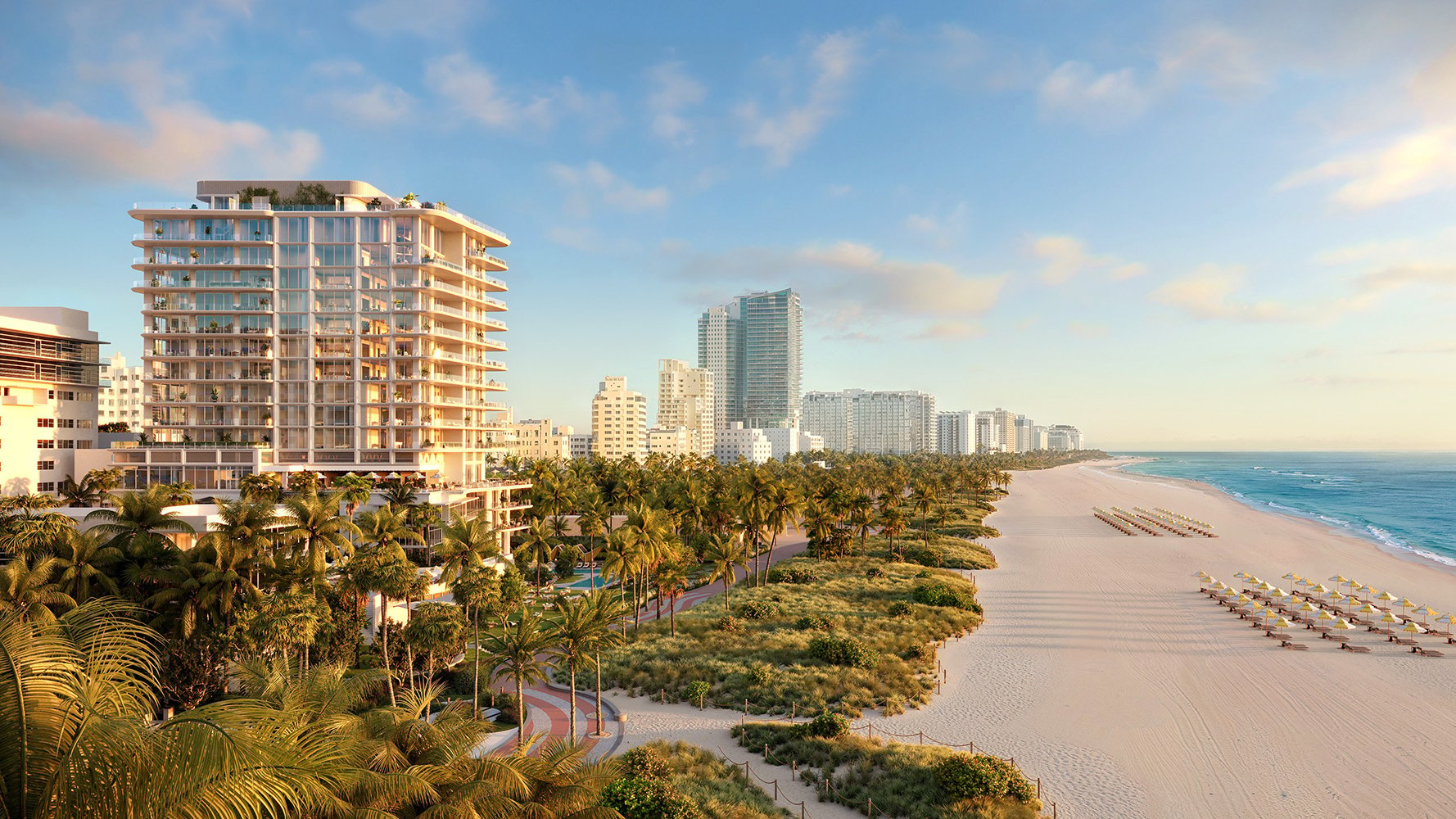
Similarly, a boutique, service-forward offering like The Ritz-Carlton Residences® Miami Beach can appeal to purchasers who want privacy without forfeiting hotel-adjacent standards. These buildings may trade in thinner volume than mid-market condos, but they can provide a more legible set of reference points than a one-off mansion.
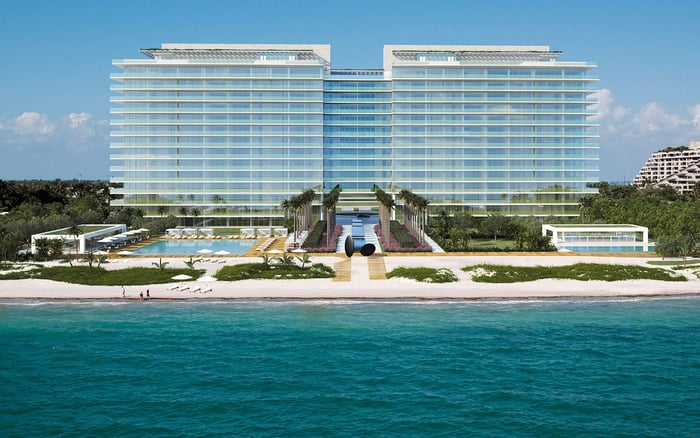
For oceanfront buyers who want a residential experience with fewer unknowns, 57 Ocean Miami Beach represents the type of product where the view plane, frontage, and building programming can be evaluated within a narrower peer set.
The larger point is consistency. Standardized floor plates, documented renovations, and recurring demand for the same addresses can make condominium pricing easier to defend. In a world of “no comps,” that consistency can itself read as luxury.
Trophy homes are still evaluated through the standard three approaches: sales comparison, cost, and income. The difference at the very top is that the sales comparison approach may have to rely on scarce and imperfect comps, forcing broader search parameters and more judgment-heavy adjustments. For a buyer, the objective is not to out-argue an appraiser. The objective is to make the valuation story more coherent, more transparent, and easier to support.
A practical playbook looks like this:
At this level, the best valuations read like a well-argued brief: limited data, clear logic, transparent assumptions, and a credible explanation of why this home is not interchangeable.
Is a record sale like Star Island a “comp” for my home? Usually not. It can shape expectations, but true comparables require similar micro-market positioning, frontage, condition, and scarcity profile.
Why do appraisers struggle with trophy homes? Because there may be few recent comparable sales, forcing broader searches and judgment-heavy adjustments within the usual appraisal approaches.
Do gated neighborhoods really command a premium? Often, yes. A gated community can trade at a premium when security, access control, and reputation are core to the buyer’s decision.
Are ultra-luxury condos easier to value than mansions? Frequently. Standardized building factors and repeat buyer demand can create cleaner reference points, especially in well-known Miami Beach addresses.
For discreet guidance on pricing, positioning, and micro-market comps, connect with MILLION Luxury.
If branded residences are on your mind — as a home or as an allocation — we would be glad to share what we are seeing, privately.
Begin a quiet conversation