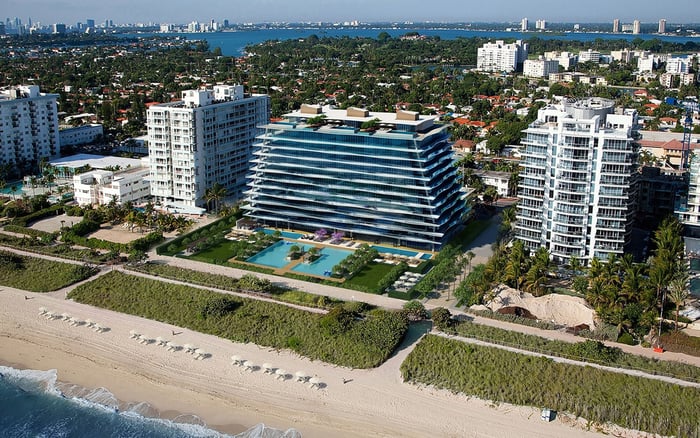
A practical buyer’s guide to comparing Oceana Bal Harbour and Fendi Château Residences Surfside through the lens of school-day rhythm, household staff movement, and family privacy during South Florida’s high-occupancy winter season.

For a family choosing between Oceana Bal Harbour and Fendi Château Residences Surfside, the deciding question is not which address feels more glamorous on a quiet afternoon. It is which home performs at 7:25 a.m. in peak season, when children need to leave, tutors may arrive later, guests are in residence, household staff are moving through the day, and the building is operating closer to full occupancy.
Both properties belong to the Bal Harbour and Surfside conversation for buyers who expect privacy, service, and a polished residential experience. Yet the useful comparison is operational. A residence that photographs beautifully can still create friction if the entry sequence, elevator pattern, staff access, amenity placement, or floor-plan separation does not support a family’s actual schedule.
This is especially true for seasonal owners who use the apartment as a true home rather than a short visit. The most practical lens is straightforward: morning school exit, afternoon return, and evening entertaining while the household continues to function.
The practical distinction is often reduced to Bal Harbour versus Surfside, but serious buyers should avoid assuming that one side automatically solves the family problem. Oceana Bal Harbour should be viewed as the Bal Harbour-side option in this comparison. Fendi Château Residences Surfside should be viewed as the Surfside-side option, with a more intimate residential context to evaluate.
That geographic distinction matters only when translated into routines. Which driveway approach is more predictable during winter traffic? Which lobby experience is easier for a caregiver managing children and bags? Which residence layout gives parents separation from bedrooms, service activity, and guest areas? Which building’s amenity and arrival pattern keeps a family from feeling exposed during the busiest weeks of the year?
For buyers comparing these two addresses, views are rarely the only issue. Exposure, access, and control often matter just as much. A terrace that feels private at noon may feel different when neighboring balconies, pool decks, or amenity levels are active. A grand entry may feel less useful if every daily movement must pass through the most public part of the property.
The morning test begins before anyone enters the car. In a functioning peak-season home, the route from bedroom to elevator to lobby to vehicle should be intuitive, calm, and repeatable. Buyers comparing Oceana Bal Harbour with Fendi Château Residences Surfside should walk that sequence in detail, preferably at the times their household actually leaves.
For Oceana Bal Harbour, the buyer question is whether the building’s layouts, amenities, entry sequence, and service setup reduce friction during weekday departures. For Fendi Château Residences Surfside, the question is similar, with emphasis on whether the setting preserves privacy while the household is in motion.
School convenience should not be judged by reputation alone. Families should verify school boundaries, academic calendars, transportation policies, carline expectations, and peak-hour routes before assigning an advantage. A building can feel close to everything and still be inefficient for a particular school-day pattern. Conversely, a property that seems less obvious on a map may perform well if its internal circulation and household rhythm are better matched to the family.
The best showing is not the prettiest showing. It is the one that reveals whether a child can leave with a backpack, a caregiver can coordinate pickup, and a parent can continue the day without the entire residence feeling mobilized around the departure.
The afternoon is where luxury residences often reveal their strengths and weaknesses. Children return with bags, sports gear, friends, drivers, tutors, and shifting plans. A well-chosen home absorbs that energy without making the primary living spaces feel constantly interrupted.
At Oceana Bal Harbour, buyers should study floor-plan separation, elevator access, amenity placement, and the relationship between family zones and more formal entertaining spaces. The goal is not simply square footage. It is whether the plan allows children to return, eat, work, decompress, and move toward amenities without crossing every adult space in the residence.
At Fendi Château Residences Surfside, the same review should focus on how the environment handles layered use. A more intimate building experience can feel calmer, more personal, and more discreet, but only if the residence and building operations provide enough separation between family life, guest movement, staff work, and amenity access.
Afternoon privacy also involves sound and sightlines. Buyers should look at where bedrooms sit relative to main living areas, how terraces are exposed, where elevators open, and whether a tutor or caregiver can arrive without turning the home into a public stage. The most elegant family apartment is often the one that lets different parts of the household happen at once.
Peak season is not only about school. It is also the season of visiting relatives, dinners, charitable events, art weeks, holidays, and late arrivals. Families who entertain while maintaining a staffed household should evaluate staff circulation with particular care.
This is where assumptions become costly. Any claim about staff elevators, service corridors, delivery paths, or back-of-house movement should be verified in building materials, condominium documents, management rules, or during a detailed operations walkthrough. Buyers should not rely on informal descriptions of how staff, vendors, deliveries, or luggage are expected to move.
For Oceana Bal Harbour, the practical issue is whether the service setup supports weekday staffing, tutoring, deliveries, and entertaining without compromising the family’s private zone. For Fendi Château Residences Surfside, the question is whether the building environment creates enough separation between residents, guests, and household support.
A dinner at home is a useful scenario. Where does catering arrive? How does luggage move when guests come in from the airport? Can staff prepare, clear, or reset without passing repeatedly through the primary family path? Does the elevator sequence allow a quiet night for children while adults entertain? These details define the difference between a beautiful apartment and a resilient family residence.
Family privacy should be evaluated through observable features: residence orientation, elevator access, amenity placement, balcony exposure, bedroom separation, and the degree of public movement near the home. These elements are more reliable than broad impressions.
At Oceana Bal Harbour, buyers should study whether the plan gives the primary suite, children’s rooms, staff-related spaces, and entertaining areas distinct roles. At Fendi Château Residences Surfside, buyers should ask whether the building format enhances discretion or concentrates activity in ways that matter during the winter season.
The right answer may differ by household. A family with young children may prize direct, low-friction movement and clear staff pathways. A family with teenagers may value bedroom separation, guest privacy, and amenity independence. A multigenerational household may need arrival and service patterns that allow grandparents, guests, children, and staff to coexist without constant overlap.
Oceana Bal Harbour and Fendi Château Residences Surfside should be compared less as lifestyle symbols and more as operating environments. The winning residence is the one that supports a family’s ordinary weekday under extraordinary seasonal pressure.
A disciplined buyer should request floor plans, study elevator and entry sequences, review rules for staff and deliveries, confirm school logistics independently, and walk the property through real-life scenarios. The question is not simply which property is more prestigious. It is which one allows the household to move gracefully when the building, the neighborhood, and the family calendar are all at their busiest.
Is Oceana Bal Harbour automatically more convenient for school-day living? Not automatically. School-day convenience depends on verified routes, school policies, household timing, and how the building functions during departures.
Is Fendi Château Residences Surfside better for buyers who want a more intimate setting? It can be a strong candidate for buyers prioritizing a more intimate atmosphere, but privacy and circulation still need to be tested against the family’s routine.
What should families review first when comparing the two buildings? Start with the morning exit sequence, including bedroom location, elevator access, lobby flow, vehicle pickup, and caregiver coordination.
Why is staff circulation so important during peak season? Staff, vendors, tutors, deliveries, and guests may overlap more often in winter, so poor circulation can make even a large residence feel exposed.
Can buyers assume there are dedicated service routes? No. Service elevators, corridors, delivery rules, and staff paths should be verified through building documents and management procedures.
How should terrace privacy be evaluated? Look at balcony exposure, neighboring sightlines, amenity proximity, and how the terrace feels at different times of day.
What makes a floor plan better for families? Strong family plans separate bedrooms, entertaining spaces, work areas, and staff functions while keeping daily movement intuitive.
Should school reputation drive the decision? It should not be the only driver. Boundaries, calendars, transportation, and real commute patterns must be confirmed for the specific household.
Which building is better for entertaining with children at home? The better fit is the one with clearer separation between guest areas, family bedrooms, staff movement, and service access.
What is the best way to shortlist comparable options for touring? Start with location fit, delivery status, and daily lifestyle priorities, then compare stacks and elevations to validate views and privacy.
To compare the best-fit options with clarity, connect with MILLION.
If branded residences are on your mind — as a home or as an allocation — we would be glad to share what we are seeing, privately.
Begin a quiet conversation