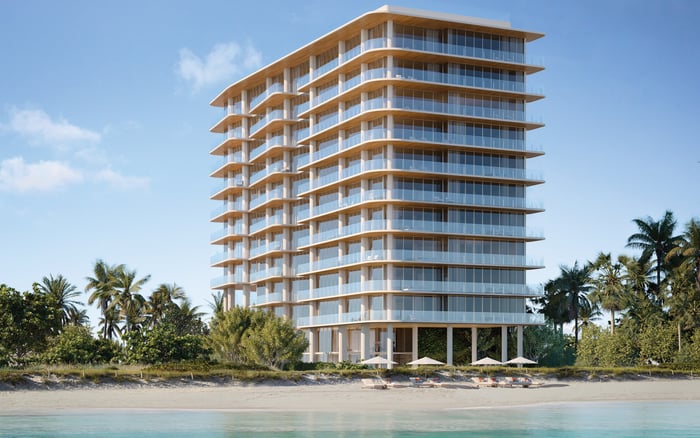
A buyer-focused underwriting guide comparing Ocean House Surfside and The Residences at Six Fisher Island through the daily realities of pets, staff, deliveries, elevators, guest access, and governing documents.

At the top of the South Florida market, the most revealing due diligence often happens behind the porte cochere. Ocean House Surfside and The Residences at Six Fisher Island represent two distinct versions of ultra-prime coastal ownership: one grounded in Surfside’s mainland beach rhythm, the other shaped by Fisher Island’s controlled access and privacy. Both can be compelling, but neither should be underwritten only by views, finishes, or amenity language.
The sharper question is operational. How do residents, staff, pets, vendors, private chefs, trainers, security teams, dog walkers, deliveries, and visiting family members actually move through the property? Where do they enter, which elevator do they use, who approves them, and what happens when several needs converge on the same afternoon?
Investment underwriting for these residences should treat pet logistics, service-elevator operations, and house-rule flexibility as core value variables. A beautiful residence that resists a buyer’s household model can create daily friction. A residence with quieter rules, clearer access paths, and responsive management can feel materially more private, even if its glamour is less obvious at first inspection.
Ocean House Surfside is the mainland, coastal counterpoint in this comparison. Its Surfside setting should be evaluated for how easily a household can move between the residence, the street, the beach, and the surrounding area. That sounds simple, but for a full-time household with staff, pets, and frequent deliveries, the practical details matter.
A buyer should ask how pets are routed from the unit to exterior areas, whether elevator restrictions apply, and how access to the street or beach functions during peak hours. If the household includes large dogs, multiple dogs, or visiting pets, the review should include size limits, breed restrictions, relief-area practicality, and whether pet-washing facilities or related procedures exist. Permission to own a pet is not the same as a smooth daily pet routine.
Oceanfront ownership also intensifies the need to understand circulation. A beach-oriented lifestyle may involve towels, gear, guests, children, caretakers, and pets moving repeatedly through the building. The underwriting question is whether the rules support that rhythm discreetly, or whether everyday movement becomes visible, constrained, or dependent on case-by-case approvals.
Ocean House may offer comparatively simpler mainland logistics than a private-island model, but simplicity should not be assumed. Buyers still need to confirm staff access procedures, service-elevator rules, delivery routing, contractor hours, guest policies, and any restrictions that affect private events or family use of amenities.
The Residences at Six Fisher Island belongs to a different category of living, where privacy and controlled access are part of the premise. That privacy is a major attraction, but it also expands the diligence file. The household is not merely entering a building; it is entering an island environment with its own access rhythm, guest clearance expectations, staff pathways, and delivery sequence.
For a buyer with full-time staff, a rotating nanny schedule, trainers, security personnel, pet-service providers, or frequent visiting guests, the private-island model must be tested before contract deadlines. How are dog walkers cleared? What must a groomer, veterinarian, or pet-transport service do before reaching the residence? Can a private chef receive specialty groceries without disrupting staff circulation? How are last-minute vendors handled?
Six Fisher may offer greater exclusivity, but the same controls that create privacy can add time cost. A late delivery, a substitute driver, a new trainer, or an overnight staff change may require more coordination than in a mainland condominium. For certain families, that structure is an asset. For others, it can become a recurring operational tax.
The diligence should therefore connect the building’s back-of-house plan to the wider island access environment. Service elevators, loading areas, arrival approvals, guest processing, and staff credentials are not separate questions. They form one chain from island entry to residence door.
In both buildings, service-elevator diligence should be treated as a serious underwriting category. Buyers should ask about elevator count, cab dimensions, protected hours, reservation rules, move-in and move-out procedures, vendor access routes, and how management separates resident privacy from staff and delivery circulation.
The most important test is not whether a service elevator exists. It is whether it can support the household’s actual rhythm. A buyer who entertains frequently may need chefs, florists, rental vendors, valet-style staff, and grocery deliveries to operate in the same narrow time window. A family with school-age children and pets may need nannies, drivers, dog walkers, and household staff moving daily without repeated friction.
At Ocean House Surfside, the emphasis is on how the building connects to the street, beach, and local Surfside context. At The Residences at Six Fisher Island, the same service-elevator review should be paired with the prior access path to the island. If a vendor must clear controlled access before reaching the building, the elevator reservation process is only one step in a longer choreography.
Buyers should request practical examples, not just policy language. Ask management how groceries are handled during busy periods, whether food delivery competes with contractor movement, how emergency repairs are prioritized, and what happens if a scheduled vendor is late.
House rules are often reviewed too late and too casually. For ultra-prime buyers, they should be read like operating covenants. The relevant sections include pets, guests, staff IDs, overnight staff, service providers, private events, deliveries, renovations, leasing, contractor access, and amenity use by family members, employees, or guests.
At Ocean House Surfside, the review should focus on how the condominium rules translate into everyday mainland living. Are pet routes prescribed? Are staff required to use specific entrances? Are deliveries limited by time or elevator availability? Are contractor hours realistic for the type of customization the buyer intends?
At The Residences at Six Fisher Island, the review may need to extend beyond project documents into island-wide or master-association requirements, along with any club-related obligations that affect the ownership experience. This is not a negative; it is simply a different governance architecture. Buyers should understand all layers before assuming that a household routine will be approved because it is common in other luxury buildings.
The best diligence combines document review with direct management interviews. Enforcement culture matters. Two buildings can have similar written rules and very different day-to-day tolerance for exceptions, advance approvals, staff substitutions, and vendor timing.
There is no universal answer in the Ocean House Surfside versus The Residences at Six Fisher Island comparison. The better fit depends on the household’s operating model.
A buyer who wants direct mainland access, beach adjacency, and a simpler relationship between residence, street, and neighborhood may lean toward Ocean House Surfside, provided the building’s rules support the intended pet, staff, and delivery routine. A buyer prioritizing privacy, controlled arrivals, and the cultural cachet of Fisher Island may prefer The Residences at Six Fisher Island, provided the additional access protocols match the household’s tolerance for planning.
For a principal using the home seasonally, operational friction may be modest. For a family office managing a residence with full-time staff, security, pets, entertaining, and frequent deliveries, it becomes central. The true luxury is not only what the residence offers on a tour, but how quietly and predictably it performs on an ordinary Tuesday.
What is the main underwriting difference between Ocean House Surfside and The Residences at Six Fisher Island? Ocean House Surfside should be read through mainland coastal convenience, while The Residences at Six Fisher Island should be read through private-island access, governance, and logistics.
Why do pet rules matter so much in luxury condominium underwriting? Pet approval is only the first issue. Buyers also need to understand routes, elevators, relief areas, service providers, and any size or breed limits.
What should pet owners ask at Ocean House Surfside? Ask about pet routes, elevator restrictions, street and beach access, washing facilities, relief-area practicality, and any written limits in the governing documents.
What extra pet diligence applies at The Residences at Six Fisher Island? Buyers should test how dog walkers, groomers, trainers, veterinarians, and pet-transport providers are cleared onto the island and into the building.
Why are service elevators an investment issue? Service elevators affect staffing, deliveries, move-ins, repairs, entertaining, and privacy, all of which influence the residence’s daily usability.
What service-elevator details should buyers request? Request elevator count, cab size, reservation rules, protected hours, move-in policies, vendor routes, and delivery procedures.
Are house rules more important on Fisher Island? They can be more layered because ownership may involve project documents plus island, master-association, or club-related requirements.
Does Surfside automatically mean easier logistics? Not automatically. Surfside provides mainland context, but Ocean House Surfside rules may still govern pets, deliveries, staff access, and contractor hours.
Who should perform this diligence? Buyers should involve counsel, household managers, family-office representatives, and any staff who understand the intended operating model.
What is the simplest way to compare the two properties? Map one typical week of household activity, then confirm whether each building’s rules, access paths, and management culture can support it.
To compare the best-fit options with clarity, connect with MILLION.
If branded residences are on your mind — as a home or as an allocation — we would be glad to share what we are seeing, privately.
Begin a quiet conversation