Formula 1’s contract extension for the Miami Grand Prix through 2041 turns a marquee weekend into a long-term civic asset. For luxury real estate, permanence matters: it justifies permanent infrastructure, compresses development timelines, and keeps Miami on a predictable global calendar alongside other headline events like FIFA World Cup 2026 matches. This article looks at what the extension suggests for pricing power, neighborhood selection, and where international demand is already concentrated.
Formula 1’s decision to extend the Miami Grand Prix through 2041 is more than sports news. For a city whose luxury market is increasingly shaped by international demand, brand visibility, and corporate migration, a long-duration global event works like an annual validation. It signals to buyers, developers, and operators that Miami will remain on the same predictable calendar as Monaco, Singapore, and Austin, along with the media attention, hospitality spend, and high-net-worth travel that follow.
What elevates the extension is the shift from pop-up infrastructure to permanent investment. The race’s long-term footprint has been associated with roughly 190,000 square feet of permanent Paddock Club hospitality space. In real estate terms, permanence changes the math. It supports ongoing upgrades to the city’s front-of-house experience: airports, hotel keys, private dining, and the VIP logistics that determine how second-home owners actually live in Miami.
For luxury buyers, the takeaway is straightforward. When a market’s global narrative is repeatable for decades, the premium is driven less by a single weekend and more by confidence in long-term positioning.
Miami-Dade’s recorded pattern of 14 consecutive years of home price appreciation highlights a useful distinction: marquee events accelerate attention, but they typically amplify an existing story instead of creating a new one. That framing matters because it positions F1 as a tailwind layered onto structural demand drivers that already define South Florida’s luxury appeal, including climate, taxation, air connectivity, and a maturing high-end product.
The forward calendar adds more broadcast moments. Miami is set to host FIFA World Cup 2026 matches, and hotel construction activity across World Cup markets has been described as strong heading into 2026. Many buyers will never attend a match, yet the impact is still tangible. Global television exposure functions like city-scale marketing, reinforcing Miami’s identity as a lifestyle capital.
These events also raise expectations locally. As hospitality competition intensifies, the baseline improves for concierge programs, security protocols, wellness offerings, and private transportation. That higher standard helps explain why branded residential towers and amenity-forward new construction continue to command attention.
To understand why Miami’s luxury new-construction pipeline keeps launching, start with the buyer base. A Miami Association of Realtors cited international report found global buyers purchased 49% of South Florida new-construction condo units, with most international demand coming from Latin America. The same report notes that international buyers represented 43% of units sold in Downtown Miami.
That global footprint influences what gets built, how it is operated, and how it is positioned. International buyers often prioritize:
This is where the long-horizon F1 signal becomes practical. A multi-decade event calendar supports Miami’s reputation as a cosmopolitan, predictable place to allocate both time and capital. It also strengthens the case for buildings that operate more like private clubs than conventional apartments.
In the urban core, the luxury conversation increasingly centers on where to position within Greater Downtown and Brickell. Buyers can choose between distinct submarkets with different pacing, different waterfront relationships, and different exit strategies.
Recent reporting on Greater Downtown Miami luxury condo statistics shows Edgewater leading on pricing at about $902 per square foot and a roughly $1.575 million median sale price. Downtown Miami luxury condos were reported around $754 per square foot with a roughly $1.395 million median sale price, suggesting a lower entry point than Edgewater while remaining in the same broader ecosystem.
Brickell’s market-trend reporting has cited a roughly $700,000 median asking price and around $658 average price per square foot for Brickell condos. Those numbers reinforce Brickell’s role as a deep, liquid market with broad buyer participation.
For ultra-premium buyers, the decision is rarely about the absolute number. It is about what the number buys: view corridors, waterfront proximity, building operations, and the brand gravity that can help preserve value across cycles.
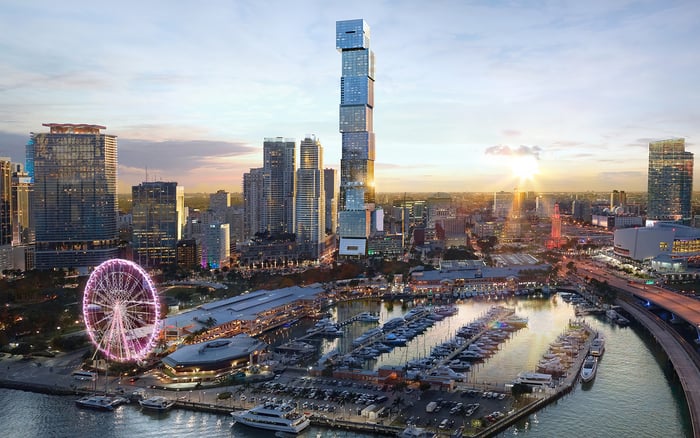
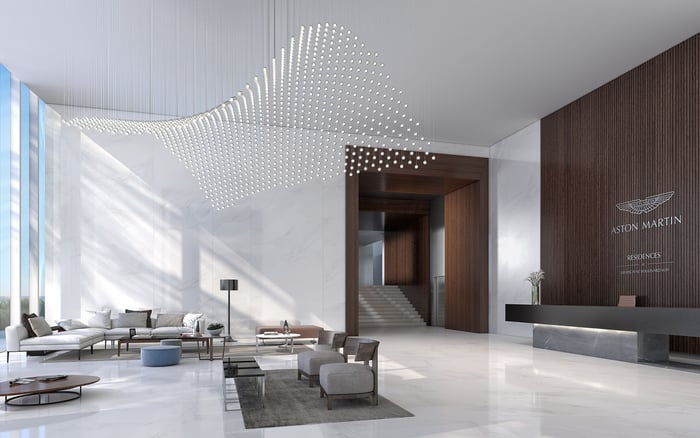
A vivid example of brand functioning as a stabilizer is Aston Martin Residences Downtown Miami, a 70-story tower with 391 residences and a full amenity program. In a market where global buyers already account for a large share of Downtown deals, an internationally recognized marque can act as cultural shorthand for clients who split time across world cities.
While the core can offer liquidity and density, Miami-beach delivers a different kind of value: scarcity. True oceanfront new construction is limited, and when it does appear, pricing often reflects the finite coastline.
Consider 57 Ocean Miami Beach, an oceanfront condominium with 81 residences and penthouses marketed up to about $14.495 million. That price behavior is less about event weekends and more about a persistent imbalance: global demand meets limited beachfront opportunity.
A strengthened global events calendar reinforces the beach scarcity thesis by making high-net-worth travel patterns more predictable. Owning a residence that feels resort-like, yet not transient, becomes more valuable when the city’s cultural peaks repeat year after year.
A second expression of this direction is the private-collection model, where the ownership experience is built around hospitality-level service. Shore Club Private Collections Miami Beach reflects how the beach market has been moving: fewer compromises, more curated programming, and operations that anticipate how global clientele live now.
North of the beach, Bay Harbor Islands and Indian Creek-adjacent micro-markets continue to attract buyers who want a quieter, boutique feel without giving up the water.
A Traded.co report said Indian Creek Residences & Yacht Club sold out and cited an average pricing level around $1,900 per square foot. Regardless of the exact unit mix, the takeaway remains consistent. In small, waterfront pockets with limited inventory, buyers will pay for privacy, constrained supply, and marina adjacency.
That thesis is easier to underwrite when Miami’s global relevance feels durable. Buyers choosing this lifestyle are often choosing consistency: a predictable arrival experience, a reliable year-round service ecosystem, and access to the same cultural highs that bring the world to South Florida.
For those tracking new construction with a Bay Harbor lens, Indian Creek Residences and Yacht Club represents the type of boutique, water-oriented product that typically trades on scarcity more than scale.
Luxury buyers track where institutional capital moves, not because they need to mirror it, but because it can reveal where the region’s economic gravity is consolidating.
The relocation of Ken Griffin’s Citadel from Chicago to Miami has been widely covered as a signal of Miami’s growing finance-sector pull. More recently, Ken Griffin and Goldman Properties acquired the 545 Wyn office building in Wynwood from Sterling Bay for about $180 million. The property has been reported at nearly 400,000 square feet across 10 stories, with major tenants including Sony Music Group and PwC.
For residential buyers, the relevance is indirect but meaningful. A stronger office and employment core can support:
In practice, this strengthens the proposition that Miami is not only a second-home market. It is increasingly a city that can be used like a primary one, which aligns with the mindset today’s luxury market continues to court.
An F1 contract through 2041 does not mean every neighborhood benefits equally. It suggests that Miami’s global brand has a longer runway, and buyers should match their purchase to the type of demand that brand reliably attracts.
Practical considerations sophisticated buyers continue to prioritize:
In a region defined by both global spectacle and deepening economic fundamentals, the enduring advantage often belongs to residences that feel inevitable: hard to replicate, well-operated, and anchored to a location that remains relevant in any cycle.
What does the F1 Miami extension through 2041 signal for buyers? It reinforces long-horizon confidence in Miami’s global visibility and event-driven hospitality investment.
Will F1 directly raise condo prices everywhere? Not uniformly. It tends to amplify existing demand patterns, especially in scarce, high-service locations.
Why does permanent Paddock Club space matter? Permanent hospitality infrastructure signals long-term commitment and supports a more consistent luxury travel ecosystem.
Is international demand still a key driver? Yes. International buyers have been reported as purchasing 49% of South Florida new-construction condo units.
Where is international buying especially concentrated? Downtown Miami has been reported with international buyers representing 43% of units sold in that area.
How do Downtown and Edgewater compare in luxury pricing? Reported stats show Edgewater around $902 per square foot versus Downtown around $754 per square foot.
What about Brickell pricing levels? Recent market-trend reporting cited about $658 average price per square foot for Brickell condos.
Why do oceanfront projects price so aggressively? Oceanfront supply is finite, and demand is global, so scarcity can translate into premium pricing.
What does Wynwood office investment suggest? It indicates institutional confidence in Miami’s core neighborhoods, which can support broader urban vitality.
How should I choose between urban core and beach? Choose based on lifestyle: liquidity and walkability in Downtown or Brickell, versus scarcity and resort-like living in Miami-beach.
For confidential guidance on South Florida’s premier addresses, connect with MILLION Luxury.
If branded residences are on your mind — as a home or as an allocation — we would be glad to share what we are seeing, privately.
Begin a quiet conversation