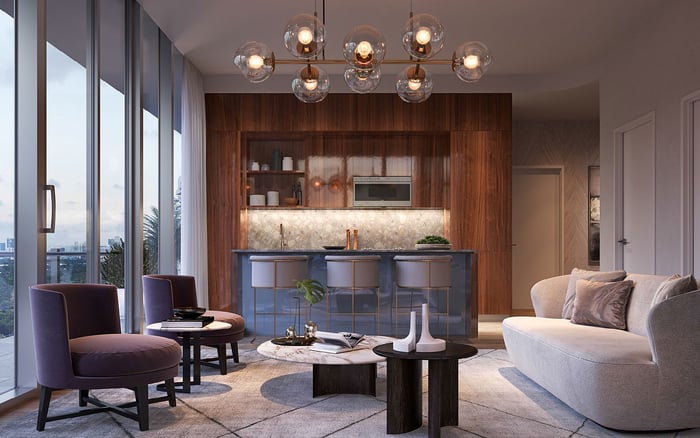
For California buyers splitting time in Florida, the choice between Miami and Palm Beach is less about prestige than cadence, privacy, social ritual, and how a residence supports daily life.

For buyers splitting time between California and Florida, the question is often framed too simply. Miami energy or Palm Beach ceremony can sound like a preference test, but at the top of the market, it is really a study in rhythm. The right residence is not the one with the louder reputation. It is the one that makes a cross-country life feel composed.
California buyers tend to arrive with a mature sense of design, climate, wellness, and privacy. They know what good light does to a room. They understand the value of outdoor space that can be used easily and often. They are often comparing not just neighborhoods, but entire ways of moving through a week. In that context, Miami and Palm Beach offer different forms of luxury.
Miami is kinetic, vertical, international, and increasingly design-led. Palm Beach is ceremonial, quieter, and shaped by continuity. One prizes access and immediacy. The other rewards restraint and routine. Neither is inherently superior. The better choice is the one that matches how often you will arrive, whom you expect to host, and whether your Florida life is meant to amplify your California life or soften it.
Miami energy is not simply nightlife or visibility. For serious buyers, it means optionality. A Miami residence can function as a social base, a cultural address, a work-adjacent retreat, and a place to entertain without the formality of an estate. The appeal is efficiency with atmosphere.
Brickell, in particular, attracts buyers who want a polished urban center with a sense of momentum. A residence such as 888 Brickell by Dolce & Gabbana speaks to that buyer because the address itself becomes part of a larger lifestyle decision: arrive, dine, host, meet, reset, and leave without friction. For California owners accustomed to traffic-sensitive planning, the value of a compact, service-rich environment can be significant.
Miami Beach answers a slightly different impulse. It keeps the water, the visual drama, and the resort cadence close, while still allowing a buyer to remain connected to the city’s social charge. The Perigon Miami Beach fits naturally into this conversation because Miami Beach is often where buyers try to balance the serenity of a coastal home with the electricity of Miami itself.
The buyer who chooses Miami is usually choosing movement. Dinner plans can happen late. Friends may arrive spontaneously. The residence often needs to absorb quick transitions from airport to meeting, from swim to evening, from private morning to public night. If that sounds energizing rather than exhausting, Miami energy may be the more natural fit.
Palm Beach ceremony is not stiffness. It is choreography. It is the satisfaction of a place where arrival feels intentional, daily routines have polish, and discretion is part of the architecture of life. For buyers coming from California, especially those who already live in estates or more private enclaves, Palm Beach can feel less like reinvention and more like refinement.
The appeal is emotional as much as practical. Palm Beach asks less of the buyer in terms of constant novelty. Its luxury is in repetition: the same morning walk, the same table, the same quiet return. A residence such as Palm Beach Residences belongs in that frame because the name itself signals a priority many bi-coastal buyers recognize: a Florida address that feels settled from the moment one arrives.
West Palm Beach adds another layer to the decision. It can offer proximity to Palm Beach sensibilities while speaking to buyers who want a more flexible urban edge. Alba West Palm Beach and The Ritz-Carlton Residences® West Palm Beach give buyers points of comparison for a life that is still refined, but perhaps less formal than Palm Beach proper.
The Palm Beach buyer is often not seeking more stimulation. They are seeking a setting that protects attention. The home is a place to recover from travel, receive close friends, and move through the season with grace. If Miami is about expanding the calendar, Palm Beach is about editing it.
Buyers moving between California and South Florida often bring expectations shaped by indoor-outdoor living, architectural literacy, and a high threshold for service. They may not be impressed by size alone. They look for proportion, privacy, light, terrace usability, arrival experience, and the feeling of calm once the door closes.
That is where the Miami versus Palm Beach decision becomes personal. A California owner who spends weekdays in demanding professional settings may want Florida to deliver immediate social energy. Another may want Florida to be the opposite of Los Angeles or the Bay Area: quieter, more ritualized, less exposed.
Second-home ownership also changes the test. A primary residence can afford to be complex because life organizes around it. A second residence should reduce decisions. Staff access, building services, parking flow, guest accommodations, storage, wellness routines, pet logistics, and the ease of locking and leaving matter as much as views. The most glamorous address can disappoint if every arrival feels like management.
This is why lifestyle should not be treated as a decorative category. It is the underwriting logic of the purchase. If the home improves the way you move between coasts, it is valuable. If it simply photographs well, it may not be enough.
Start with frequency. If you expect shorter, more frequent trips, Miami may reward you with density and immediacy. If you plan longer seasonal stays, Palm Beach may offer the calm structure that makes extended time feel civilized.
Then consider your guest profile. Miami works beautifully for mixed-age entertaining, visiting friends, and a more spontaneous social life. Palm Beach is often better for quieter hosting, family rhythm, and gatherings where privacy matters more than spectacle.
Next, test your appetite for visibility. Miami can be discreet, but its best-known neighborhoods often carry a sense of display. Palm Beach can be social, but its codes generally reward understatement. A buyer who feels enlivened by being in the flow may lean south. A buyer who values controlled access may lean north.
Finally, decide whether your Florida residence should contrast with California or continue it. Some buyers want Miami because it feels like a sharper, warmer, more vertical counterpoint to the West Coast. Others want Palm Beach because it offers a more ceremonial version of coastal ease. Both choices can be sophisticated. The mistake is buying for the version of yourself you imagine, rather than the one who will actually land at the airport, unpack, and live.
Miami energy matters more when the buyer wants Florida to be active, connected, and culturally charged. Palm Beach ceremony matters more when the buyer wants Florida to be restorative, private, and socially precise.
The strongest answer may even be geographic layering. Some buyers will prefer a Miami condominium for quick trips and a Palm Beach or West Palm Beach setting for longer stays. Others will choose one base and allow it to define their Florida identity. What matters is not choosing the address with the most noise around it. It is choosing the one whose rhythm you can inhabit effortlessly.
For the California buyer, South Florida is not a single proposition. Brickell, Miami Beach, Palm Beach, and West Palm Beach each offer a different script. The luxury is knowing which script belongs to you.
Is Miami better for buyers who travel frequently from California? Miami can suit shorter, high-activity visits because its appeal is built around access, pace, and optionality.
Is Palm Beach better for longer seasonal stays? Palm Beach often suits buyers who want routine, privacy, and a more ceremonial pace during extended time in Florida.
Should a California buyer prioritize neighborhood or building first? Start with lifestyle fit, then evaluate the building. The best residence should support the way you actually move between coasts.
Does Brickell make sense as a second home base? Brickell can make sense for buyers who value urban convenience, dining access, and a lock-and-leave format.
How does Miami Beach differ from Brickell for this buyer? Miami Beach brings a more coastal, resort-oriented mood, while Brickell is more vertical and city-centered.
Why do some buyers prefer West Palm Beach over Palm Beach? West Palm Beach can offer a refined setting with a more flexible urban feel, depending on the buyer’s routine.
What is the biggest mistake bi-coastal buyers make? They sometimes buy for prestige rather than cadence. A second home should make travel and daily life easier.
Can a buyer enjoy both Miami energy and Palm Beach ceremony? Yes, but the primary base should reflect the rhythm used most often, not the occasional mood.
How important is service in this decision? Service is central because a part-time residence must function smoothly before arrival, during stays, and after departure.
What should define the final decision? The final decision should be guided by privacy, ease, hosting style, trip length, and the emotional purpose of the home.
For a discreet conversation and a curated building-by-building shortlist, connect with MILLION.
If branded residences are on your mind — as a home or as an allocation — we would be glad to share what we are seeing, privately.
Begin a quiet conversation