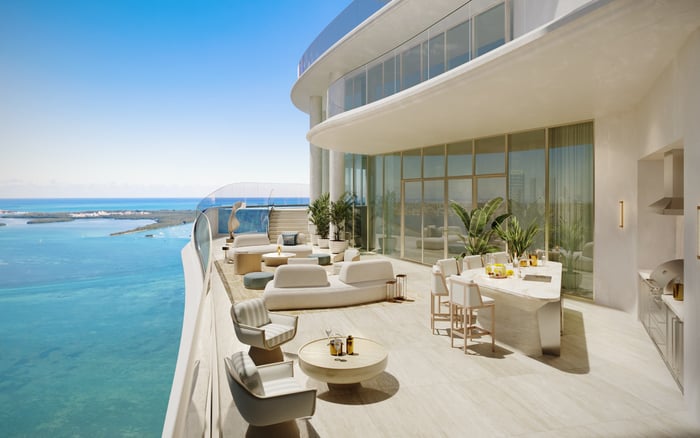
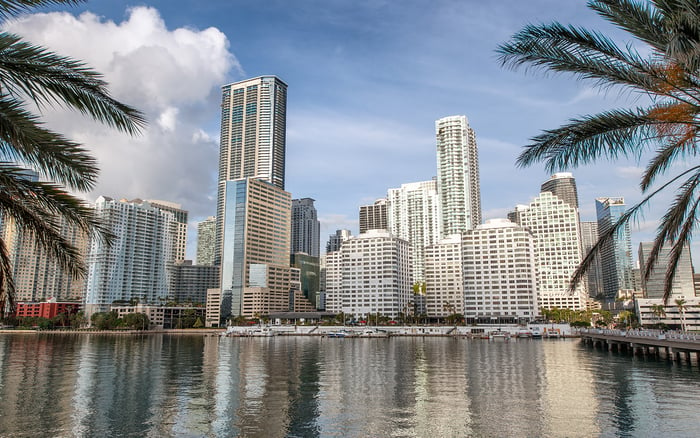
International demand has become the defining force behind South Florida’s new-construction luxury market. With foreign buyers representing a majority of recent new-construction purchases and coming from an unusually broad set of countries, pricing power and product strategy increasingly reflect global expectations. For high-net-worth buyers, understanding where this demand concentrates, why branded residences work, and how cash-heavy competition behaves can sharpen both acquisition timing and negotiation posture.
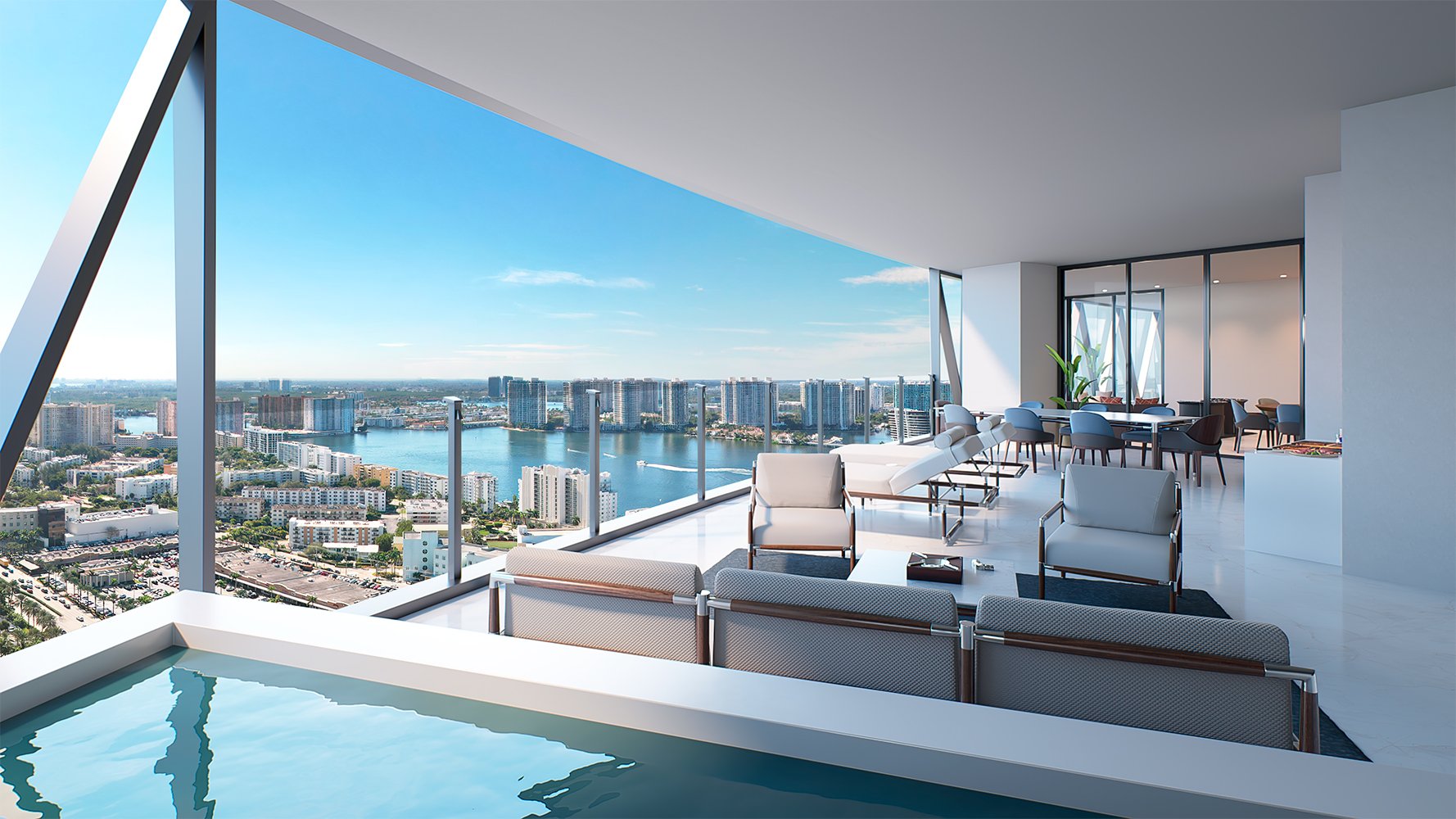
South Florida has long attracted international capital, but recent numbers sharpen the point: international buyers accounted for 52% of all new-construction, pre-construction, and condo-conversion sales across South Florida over roughly the last 22 months. In the prior period, that figure was 49%. In a mature luxury market, a few points are not noise. They can mark the difference between a meaningful segment of demand and the majority of it.
For luxury residential product, this is not a distant macro story. It affects how developers pace releases, how lenders and sales teams model absorption, and how buyers should interpret momentum. When more than half the buyer pool is global, pricing begins to reference more than one metro. South Florida starts to behave like a portfolio of international comparables: São Paulo, Mexico City, Bogotá, Madrid, Istanbul, Toronto.
The practical outcome is visible in the product itself. New luxury supply is increasingly designed to communicate instantly to someone arriving from abroad, often purchasing through a family office, a corporate entity, or as a second-home hedge. In that setting, clarity matters: predictable operations, recognizable service standards, and an ownership experience that does not require constant presence.
International participation is often treated as a headline, but its effect on decision-making is most evident in three areas that consistently matter to high-net-worth buyers.
First, it changes the velocity at which new supply can move. Coverage of the current cycle has emphasized that foreign buyers are not simply active in resale. They are a decisive force in absorbing new construction. When demand is anchored by purchasers who are comfortable underwriting lifestyle, currency exposure, and long-term optionality, the market can digest inventory that may look ambitious through a purely domestic lens.
Second, it expands diversification within the buyer base. Recent reporting cites purchases from 73 countries. That breadth is an underappreciated stabilizer. When one region slows, another can step in. It also helps explain why certain buildings feel “globally liquid” even when local sentiment shifts with headlines.
Third, it pulls standards upward. Global buyers tend to compare service, security, and programming across cities, which helps explain why branded residences and hotel-adjacent living have matured beyond marketing. In practice, a brand can function as a translation layer, aligning a buyer’s expectations with a neighborhood they may be learning for the first time.
The international buyer profile is not a single bloc, but a few patterns show up repeatedly in reporting.
Latin American buyers represent the majority of international purchasers of South Florida new-construction units, a point reinforced across multiple international reports and submarket breakouts. Within that group, Colombia and Mexico stand out as the two largest cohorts in the latest coverage, at 23% and 20% respectively by share. Argentina (11%) and Brazil (9%) follow. Additional notable presence is cited from Turkey (4%), Peru (4%), Spain (4%), Italy (3%), Canada (2%), and Ecuador (2%).
For developers and sellers, this mix informs decisions around unit configuration, finishes, and amenity priorities. For buyers, it clarifies the competitive set: often sophisticated purchasers who value discretion, turnkey operations, and resilient lifestyle access.
Just as importantly, Florida is the number one U.S. destination for international homebuyers, capturing 23% of U.S. international home purchases in the most recent summary materials. And within Florida, the Miami–Fort Lauderdale–West Palm Beach metro is repeatedly described as the state’s primary engine for international transactions. The global spotlight is not evenly distributed. It is concentrated, and South Florida sits at the center of that concentration.
International buyers in South Florida skew heavily toward cash, with local reporting emphasizing substantially higher all-cash usage among foreign purchasers than typical U.S. benchmarks.
In luxury dealmaking, that reality tends to show up in two immediate ways.
One, it compresses timelines. Cash buyers can act quickly, and in new development they often prefer to create certainty through larger deposits and cleaner terms. Even when financing enters the picture, cash establishes the psychological baseline: speed, simplicity, and fewer contingencies.
Two, it shifts negotiation leverage away from headline price and toward structure. In a cash-leaning environment, concessions are more likely to appear in deposit schedules, upgrade packages, furnishings, closing flexibility, or the ability to secure a preferred stack, view corridor, or exposure. For a buyer who is financing, the strategic goal is not necessarily to mimic cash. It is to compete with certainty.
This is also why Pre-construction remains so relevant in South Florida. It can align with global planning cycles through staged deposits and longer horizons, and it can unlock inventory that simply does not exist on the resale side, especially in highly controlled buildings.
Sunny Isles Beach has become one of the clearest laboratories for branded-residence demand, with branded projects repeatedly positioned as magnets for international purchasers. The appeal is not only the name on the door. It is what the name implies: consistent service, a familiar operating model, and a lower-friction ownership experience for buyers who may not live in the residence year-round.
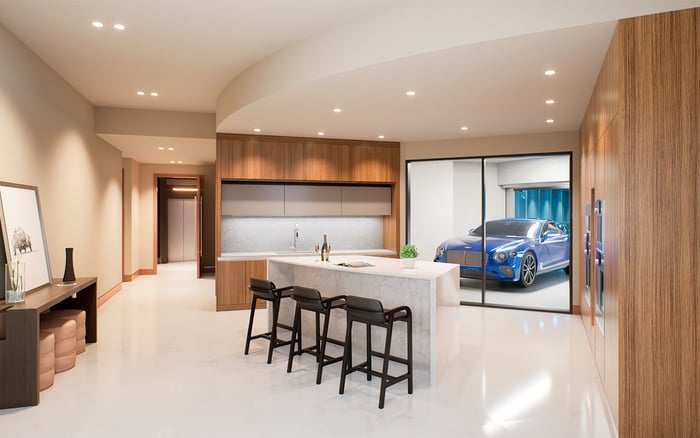
In that context, Bentley Residences Sunny Isles and St. Regis® Residences Sunny Isles reflect the direction of the market: residences that treat hospitality, arrival, and long-term upkeep as core product attributes. For international buyers, that consistency can reduce perceived risk. For domestic buyers, it can broaden resale appeal by widening the future buyer pool.
The takeaway is practical. If global demand continues to absorb a majority of new luxury supply, buildings that are most legible to international buyers often have an advantage in absorption. And in luxury, absorption frequently supports firmer pricing.
South Florida luxury is a mosaic of micro-markets, each with its own buyer logic. The connecting thread is lifestyle access paired with a clear identity, whether the buyer is seeking trophy status, lock-and-leave convenience, or privacy-forward scarcity.
Miami Beach remains one of the region’s most internationally “readable” addresses, supported by trophy transactions that telegraph depth of capital. 2025 coverage frequently cited the $120 million sale at 26 Star Island Dr, a headline that reinforces how aggressively ultra-high-net-worth buyers compete for rare waterfront assets.
On the condo side, market reporting has tracked sharp moves in Miami Beach and South Beach pricing, with recent quarterly summaries noting momentum and moderate gains even as the market works through elevated levels. In this environment, buildings that deliver privacy and service can bridge two mindsets: the ease of condo living and the control and discretion many buyers associate with an estate.
For buyers who prioritize a curated ownership experience, Casa Cipriani Miami Beach fits into a broader shift toward club-led living, where discretion and programming are central, not incidental. Meanwhile, Setai Residences Miami Beach reflects the persistent value of established hospitality DNA in a market where international buyers often purchase familiarity as much as square footage.
Make no mistake: Miami Beach is not simply a location. It is a signal to global capital that liquidity is present.
Sunny Isles Beach has long functioned as a landing zone for international second-home demand, and the current emphasis on branded product reinforces its role as a global-facing coastline. In conversation, many buyers refer to the submarket as Sunny-isles, shorthand for a waterfront lifestyle that can be simpler to operate than a single-family alternative.
For buyers, the key is to separate “oceanfront address” from “oceanfront experience.” Views matter, but so do arrival sequences, elevator privacy, staffing depth, and the building’s ability to stay pristine in shoulder seasons. In internationally driven buildings, operations are part of the asset.
Fisher Island is widely characterized as America’s wealthiest ZIP code in market coverage and broker commentary, and it occupies a distinct psychological position. It is not only exclusive; it is structurally scarce. That scarcity is why the submarket often behaves differently than the broader region, particularly at the top of the market.
For international buyers, Fisher Island can read as an enclave insulated from day-to-day volatility. For domestic buyers, it can serve as a privacy-first alternative to more visible luxury districts, with a different relationship to access, discretion, and community.
Not every international buyer is looking for a resort-forward lifestyle. Reporting has also highlighted Coral Gables and Coconut Grove as active luxury condo submarkets, with attention to pricing, time-to-contract, and other market indicators. These neighborhoods offer a different register of prestige: established institutions, a residential cadence, and an atmosphere that can feel closer to legacy East Coast markets.
For buyers weighing a primary residence, this “lived-in” quality can be the point. The value proposition is not spectacle. It is day-to-day usability, long-term neighborhood identity, and the kind of place-making that does not rely on novelty.
When a market is globally bid, price discovery becomes less local. That does not mean pricing only moves in one direction. It means the buyer pool can shift quickly based on currency dynamics, geopolitics, and cross-border capital controls. It also means specific product types can detach from broader averages, outperforming because they match what global buyers want and trust.
A useful way to interpret this is through segmentation.
For buyers, the most actionable discipline is to monitor not only listing volume, but the character of absorption. If international demand continues to represent roughly half or more of New-construction purchases, the most competitive buildings may effectively trade as if they are pre-sold long before a purely domestic buyer expects.
Timing, then, becomes less about waiting for a universal shift and more about selecting the right lane. In globally favored buildings, early positioning and contract strength can matter more than trying to “time” a headline.
In an internationalized market, advantage often goes to the most prepared buyer. The following principles tend to hold, whether you are purchasing from abroad or buying locally.
Underwrite ownership, not just the view. Service models, staffing, and long-term operating standards tend to matter more in buildings that sell to global second-home owners.
Treat contract structure as a lever. In Pre-construction, deposits, timing, and clarity on finishes can be as consequential as price, especially when competing with cash-forward buyers.
Separate “brand value” from “resale liquidity.” A brand can enhance marketability, but buyers should still evaluate the underlying location, management, and buyer depth for the submarket.
Calibrate to micro-markets. Miami-beach, Sunny-isles, and Fisher-island each reward different decision criteria, from lifestyle to privacy to scarcity.
What is driving international demand for South Florida new construction? South Florida functions as a global-facing market, and recent reporting indicates international buyers now represent a majority of new-construction, pre-construction, and condo-conversion purchases. The breadth of the buyer base, spanning dozens of countries, supports steady absorption even when individual regions fluctuate.
Which countries are most active among new-construction buyers? Recent reporting identifies Colombia and Mexico as the two largest cohorts by share, followed by Argentina and Brazil, with additional demand documented from Europe and Canada.
Why do branded residences matter so much in this cycle? For international and second-home buyers, brands can reduce perceived risk by signaling consistent service, security, and maintenance standards. In practical terms, that can make a building easier to understand, easier to own, and in many cases easier to resell.
How does cash-heavy international buying affect negotiations? It tends to prioritize speed and certainty, which often shifts negotiations toward terms and structure rather than only the headline number. In New-construction and Pre-construction transactions, that can mean competing through deposit schedules, clarity, and clean execution.
For discreet guidance on South Florida’s global luxury market, connect with MILLION Luxury.
If branded residences are on your mind — as a home or as an allocation — we would be glad to share what we are seeing, privately.
Begin a quiet conversation