A discreet buyer’s guide to evaluating safe-room claims in South Florida luxury homes through standards, engineering documents, product approvals, wind assumptions, and flood risk.
.jpg)
In South Florida’s upper tier, the phrase “safe room” is often delivered with the same confidence as a private elevator, summer kitchen, or temperature-controlled wine room. A sophisticated buyer should hear something different. A safe room is not a mood, a design flourish, or a line in a listing description. It is a life-safety claim, and life-safety claims require proof.
The first distinction is between a room that feels secure and a room designed for extreme wind events. For a luxury buyer, that distinction matters because it moves the conversation from aesthetics to performance.
That does not mean every exceptional residence needs a certified storm shelter. It means the buyer should understand exactly what is being represented. If a reinforced closet, office, library, or wine cellar is being marketed as a safe room, the question is not whether it looks convincing. The question is whether the construction documents support the claim.
A tourist asks, “Where is the safe room?” A luxury buyer asks, “May I see the sealed drawings, specifications, permit records, product documentation, and design assumptions?” That shift changes the entire tour.
The room should be evaluated as a complete protective envelope: walls, roof or ceiling, floor or foundation anchorage, door assembly, hardware, and all penetrations. If one element is undocumented, the system may be weaker than the sales language implies. Reinforced walls do not rescue an under-specified door. A heavy door does not compensate for unreviewed mechanical penetrations. A beautifully paneled interior does not prove that the structure was designed as a shelter.
The applicable building code is the baseline framework, but buyers should verify which edition and local requirements governed the original construction or any renovation. In an estate improved over time, the most important file may not be the glossy architectural set. It may be the permit record showing what was actually approved and inspected.
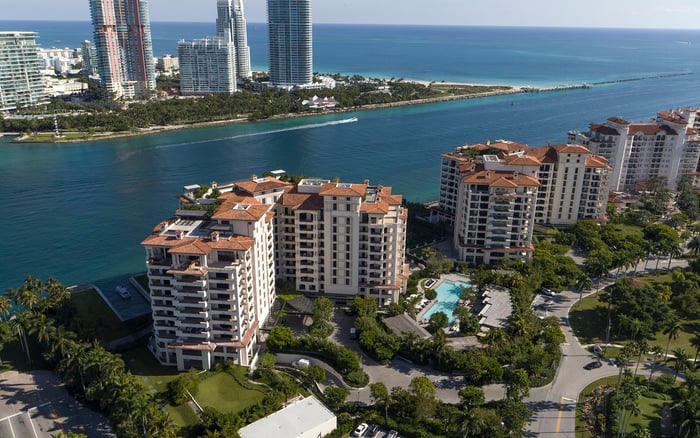
For search discipline, expectations shift across Miami Beach, Brickell, Sunny Isles, Fisher Island, oceanfront, and new-construction homes. A vertical residence, a waterfront estate, and a newly delivered tower may all use the same phrase, but the due-diligence path can be very different.
In safe-room feasibility, the door is not a detail. It is a critical assembly. The room’s performance depends on tested and properly installed openings, including the frame, anchorage, hardware, and any glazing or louvers that may be part of the design.
Luxury buyers often focus on thickness, weight, or discretion. Those qualities are secondary. The better question is whether the door assembly is part of the engineered envelope, and whether its rating, installation, and surrounding structure align. If the room was altered after completion, even a small change can matter. A new lock, concealed access panel, data conduit, or decorative finish may be harmless, but it should not be assumed harmless without review.
The same logic applies to HVAC, plumbing, electrical, communications, and security penetrations. In a trophy property, convenience systems are abundant. Fresh air, backup power, camera feeds, secure communications, humidity control, and concealed lighting may be desirable. But every penetration through the envelope is an engineering issue before it is a lifestyle upgrade.
A serious South Florida buyer separates wind protection from flood, surge, and elevation risk. A room may be designed for extreme wind and still be inappropriate if it is located where water can make occupancy unsafe. That is especially important in coastal and waterfront settings, where surge behavior, site elevation, and access routes can determine whether sheltering in place is reasonable.
Flood hazard mapping should be reviewed for the specific address, not the neighborhood in general. Elevation Certificates are also central due-diligence documents because they show elevation information used for floodplain management and insurance rating. A buyer should know the elevation of the structure, the elevation of the proposed safe-room floor, and how that compares with the property’s mapped hazard context.
Coastal buyers should also ask whether the property is affected by coastal construction control requirements. Construction seaward of established coastal lines carries its own regulatory framework, which can influence what was permitted, what can be modified, and how future improvements should be evaluated.
The polished answer “It is built for Category 5” is not enough. Wind-speed assumptions should be site-specific and reviewed by a qualified professional. The better file identifies the design inputs rather than relying on storm-category shorthand. Categories describe storms in a broad public-safety context; engineering requires more precise assumptions.
In South Florida’s High Velocity Hurricane Zone context, exterior doors, windows, shutters, roofing assemblies, and related envelope products deserve their own review. A buyer should verify whether products have appropriate state or county approvals instead of relying on brochure claims or showroom confidence.
This is particularly relevant when a safe-room discussion is part of a larger resilience story. Impact glass, shutter systems, garage doors, roof assemblies, and exterior openings all influence how the home performs under wind pressure and debris exposure. For a buyer, the mandate is simple: ask for the approval numbers and installation details.
Product approval is not only about whether an item was tested. It is about whether the installed condition matches the approved condition. Size, anchorage, substrate, pressure rating, and location can all matter. A window appropriate in one opening may not automatically be appropriate in another. A door approved under one installation method may not be equivalent when installed differently.
The most refined safe-room tour is calm, brief, and document-led. Ask where the room is, what hazards it was designed to address, who designed it, what standard or guidance informed it, and what records prove the answer. Then pause. The quality of the response often reveals more than the room itself.
A credible owner or representative should be able to produce the relevant plans and product records, or at least explain where they are held. If the answer is purely verbal, treat the claim as unverified. If the room is positioned as a dual-use space, such as a closet, office, library, or wine room, confirm that the luxury function did not compromise the protective function.
The best buyer-grade question is not “Does the house have a safe room?” It is: “Can the owner produce the plans, approvals, product documentation, and hazard assumptions proving what this room is designed to withstand?” In South Florida, that question is not alarmist. It is simply the standard of care for a serious acquisition.
Is a panic room the same as a hurricane safe room? No. A panic room may focus on security, while a hurricane safe room must be evaluated for extreme-wind performance and documented design criteria.
What should I ask for first when a listing mentions a safe room? Ask for sealed drawings, specifications, permit records, product approvals, and the design assumptions behind the room.
Is a reinforced closet enough to qualify as a safe room? Not by itself. The walls, ceiling, foundation anchorage, door, and penetrations must work together as a documented protective envelope.
Why is the door so important? The door is a vulnerable opening, so its tested assembly, frame, anchorage, hardware, and installation must align with the room’s intended performance.
Can a wine cellar or office double as a safe room? It can only be represented that way if the structural and product documentation supports the safe-room claim.
Should I trust the phrase Category 5 safe room? Treat it as marketing until a qualified professional verifies site-specific wind assumptions and the documents behind them.
Does flood risk matter if the room is wind-rated? Yes. Wind protection and flood safety are separate issues, and a wind-safe space may still be unsafe in a flood-prone location.
What flood documents should a buyer review? Review address-specific flood hazard information and the Elevation Certificate, then compare those findings with the room’s location.
Do product approvals apply only to the safe-room door? No. Exterior windows, doors, shutters, roofing assemblies, and other envelope products should be checked where relevant.
Who should review safe-room feasibility before closing? Use qualified building, engineering, and flood-risk professionals who can read the plans, approvals, and site conditions together.
For a discreet conversation and a curated building-by-building shortlist, connect with MILLION.
If branded residences are on your mind — as a home or as an allocation — we would be glad to share what we are seeing, privately.
Begin a quiet conversation