A practical, design-minded guide to assessing executive offices in South Florida penthouses, from privacy and acoustics to light, technology, terrace adjacency, and long-term resale flexibility.
In a South Florida penthouse, the executive office is no longer a decorative afterthought with a handsome desk and a view. For principals who move between boardrooms, private aviation, global calls, philanthropic work, family governance, and concentrated creative thinking, the office has become one of the residence’s most revealing rooms. It shows whether the home can support real life at the highest level, not simply weekend hospitality.
The best penthouse offices feel composed before they feel impressive. They allow a buyer to move from breakfast to a confidential call without crossing the social heart of the home. They frame water, skyline, or garden outlooks without turning the workday into a glare problem. They provide enough separation to protect attention, but not so much isolation that the room feels exiled from the residence.
In South Florida, this balance is especially important because the same home may be used for work, entertaining, family visits, seasonal stays, and quiet retreat. Whether the residence is in Brickell, an oceanfront setting, Miami Beach, Sunny Isles, or a more discreet enclave, the office should be judged as a working instrument, not a lifestyle prop.
A floor plan can make an office look persuasive long before it proves useful. Begin by mapping the owner’s actual workday. Does the office need to support long video calls, document review, private advisory meetings, design work, trading screens, or simply two hours of uninterrupted focus each morning? Each answer changes the evaluation.
A true executive office should accommodate the principal’s primary work posture without compromise. A compact writing room may be elegant, but it will not function for someone who needs multiple screens, secure storage, and space for an assistant to step in discreetly. Conversely, a large office that reads like a conference room may be too formal for a buyer seeking calm, privacy, and personal rhythm.
Look carefully at wall lengths, door swings, ceiling height, and window placement. Built-ins can be beautiful, but they should not limit future desk orientation or force the user to face away from the room’s most stabilizing view. The strongest offices usually offer at least two credible furniture plans, allowing the space to evolve as ownership needs change.
Privacy is the foundation of an executive office. A buyer should understand what can be seen and heard from the office, and what the office can hear in return. If the room opens directly into a great room, media lounge, or primary entertaining corridor, it may look convenient but perform poorly during dinner preparation, guest arrivals, or family activity.
Evaluate the path from the private elevator, main entry, service areas, bedrooms, and terraces. An office near the entry can be ideal for brief meetings, but only if it can be closed down acoustically and visually. An office near the primary suite may offer quiet, but it can blur personal and professional boundaries if visitors must pass through intimate areas of the home.
Door quality matters. So do thresholds, seals, adjacent mechanical spaces, and the hardness of surrounding finishes. Stone, glass, and high ceilings can create a magnificent room, but they can also amplify sound. For a serious user, acoustic treatments should feel integrated into the design language rather than added after the fact.
South Florida light is seductive, but an executive office must make it manageable. A spectacular exposure can become a liability if it creates screen glare, overheats the room, or forces shades to remain closed through the most productive hours of the day. The question is not whether the view is beautiful. The question is whether the view can be enjoyed while work continues comfortably.
Visit, when possible, at the time of day the office will be used most. Notice how light hits the desk plane, the camera position for calls, bookshelves, art walls, and seating. A room designed only for sunset drama may not serve a principal who works early mornings. Likewise, a bright coastal view may require a careful shading strategy to preserve both comfort and discretion.
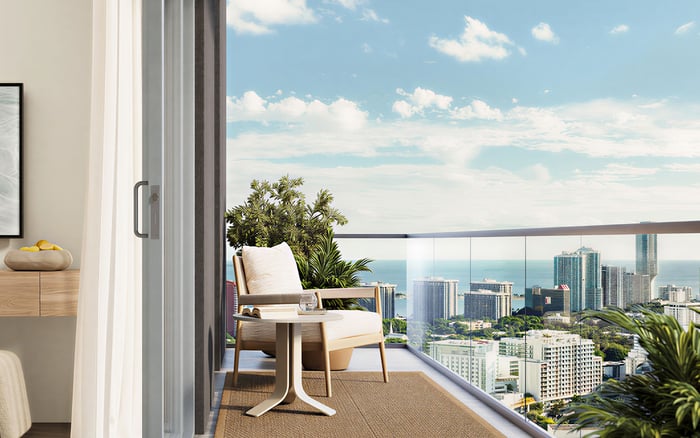
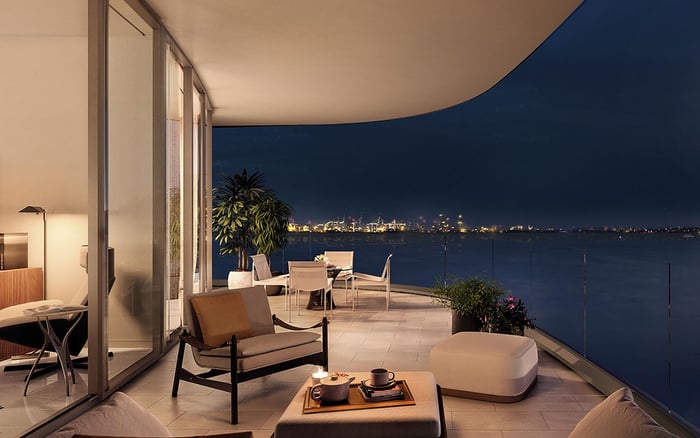
A terrace beside the office can be a meaningful advantage when it is properly handled. It offers a place to step outside between calls, take a private conversation, or reset without leaving the residence. Still, the terrace should complement the office rather than replace its interior performance. Outdoor adjacency is most valuable when doors, shading, flooring transitions, and privacy have been carefully resolved.
A polished office can fail quietly if its infrastructure is weak. Buyers should look beyond the visible desk and ask how power, data, lighting, climate control, and audiovisual needs will be handled. The most refined rooms conceal complexity while making daily use effortless.
Consider where equipment will live. Routers, printers, charging drawers, document storage, shredding, monitors, microphones, and lighting controls should not clutter the room. If the office is intended for frequent video calls, evaluate the camera background, front lighting, side lighting, echo, and the ability to close shades without darkening the entire space.
Climate is equally important. A room with extensive glass, strong exposure, or concentrated equipment may need careful temperature control. If the office shares conditioning with a larger entertaining space, the user may have less comfort precision than expected. An executive office should feel composed at the start of a call and remain composed two hours later.
Different South Florida settings place different demands on an executive office. In Brickell, buyers may prioritize skyline orientation, a meeting-ready arrival sequence, and separation from the social core of the residence. In an oceanfront penthouse, glare management, privacy from neighboring towers, and the relationship between the desk and horizon become central. In Miami Beach or Sunny Isles, the office may need to reconcile resort-like views with the discipline of a true work environment.
The strongest comparison is not simply room size. It is performance. Does the office support confidential work when guests are present? Can it handle a formal call without visual noise behind the principal? Does the view calm the room or dominate it? Is there enough storage to avoid turning the desk into a staging area? Can the space become a library, den, or secondary lounge later without feeling over-customized?
For buyers considering multiple residences, create a consistent evaluation matrix. Score each office on privacy, light control, acoustic potential, technology readiness, furniture flexibility, proximity to bedroom areas, proximity to service areas, and the quality of the view when seated. A smaller room with excellent discipline may outperform a larger room with poor circulation and uncontrolled light.
An executive office should project authority without becoming overly specific. Heavy millwork, unusual desk platforms, fixed conference tables, or highly personalized display walls can reduce the room’s adaptability. Better choices tend to be architectural rather than theatrical: balanced proportions, refined cabinetry, concealed storage, appropriate lighting layers, and surfaces that age well.
Think also about the next use. Even if the current owner needs a high-functioning office, a future buyer may imagine a library, media room, wellness lounge, or private sitting room. The most valuable office performs today and remains legible tomorrow. It has enough infrastructure to serve serious work, but enough restraint to invite another interpretation.
Art placement is another subtle indicator. A room that offers clean walls for important works, controlled light, and comfortable viewing distances often feels more complete. The office should not depend solely on the view for its identity. When the blinds are lowered and the laptop is open, the room still needs presence.
Before committing to a penthouse, walk the office slowly and test it as if the day has already begun. Sit where the desk would be. Look toward the camera background. Close the door and listen. Open the shades, then close them. Imagine a private guest arriving for a short meeting. Imagine a family dinner beginning nearby. Imagine the room at night, when reflections in the glass may change the feeling completely.
Ask whether the office can carry three roles: command, retreat, and future flexibility. Command means it supports meaningful work. Retreat means it restores focus rather than consuming it. Flexibility means the room can adapt to the next season of ownership without costly reinvention.
For a luxury buyer, the right executive office is not necessarily the grandest room. It is the room that protects time, attention, and privacy with the least friction. In South Florida’s most desirable penthouses, that quiet competence can be one of the clearest signs of a residence designed for serious living.
What is the first thing to evaluate in a penthouse executive office? Start with how the room will be used each day. Function should lead the assessment before finishes or views.
Is a large office always better in a penthouse? Not necessarily. A smaller room with privacy, good proportions, and controlled light can outperform a larger but noisy space.
How important is the view from the desk? The view matters, but it should support concentration rather than create glare or distraction. Test the view from a seated position.
Should an executive office be near the primary suite? It can be convenient, but visitor access and personal privacy must be considered. The best location depends on how meetings are handled.
What makes an office suitable for video calls? Look for quiet, flattering light, a composed background, and enough control over shades and acoustics. Technology should be discreetly integrated.
Does terrace access add value to an office? Terrace access can be valuable when privacy, shading, and door placement are well resolved. It should enhance the office, not compensate for weaknesses.
How should buyers compare offices across different penthouses? Use the same criteria for each property: privacy, light, sound, technology, storage, flexibility, and circulation. Consistency makes tradeoffs clearer.
Can an over-customized office hurt resale appeal? Yes, if the design is too personal or difficult to adapt. Flexible architecture usually has broader long-term appeal.
What storage should an executive office include? Plan for documents, devices, charging, printers, and personal items without visible clutter. Concealed storage keeps the room calm.
What is the best way to shortlist comparable options for touring? Start with location fit, delivery status, and daily lifestyle priorities, then compare stacks and elevations to validate views and privacy.
If you'd like a private walkthrough and a curated shortlist, connect with MILLION.
If branded residences are on your mind — as a home or as an allocation — we would be glad to share what we are seeing, privately.
Begin a quiet conversation