A discreet buyer’s guide to evaluating privacy, sightlines, neighboring towers, balcony exposure, and future development risk before purchasing along South Flagler in West Palm Beach.
On South Flagler, the most compelling residences often begin with light, water, and a sense of elevation above the daily rhythm of West Palm Beach. Yet for the buyer considering a luxury condominium, privacy is not an abstract lifestyle preference. It is a measurable component of value, comfort, and long-term confidence.
The central question is simple: what will you actually see, and who may be able to see you? A residence can have an elegant floor plan, a generous balcony, and a beautiful waterfront address, yet still feel exposed if a neighboring tower aligns directly with primary living spaces, bedrooms, baths, or terraces. The inverse is also true. A unit that appears less dramatic on paper may live more privately because its sightlines are oblique, its outdoor space is shielded, or its principal rooms face a more open corridor.
This is why privacy analysis belongs beside pricing, finishes, amenities, and carrying costs. For MILLION Buyer's Guides readers evaluating South Flagler, the goal is not simply to find the highest floor or the broadest view. The goal is to understand the geometry of everyday life before the contract becomes emotional.
Marketing imagery is designed to communicate aspiration. A buyer’s privacy review should be more forensic. Start by separating the view into three layers: the immediate foreground, the middle distance, and the long horizon. Privacy is usually won or lost in the foreground and middle distance, where nearby structures, future parcels, and angled balconies can shape daily living.
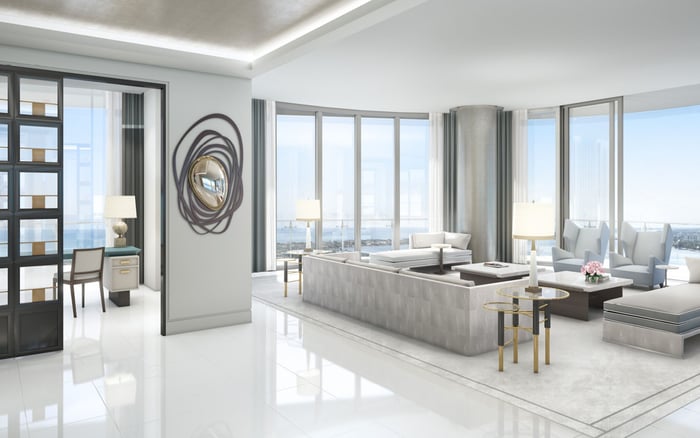
When comparing residences such as South Flagler House West Palm Beach or Maison D'Or South Flagler, ask how the residence addresses neighboring massing. Does the main living room face directly toward another tower, or does it look past it? Are bedroom windows aligned with another building’s balconies? Does the terrace feel like an outdoor room, or like a stage visible from multiple elevations?
A useful test is to imagine the residence at three moments of the day. Morning routines, evening entertaining, and late-night lighting each create different privacy conditions. Glass that feels discreet in daylight can become more transparent after sunset when interior lighting is bright. Window treatments help, but they should not be the only privacy strategy in a home marketed for exceptional living.
Privacy is often embedded in the floor plan. A residence with corner exposure may offer broader outlooks, but it can also introduce more angles from which neighboring buildings can observe the interior. A deep terrace may create a buffer, while a shallow projecting balcony may leave the living room more visible. Primary suites placed at the edge of a tower can be spectacular, but buyers should confirm whether the bedroom glass faces open sky, another facade, or an active amenity deck.
Look carefully at the hierarchy of rooms. Formal living and dining areas can tolerate a degree of urban theater. Primary bedrooms, baths, dressing areas, and family spaces usually require more discretion. If the most private rooms are also the most exposed, the residence may require constant use of shades, changing how the home lives.
This is especially important when considering high floors. Elevation can reduce street-level exposure and improve long views, but it does not automatically solve tower-to-tower privacy. If another building rises within a similar field of view, a higher floor may simply shift the sightline rather than eliminate it. The better question is not, “How high is it?” It is, “What is opposite it, now and later?”
South Flagler buyers should treat the surrounding blocks as part of the residence. Existing towers are only the first layer of analysis. Adjacent and nearby parcels should be viewed with a careful eye toward what could reasonably change. A low-rise structure, parking area, or underused site may preserve openness today, but it should not be assumed to remain unchanged.
This is not a reason to avoid new construction. It is a reason to ask sharper questions. If a residence depends on a particular open angle, buyers should understand whether that angle is structurally protected by water, street width, civic space, or building placement, or whether it is simply open because nothing taller has been built there yet.
Projects such as Forté on Flagler West Palm Beach and Shorecrest Flagler Drive West Palm Beach underscore why buyers in this corridor increasingly compare not only interiors, but also orientation, setbacks, and neighboring relationships. The most private home may not be the one with the most cinematic first impression. It may be the one whose exposure remains composed as the district evolves.
A serious privacy review should be documented. Request stack plans, unit plans, terrace diagrams, and any available renderings that show neighboring structures in context. If a sales presentation emphasizes a view, ask from which line of sight that view is represented. A living room vantage point may differ from the primary bedroom, breakfast area, or terrace corner.
For resale condominiums, visit at different times if possible. Stand where life actually happens: beside the bed, at the kitchen island, near the bath window, and at the deepest part of the terrace. Look outward, then look back inward from the terrace if access allows. The privacy question is reciprocal. If you can easily see into a neighboring home, a neighboring resident may be able to see into yours.
For pre-construction, focus on orientation and assumptions. Ask what neighboring towers are shown in the visual materials, what is excluded, and whether any future context is illustrated. The objective is not confrontation. It is clarity. A buyer should know which parts of the privacy story are fixed by architecture and which depend on conditions beyond the building.
Absolute seclusion is rarely the point of South Flagler living. Buyers are drawn to the waterfront setting, refined services, cultural access, and the ability to live within a polished urban environment while remaining close to Palm Beach. The art is balancing openness with discretion.
A home that is too enclosed may sacrifice the very qualities that make the corridor desirable. A home that is too exposed may feel performative. The sweet spot is a residence that offers water, sky, and city presence while preserving intimate zones for daily life.
For some buyers, that may mean a residence with fewer direct-facing glass walls. For others, it may mean a terrace that looks past adjacent buildings rather than into them. In a building such as The Ritz-Carlton Residences® West Palm Beach, as with any luxury address, the most valuable comparison is often between stacks, not just between buildings.
Before committing, reduce the decision to a few disciplined questions. Which rooms are exposed? Which rooms feel protected? What buildings are visible today? What nearby sites could change the experience? Are the most important views direct, angled, or partially dependent on another parcel remaining as it is?
Then consider how you actually live. If you entertain often, a visible terrace may be acceptable. If you prize quiet mornings, reading in the bedroom, or spa-like bathing rituals, privacy in the primary suite may matter more than a dramatic entertaining view. If the home will be used as a seasonal residence, ease of lock-and-leave living may make automated shades and thoughtful glass placement especially important.
The strongest South Flagler purchase is not merely the one that photographs beautifully. It is the one that remains elegant when the shades are open, the lights are on, and the neighborhood continues to mature around it.
What is the first privacy question a South Flagler buyer should ask? Ask which rooms face neighboring towers directly and which enjoy angled or open sightlines.
Are higher floors always more private? Not always. High floors can help, but tower alignment and nearby building heights may matter more.
How should I evaluate balcony privacy? Stand where seating and dining would actually occur, then check whether adjacent towers overlook that area.
Does waterfront exposure guarantee privacy? Waterfront exposure can improve openness, but side angles and nearby towers can still affect privacy.
What matters most in a floor plan? Pay close attention to bedrooms, baths, dressing areas, and family spaces, since those rooms need the most discretion.
Should I visit a resale residence more than once? Yes. Daylight, dusk, and evening interior lighting can create very different privacy conditions.
How can pre-construction buyers assess privacy? Review stack plans, terrace orientation, contextual renderings, and assumptions about neighboring parcels.
Can window treatments solve privacy concerns? They can help, but a luxury residence should not depend entirely on closed shades to feel comfortable.
Is a corner residence always better for privacy? A corner can offer broader views, but it may also create more sightlines into the home.
When should privacy concerns affect price negotiations? If exposure limits how key rooms or outdoor spaces can be used, it should be part of the value discussion.
When you're ready to tour or underwrite the options, connect with MILLION.
If branded residences are on your mind — as a home or as an allocation — we would be glad to share what we are seeing, privately.
Begin a quiet conversation