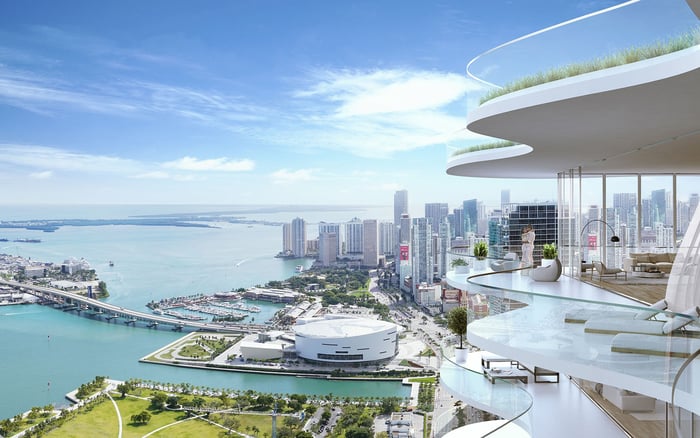
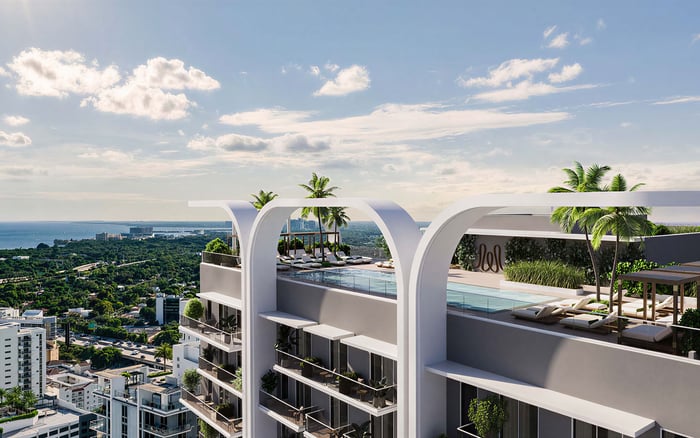
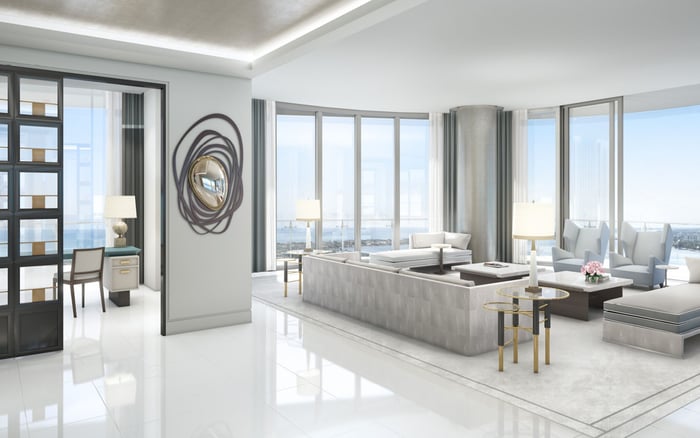
In South Florida’s luxury condo market, floor level is less a status signal than a lifestyle choice. This MILLION Luxury guide breaks down the real tradeoffs between high-floors, low-floors, and the often-overlooked middle floor sweet spot.
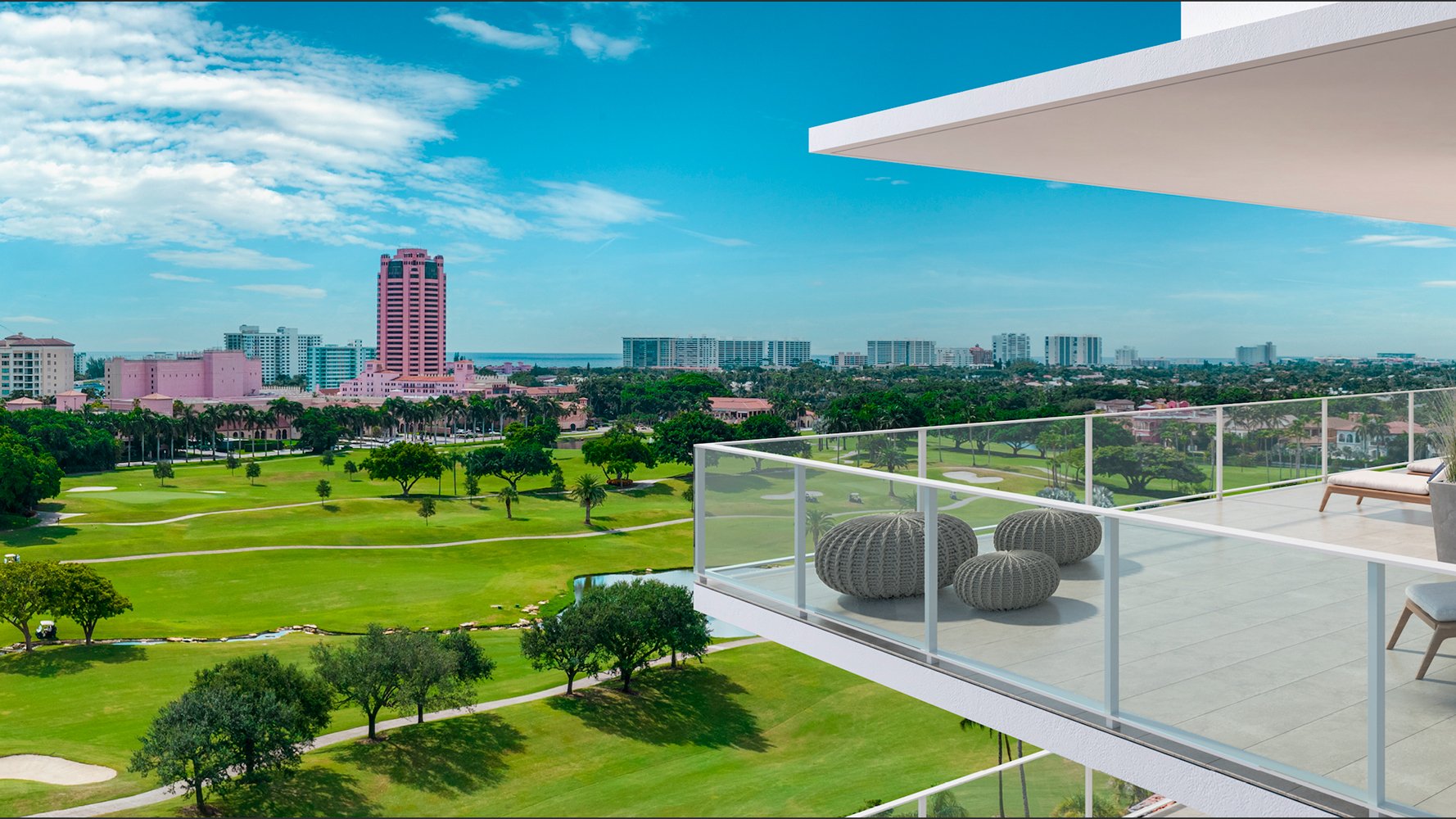
In South Florida’s ultra-premium condo market, floor level is one of the few selections that meaningfully shapes your routine every day, long after finishes and furnishings fade into the background. High floors can offer expansive sightlines, a stronger sense of separation from the street, and often better daylight. Low floors can feel immediate and efficient, especially for residents moving constantly between home, beach, car, dog walk, and dinner reservations.
Buyers usually start with the view. Seasoned owners often end up ranking different priorities: elevator reliance, nighttime privacy, how frequently they run errands, how pets fit into the rhythm of the day, and whether a balcony should feel decisively “above it all” or simply open and connected to the outdoors.
This is not a universal rulebook. Two towers on the same block can live differently based on elevator design, nearby construction, and the way surrounding buildings cast shade. Still, the core tradeoffs are consistent enough to guide a smart first decision.
The clearest advantage of higher floors is visual access: more horizon, more sky, fewer near-field obstructions. In dense Miami and Miami Beach neighborhoods, upper levels are also less likely to sit in the shadow of adjacent towers or mature trees, which can translate into steadier natural light.
Daylight is not only aesthetic. Broadly, daylight exposure in buildings is associated with comfort and well-being, which is why buyers who spend significant time at home often evaluate height, orientation, and window exposure as a single package.
In oceanfront living, height also changes the emotional character of the shoreline. Lower floors can feel immersive and close, with palms, dunes, and movement in the foreground. Higher floors tend to deliver a calmer, more cinematic panorama. Neither is better. They are simply different experiences. In Miami Beach, residences such as Setai Residences Miami Beach are often weighed through this exact lens: do you want to watch the coastline as a tableau, or live nearer to the resort edge and its energy.
Many buyers assume higher always means quieter. Height can help, but it is rarely a complete solution in a neighborhood that is inherently active. A peer-reviewed acoustic study in a multi-story residential building found the difference in daytime maximum noise exposure between low and high floors was modest, and it suggested that time-of-day effects can outweigh floor-level effects. In plain terms: a higher floor may soften street presence, but it will not necessarily erase neighborhood sound.
Privacy is where height often feels more decisive. Higher floors reduce street-level sightlines and the sense of being observed. On lower floors, direct views from sidewalks, pool decks, or neighboring terraces can change behavior: blinds stay closed more often, and the indoor-outdoor lifestyle feels less effortless.
A practical luxury lens is simple. If you love leaving glass uncurtained with soft lighting at night, higher floors can make that feel natural. If you prefer the intimacy of landscaping and the ease of stepping out, a lower level can still be exceptional, but you should evaluate real sightlines carefully.
High-floor living trades a dramatic arrival for greater dependence on elevators. That reliance becomes real during peak departures, maintenance periods, or any moment you simply want to move quickly.
Lower floors typically win on daily logistics: groceries, quick coffee, commuting, and the frequent short trips that define an active South Florida lifestyle. Many residents also value being able to take stairs for some trips, reducing elevator waits entirely.
The key question is not whether you dislike elevators. It is whether your household’s rhythm is defined by long, planned departures or constant small movements. Someone who leaves once in the morning and returns once at night experiences height differently than a household bouncing between gym, office, beach, school pickups, and errands.
In buildings where the amenity deck is a true social stage, floor placement also shapes spontaneity. If you want to slip down for a swim or meet a friend without turning it into a full ritual, low and mid-level floors can feel materially freer.
Luxury buyers rarely want to dwell on worst-case scenarios, but sophisticated ownership includes preparedness. Fire-safety guidance in the United States emphasizes that elevators should not be used during a fire and that occupants should use stairs instead. Municipal high-rise guidance similarly underscores evacuation routes and stairway use.
That reality makes floor level more consequential in emergencies: higher floors can mean longer egress times and more stairs between you and the street. For some buyers, this supports a mid-level preference. For others, it becomes a due diligence checklist: confirm stairwell access, clear signage, and how the building communicates procedures.
If you are drawn to a private, club-like model where staff presence and controlled access are central, a property such as Casa Cipriani Miami Beach may be evaluated not only for service, but for how calmly and competently the building feels organized, including the back-of-house systems that support safety and daily operations.
Top floors can run warmer due to roof exposure and the general tendency for heat to rise, which may increase cooling demand compared with more buffered units. Middle floors are often described as more thermally stable because they are insulated by conditioned residences above and below.
Air quality and ventilation in high-rises is also a building-design issue, not a simple “higher is fresher” equation. Ventilation strategies must manage airflow, pollutants, and pressure differences across a tall structure. For buyers with sensitivity to air quality, the practical move is to evaluate the building’s systems, filtration approach, and resident experience, rather than rely on floor number alone.
This is one reason experienced owners sometimes prefer mid-level floors even when they can afford higher. They still capture a sense of elevation and light, while reducing elevator friction and potentially avoiding the thermal extremes that can show up at the very top.
Across many markets, pricing often rises with floor level when views materially improve. Developers and sellers may price a “floor rise” premium explicitly or embed it within comparable sales.
For luxury buyers, the question is not whether a higher floor costs more. It is whether the premium purchases something durable: a protected sightline, meaningful light, a greater feeling of privacy, or scarcity within a low-inventory tier.
Resale logic also depends on the buyer pool. In a destination-driven segment, trophy views can be a primary draw. In a more practical owner-occupier segment, convenience and thermal stability can win. A property like The Ritz-Carlton Residences® Miami Beach often attracts buyers who weigh daily ease of service and arrival alongside height, making the “best floor” conversation more nuanced than a race upward.
A precise decision comes from walking the building like an operator, not like a tourist.
First, time your elevator experience. Visit during the hours you actually live: morning departures, late afternoon returns, weekend peak amenity use. Note how many elevators serve your stack and how quickly they arrive.
Second, test real privacy. Stand on the balcony at night with interior lights on and evaluate visibility from neighboring buildings, the pool deck, and the street.
Third, map your daily path. If your routine includes frequent beach access, dog walks, or quick errands, lower floors can feel like a lifestyle upgrade. In oceanfront settings such as 57 Ocean Miami Beach, this can be especially relevant because the street-to-sand transition is part of the appeal.
Fourth, listen for the neighborhood’s baseline sound. Because height differences can be modest relative to time-of-day patterns, confirm whether the area is calm at the hours you care about.
Finally, consider your time horizon. If you plan to hold long term, the most luxurious choice is the one that keeps your days frictionless. If you plan to trade, think about what future buyers consistently pay for: protected views, privacy, and effortless access.
In South Florida, there is no universal best floor. High floors often deliver stronger privacy and light, and they can make a Miami Beach residence feel like a retreat hovering above the city’s pace. Low floors often deliver repeatable convenience, and for some owners that convenience is the highest luxury.
A single guiding principle holds: buy the floor that supports how you truly live, not how you imagine you will live on closing day.
Are high floors always quieter than low floors? Often somewhat, but the difference can be modest, and neighborhood noise patterns can matter more than height.
Do low floors have less privacy? They can, especially where pedestrians, pool decks, or neighboring terraces have direct sightlines into windows.
Which floor is best for natural light? Higher floors often receive more daylight because they are less likely to be shaded by nearby buildings.
Is the top floor the most comfortable? Not always. Top floors can run warmer due to roof exposure, while middle floors may feel more thermally stable.
How should I think about elevator dependence? The higher you live, the more your routine is shaped by elevator wait times and maintenance periods.
Are stairs a realistic alternative on lower levels? Many residents find stairs practical for short trips on lower floors, which can meaningfully reduce daily friction.
What about safety during a fire in a high-rise? Fire-safety guidance advises using stairs instead of elevators, so higher floors can mean more stair travel during emergencies.
Is “floor rise” pricing always justified? It is most justified when height delivers durable benefits like protected views, stronger light, or a clear privacy advantage.
Which floor works best for pets? Households that take frequent walks often prefer lower or mid-level floors for faster trips outside.
What is the safest way to choose between floors? Visit at multiple times of day, test sightlines and sound, and prioritize the floor that matches your real routine. Explore South Florida residences with MILLION Luxury.
If branded residences are on your mind — as a home or as an allocation — we would be glad to share what we are seeing, privately.
Begin a quiet conversation