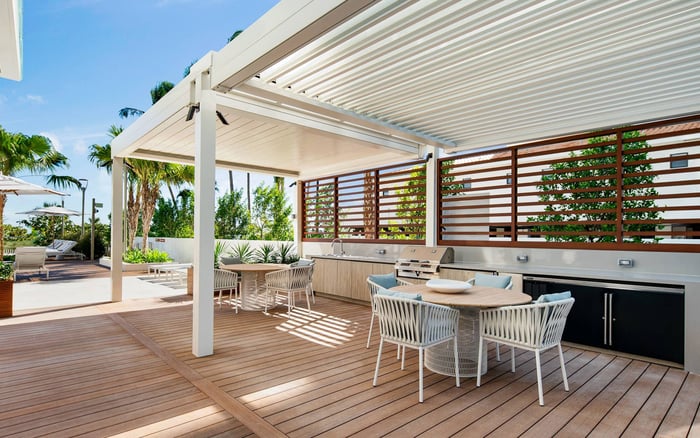
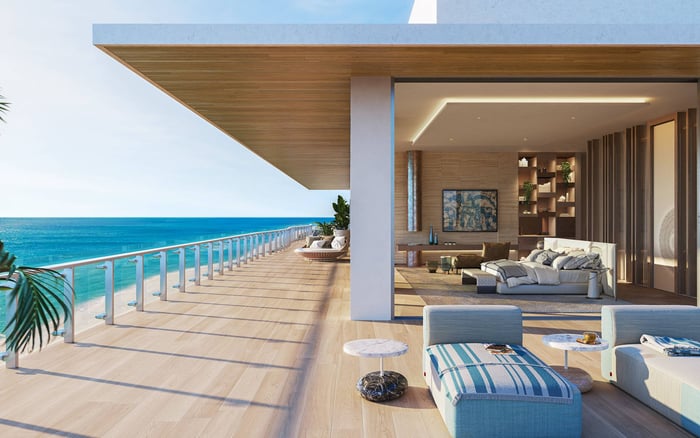
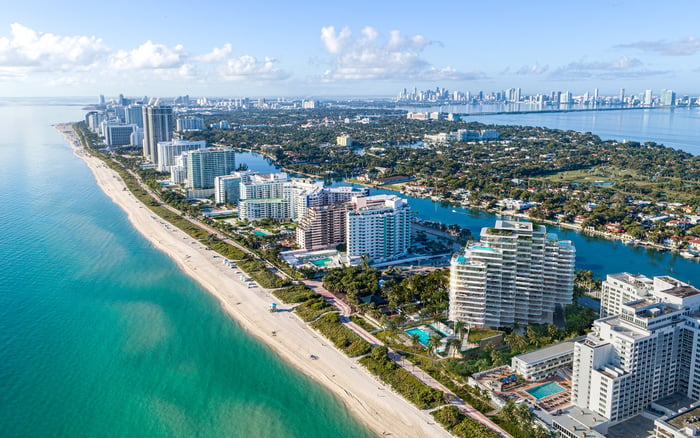
For serious waterfront buyers, a balcony is not a checkbox amenity. It is an outdoor room that must perform, especially on the Atlantic edge where wind, salt, and afternoon squalls can turn “al fresco” into “unused.” This MILLION Luxury guide compares how balcony depth and wind conditions shape day to day dining comfort, using 57 Ocean Miami Beach and Ocean House Surfside as two highly sought-after reference points, while outlining what to verify on any oceanfront purchase.
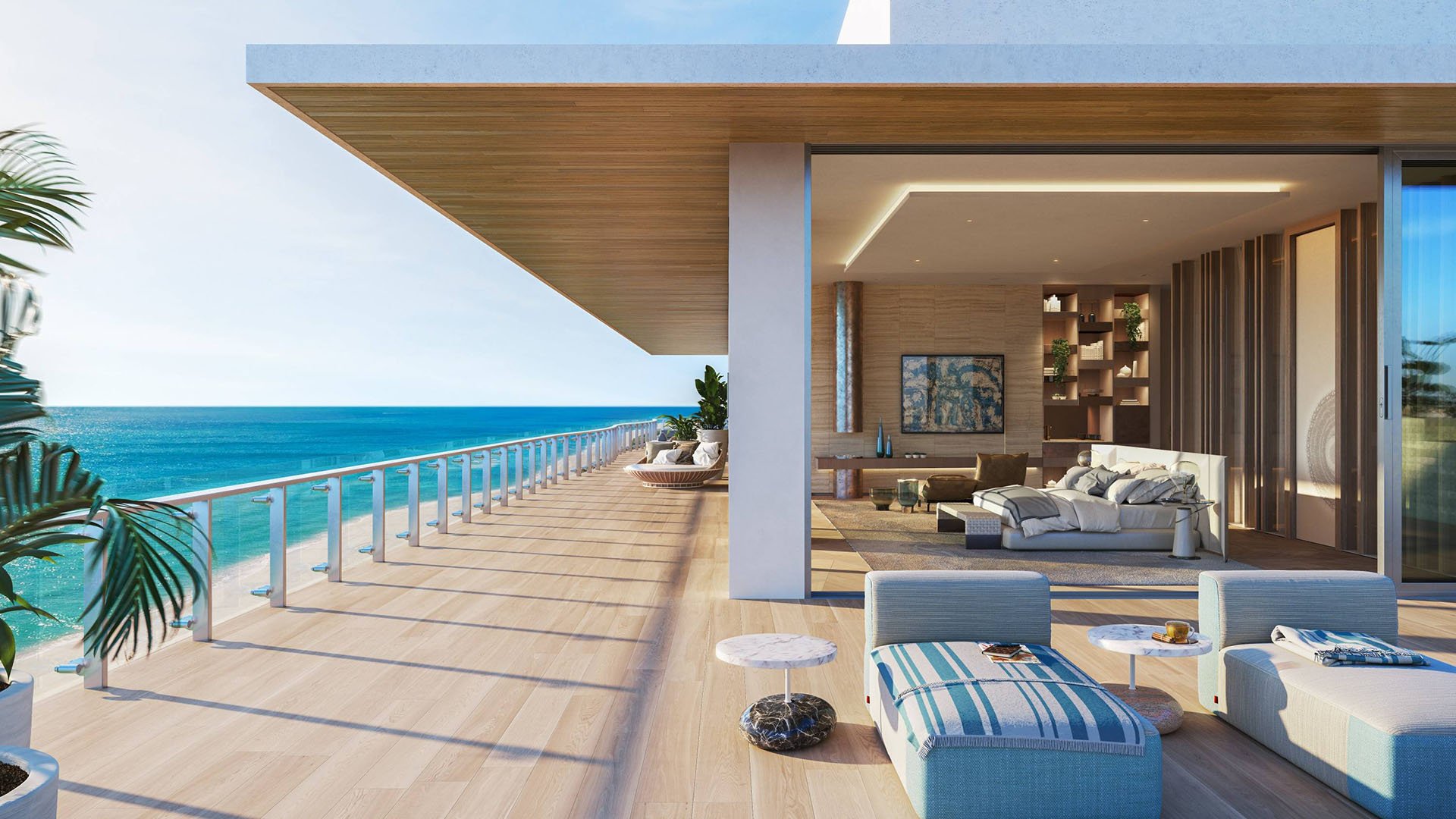
In South Florida luxury real estate, “balcony” can describe everything from a narrow viewing ledge to a true outdoor living room. For buyers who plan to dine outside routinely, depth matters more than total square footage because depth dictates real-world function: whether a table can pull out without pinning a chair, whether circulation stays comfortable, and whether a server path exists without forcing everyone to stand.
A useful way to evaluate depth is to picture three working zones. First is the rail buffer-a safety-and-comfort strip that keeps furniture from feeling pressed to the edge. Second is the dining zone, where chairs need enough clearance to sit and stand naturally. Third is the circulation zone, which allows movement to sliders, grills where permitted, or seating without disrupting the table.
When depth falls short, even a large balcony can underperform as a dining terrace because it’s wide but shallow. Conversely, a moderately sized terrace can feel generous when it has enough depth to establish that layered sequence: rail, furniture, movement.
This is the lens MILLION Luxury recommends when comparing **ocean**front options such as 57 Ocean Miami Beach and Ocean House Surfside. Brand names, amenity decks, and interior finishes matter-but in day-to-day living, the terrace is often where “luxury” either shows up clearly or quietly disappears.
Wind mitigation is not a single feature. It’s a coordinated set of conditions-exposure, geometry, and materials working together. Oceanfront wind tends to be directional and variable: calmer mornings, stronger trade-wind afternoons, and sudden gusts associated with storms. Dining comfort can shift dramatically depending on where a balcony sits on the building and how the facade shapes airflow.
What typically improves wind comfort for al fresco dining:
Architectural shielding: side returns, partial walls, or adjacent masses that interrupt a direct wind line.
Recessed terraces: a balcony set back into the building often behaves better than a protruding slab.
Ceiling or overhang effects: a well-proportioned overhead plane can reduce the sense of exposure.
Railing design: solid or semi-solid rails can reduce low-level wind across the table; fully open rails preserve view but can allow more flow at seated height.
Corner dynamics: corners can be spectacular for views, but they can also intensify gusting due to pressure differentials.
What rarely solves it by itself:
Because the Research Pack and Fact Table do not provide project-specific engineering details here, the most buyer-oriented approach is to treat wind performance as something to confirm in person and through building documentation. In other words: evaluate the outdoor room with the same rigor you apply to the kitchen.
These two communities sit in markets where discretion, quiet quality, and long-term livability drive demand. Even so, the lived experience of the balcony can vary-sometimes dramatically-based on line, elevation, and orientation.
Use this comparison framework when touring 57 Ocean Miami Beach and Ocean House Surfside.
Bring a simple measuring tool and translate depth into furniture reality. The goal isn’t to validate a brochure figure-it’s to confirm whether your preferred table size can work without compromise.
Run a “real dinner” scenario: four to six adults, chairs pulled out, someone walking behind a seated guest, and a slider door that still opens without clipping a chair. If that choreography feels tight on a calm showing, it will feel tighter when wind nudges a chair leg or catches a napkin.
Stand at seated height, then at rail height. Pay attention to where wind shows up first: ankles, tabletop, or shoulder level. A terrace can feel calm while standing and become disruptive once you sit.
Also note whether the balcony is:
Recessed or flush with the facade
On a corner or within a run of units
Facing direct ocean winds versus partially tempered by orientation
A balcony that’s even slightly more protected often becomes the one you actually use-even if the view is marginally less panoramic.
The strongest dining terraces read like rooms: defined edges, a comfortable ceiling plane, and a sense of enclosure without feeling boxed in. If a balcony reads as a platform rather than a room, wind tends to be more noticeable and furniture placement becomes less forgiving.
On any tour, ask to see multiple lines when possible. Within the same property, one stack may have the depth and shielding that make dining effortless, while another may be better suited to a pair of loungers and a cocktail table.
You don’t need to be an architect to spot performance cues. These signals often correlate with terraces owners use-and enjoy.
A dining-first balcony needs to support both furniture and movement. If a dining set crowds the rail or blocks the door, the terrace becomes a photo moment rather than a lifestyle feature.
Even a modest return wall can materially improve comfort. The goal isn’t to eliminate breezes-it’s to avoid constant gusting that disrupts plates, glassware, and conversation.
There’s always a tradeoff between an uninterrupted view and day-to-day comfort. Buyers who entertain frequently should prioritize seated-height comfort first, then decide how much openness they want above that.
On the ocean, materials aren’t cosmetic. Salt air and humidity punish metals, fasteners, and fabrics. A “wind-ready” balcony is also a “maintenance-ready” balcony-finishes, rail systems, and door hardware that can handle coastal reality.
For perspective, it can be helpful to tour other coastal product types even if you are focused on Surfside or Miami Beach. A property such as The Perigon Miami Beach can provide a useful contrast in how newer ultra-luxury buildings treat terraces and facade exposure.
Balcony comfort is partly design, partly rules. Before you commit, confirm the practical constraints that can quietly limit al fresco dining.
Many luxury buildings regulate what can be stored outdoors and how it must be secured. Ask about:
Minimum or maximum furniture dimensions, if any
Whether outdoor rugs, umbrellas, or freestanding heaters are permitted
Requirements for securing lightweight items (wind events can turn accessories into hazards)
Outdoor dining breaks down quickly when water intrusion or door leaks become a recurring issue. Confirm how the building addresses:
Drainage and slope of balcony surfaces
Threshold detailing at sliding doors
Maintenance responsibility for door tracks, seals, and balcony drains
A balcony is a structural element with real limits. If you envision oversized planters or heavy stone tables, confirm allowable loads and placement guidelines.
Wind carries sound differently. A terrace that’s more exposed may also be more acoustically open. If privacy matters, assess sightlines and the proximity of adjacent balconies.
To see how different neighborhoods approach outdoor living, it is also worth comparing non-oceanfront but lifestyle-driven terraces in other markets such as Brickell. 2200 Brickell offers a contrasting urban context where breezes, views, and terrace use are shaped by skyline and bay conditions rather than direct Atlantic exposure.
Wind and comfort are experiential. Treat the showing like a quick usability test.
Sit down. If no furniture is staged, map chair placement and clearance in real time.
Listen. Wind noise at rail lines, around corners, and at sliders matters.
Watch for microclimate clues. Loose signage, rattling rails, or salt residue can signal exposure.
Return at a different time if you can. Conditions shift from morning to late afternoon.
If you are considering multiple oceanfront options beyond Surfside and Miami Beach, a tour of 2000 Ocean Hallandale Beach can help calibrate what “usable outdoor room” feels like in another oceanfront submarket.
In ultra-premium South Florida, a balcony is not merely an extension of square footage. It’s a daily quality-of-life feature that determines whether oceanfront living feels effortless or slightly compromised.
When comparing 57 Ocean Miami Beach and Ocean House Surfside, focus less on the label “oceanfront” and more on the mechanics of outdoor comfort: depth that supports real dining, geometry that creates an outdoor room, and wind behavior that keeps the space inviting across seasons. The best terrace is the one that turns an ordinary Tuesday into an occasion-without requiring constant adjustment.
What balcony depth is best for a real dining table? Enough depth for chairs to pull out and a clear walking path behind them.
Is a higher floor always windier on the ocean? Often yes, but wind depends on orientation, corners, and facade geometry.
Do recessed balconies help with wind? Typically, yes. Recessed terraces often feel calmer than protruding slabs.
Can balcony railings affect dining comfort? Yes. More open rails preserve view but can increase wind at seated height.
Are corner balconies better or worse for al fresco dining? Views can be exceptional, but corners may experience stronger gusting patterns.
What should I check about sliding doors to the balcony? Confirm smooth operation, tight seals, and good drainage at the threshold.
Do buildings restrict what I can keep on the balcony? Many do. Verify rules for umbrellas, heaters, grills, and item tie-downs.
How can I judge wind on a calm showing day? Sit at table height, listen for wind noise, and look for exposure clues.
What materials hold up best on oceanfront balconies? Coastal-grade, corrosion-resistant components generally perform better over time.
Should I prioritize depth or view when choosing a balcony? If you will dine outside often, depth and comfort usually outperform a marginal view gain.
If you'd like a private walkthrough and a curated shortlist, connect with MILLION Luxury.
If branded residences are on your mind — as a home or as an allocation — we would be glad to share what we are seeing, privately.
Begin a quiet conversation