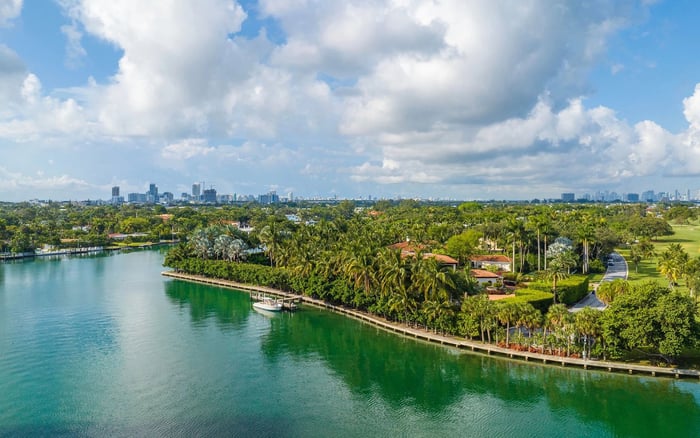
For Greenwich families evaluating Fisher Island, the move is more than a luxury purchase. It is a domicile, governance, staffing, club-access, and resilience decision that should be coordinated before closing.

For many Greenwich families, Fisher Island represents a highly specific South Florida move: private, controlled, resort-like, and close enough to Miami’s financial, cultural, and aviation infrastructure to support a serious family-office operation. Yet the strongest buyers approach the transition less as a real estate acquisition than as a redesign of the family platform.
A principal may shift personal residence to Florida. A family office may move some or all operations to South Florida. The family may still retain a Northeast home, school ties, medical relationships, trustees, aircraft logistics, and New York-linked business interests. Each decision carries distinct implications. Treating them as a single event can create avoidable friction.
This is why the Greenwich-to-Fisher Island conversation often begins with taxes, then quickly broadens into legal records, estate planning, staffing, club membership, condominium governance, insurance, storm planning, cybersecurity, and continuity of household service. For MILLION’s Buyer's Guides audience, the essential question is not whether Fisher Island is desirable. It is whether the move is built to withstand scrutiny and operate elegantly.
Florida’s constitution prohibits a state personal income tax, while Connecticut imposes an individual income tax. For high-income households, that difference is often central to the analysis, especially with the federal deduction for state and local taxes generally capped at $10,000. Connecticut’s estate and gift tax framework, contrasted with Florida’s lack of a separate estate tax for estates of decedents dying on or after January 1, 2005, can also matter in multigenerational planning.
Still, buying on Fisher Island does not automatically make a family Florida-domiciled. Domicile is supported by facts, records, behavior, and consistency. A Miami-Dade Declaration of Domicile can help establish a paper trail, but it should align with broader action: Florida driver licenses, vehicle registration, insurance changes, voter and address records where applicable, banking and advisory records, and the practical relocation of day-to-day life.
Family offices should also distinguish the principal’s domicile from the office’s operating footprint. Entity records, officer locations, board meetings, investment decision-making, payroll, vendors, document custody, and technology controls can all become part of the operating picture. If Greenwich remains meaningful because of New York access, the plan should acknowledge that reality rather than pretend it no longer exists.
Greenwich offers an established Northeast lifestyle with direct commuter-rail access into the regional network, a meaningful advantage for families with continuing New York obligations. Fisher Island is different by design. It is a private island club community in Miami Beach, with resort-style amenities including golf, racquet sports, marina, beach, spa, dining, and other lifestyle offerings. Access, staffing, guest movement, deliveries, household maintenance, and emergency plans must be calibrated around private-island logistics rather than ordinary street access.
The best-prepared families run a practical day-in-the-life exercise before closing. How will principals reach aircraft, meetings, schools, physicians, and cultural events? How will domestic staff commute? How will vendors be approved? What happens when guests arrive during peak social season? Which household functions should remain on island, and which should be supported from Miami Beach, Brickell, Coconut Grove, or another mainland base?
Residential selection should reflect that operating rhythm. A buyer comparing The Residences at Six Fisher Island with The Links Estates at Fisher Island is not simply comparing architecture. The family is comparing privacy, household flow, staff accommodation, storage, entertaining patterns, arrival sequences, and long-term governance fit.
On Fisher Island, real estate and club life are closely related in perception, but not identical in diligence. Club membership should be addressed early, including access, approval process, costs, timing, privileges, limitations, and how membership intersects with family use. Buyers who leave this to the end can discover that the lifestyle they assumed requires separate decisions.
Condominium review is equally important. Florida condominium ownership is governed through association documents, budgets, reserves, assessments, use restrictions, approval rights, alteration rules, insurance arrangements, and board governance. These details can materially affect ultra-prime ownership, particularly for families accustomed to the autonomy of a Greenwich estate.
A residence such as Palazzo della Luna may appeal to buyers seeking an established island condominium context, while mainland alternatives such as The Ritz-Carlton Residences® Miami Beach can help families compare privacy with bridge-access convenience. Neither choice is inherently superior. The better fit is the one that supports how the household actually lives.
Florida’s homestead exemption framework can reduce taxable value for qualifying primary residences, and the state constitution also provides homestead protections from forced sale. For high-net-worth families, these issues are often reviewed alongside trusts, marital planning, creditor exposure, estate architecture, and liquidity strategy.
The key is integration. A residence should not be selected only because it appears tax-efficient. It should also align with ownership structure, succession planning, renovation intentions, privacy expectations, lender requirements, insurance, and the family’s long-term presence in Florida. Investment, in this context, is not merely appreciation potential. It is the compound value of legal durability, operational ease, and lifestyle adoption.
Fisher Island’s ZIP code, 33109, has repeatedly ranked among the most expensive in the United States, reinforcing the pricing context buyers should expect. Ultra-prime scarcity can be attractive, but it does not replace disciplined underwriting. Carrying costs, assessments, club obligations, insurance, liquidity, and resale depth all belong in the model.
Waterfront ownership on a private island demands a different standard of preparation. Miami-Dade hurricane planning should be incorporated into the household manual, covering family evacuation, staff responsibilities, insurance contacts, backup power, water intrusion protocols, art and wine protection, vessel plans, pet logistics, and post-storm access.
Flood exposure should be checked through federal mapping tools before purchase, and insurance assumptions should be tested early. This is particularly important for waterfront or island property, where elevation, building systems, association protocols, and access can influence risk management.
Private aviation can help preserve continuity. Miami-Opa locka Executive Airport serves general aviation in Miami-Dade County, making it part of the relocation calculus for families moving between South Florida, New York, Europe, the Caribbean, and other operating centers. The point is not merely convenience. It is controlled mobility when calendar, privacy, or weather demands it.
Before contract, principals and advisers should align on five lanes. First, tax domicile and state-tax modeling, including Connecticut exposure and Florida residency steps. Second, estate and gift planning, including how Florida homestead interacts with the family’s broader structure. Third, property diligence, including condominium documents, reserves, assessments, insurance, flood exposure, and association approvals. Fourth, lifestyle diligence, including club membership, transportation, staffing, schools, healthcare, pets, security, and household vendors. Fifth, operating-platform design, including entity records, employee location, cybersecurity, document retention, succession planning, and vendor migration.
Families considering a partial mainland complement may also evaluate Brickell for office proximity. St. Regis® Residences Brickell, for example, sits in a different lifestyle category than Fisher Island, but it illustrates why some households separate private residence from business adjacency.
The smartest relocation is not rushed by a tax calendar alone. It is sequenced, documented, and lived with consistency.
Does buying on Fisher Island automatically establish Florida domicile? No. Domicile depends on records, conduct, intent, and consistency across legal, tax, and personal life.
Why do Greenwich families focus on Florida tax residency? Florida prohibits a state personal income tax, while Connecticut imposes individual income tax and has estate and gift tax rules.
Should a family office move at the same time as the principal? Not always. The principal’s residence and the office’s operating platform should be analyzed separately.
Is Fisher Island Club membership automatic with a residence purchase? It should not be assumed. Buyers should diligence membership access, approval, costs, and timing early.
What condominium issues matter most on Fisher Island? Governance, reserves, assessments, use restrictions, insurance, alteration rights, and approval procedures can all affect ownership.
Can a family keep a Greenwich presence after moving? Yes, but the facts should be coordinated with tax and legal advisers so the Florida position remains consistent.
Why is hurricane planning important for Fisher Island buyers? Island ownership requires plans for family evacuation, staffing, insurance, backup power, property management, and post-storm access.
Should buyers review flood exposure before closing? Yes. Flood mapping, elevation, insurance assumptions, and building resilience should be reviewed before purchase.
How does private aviation fit into the move? General aviation access in Miami-Dade can support mobility between South Florida, New York, and other family-office hubs.
Is Fisher Island mainly a lifestyle decision or an investment decision? It is both. The strongest buyers evaluate lifestyle, tax posture, governance, resilience, liquidity, and long-term family use together.
If you'd like a private walkthrough and a curated shortlist, connect with MILLION.
If branded residences are on your mind — as a home or as an allocation — we would be glad to share what we are seeing, privately.
Begin a quiet conversation