A buyer-focused guide to evaluating whole-home Wi-Fi planning at Glass House Boca Raton, from cabling and access points to testing, smart-home resilience, and storm-aware network design.

At Glass House Boca Raton, the most important technology question may not be how polished the residence appears in a rendering. It may be whether the future home can support the way its owner actually lives: video meetings from a private office, streaming in the media room, automated shades, cloud-based security, climate control, guest access, and monitoring during long absences.
For luxury buyers, whole-home Wi-Fi should be treated as residential infrastructure, not as a soft amenity implied by phrases such as state-of-the-art connectivity. The distinction matters. A beautifully staged room can suggest ease, calm, and control, but a rendering cannot show whether the primary suite has a hardwired data point, whether a terrace receives stable coverage, or whether the office is supported by a dedicated access point rather than a signal struggling through dense construction.
This is especially relevant in South Florida, where refined coastal buildings often combine reinforced concrete, rebar, impact-rated glazing, low-emissivity glass, and substantial interior partitions. Those elements are desirable for durability, acoustics, and storm resilience, yet they can also weaken wireless radio signals. A network concept that works in a wood-frame house should not be assumed to perform the same way in a concrete-and-glass condominium.
The first buyer mistake is assuming that connectivity is somehow embedded in the visual promise of a new residence. Renderings can reveal ceiling heights, material palettes, furniture proportions, sightlines, and the emotional tone of a room. They do not reveal the low-voltage plan.
For a buyer evaluating Glass House Boca Raton, the practical questions are straightforward. Which rooms have dedicated fiber or copper data drops? Where are access points intended to be installed? Is the media room wired for high-bandwidth streaming? Can a home office support video conferencing and trading platforms without depending on a distant consumer-style router? Is the terrace part of the coverage plan, or is it merely adjacent to it?
These are not secondary questions for a second-home owner. They are central to daily usability and remote confidence. When a residence is used seasonally or managed from another city, climate control, cameras, lighting, entry systems, leak alerts, and other monitoring functions depend on network continuity. The risk is not simply inconvenience. It is discovering after closing that a visually serene home is digitally fragile in precisely the spaces that matter most.
Marketing language can be useful as an invitation, but it should not end the inquiry. Buyers should ask for the underlying low-voltage drawings, specifications, and measurable testing standards that support any connectivity claim.
A serious review should include the building’s internet-service options, in-unit cabling plan, access-point locations, structured media spaces, risers, and upgrade pathways. The aim is not to turn the buyer into a network engineer. It is to confirm that the home is designed for present and future bandwidth expectations, rather than retrofitted around limitations after the finishes are complete.
In a new-construction or pre-construction purchase, this review is especially valuable because certain decisions may be more practical before walls, ceilings, and millwork are finalized. Buyers should ask whether key rooms are pre-wired and whether there is a defined location for gateways, switches, controllers, and other network equipment. They should also clarify whether the equipment cabinet or media space is properly organized, ventilated, and accessible for service.
For Glass House Boca Raton, the appropriate posture is disciplined rather than skeptical. The project may present a compelling lifestyle, but technology deserves its own verification layer. Ultra-prime buyers routinely review appliance packages, stone selections, closet systems, and lighting. The network should receive the same precision.
In luxury residences, the difference between having Wi-Fi and having well-planned Wi-Fi is often the access-point strategy. Ceiling-mounted access points are materially different from relying on a single consumer-style router placed in a cabinet or utility area. Placement affects signal strength, room-to-room roaming, device handoff, and the ability to support simultaneous users.
Buyers should verify whether the residence is planned around multiple access points and, just as important, whether those access points use wired backhaul. In simple terms, a multi-access-point system performs best when each access point is connected by cable rather than repeating a weak wireless signal from another part of the home. Wireless repeaters may be acceptable in modest applications, but they are not the standard one should casually accept in a high-value coastal residence.
Dense multifamily buildings add another layer. Neighboring residences, amenity areas, building systems, and personal devices can create crowded wireless spectrum. That makes channel planning, access-point selection, and post-installation testing important verification items. In a building where many owners expect flawless connectivity, the invisible wireless environment can be as important as the visible finishes.
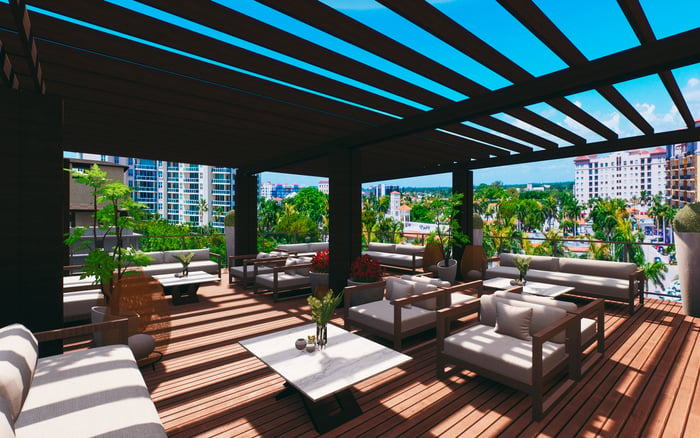
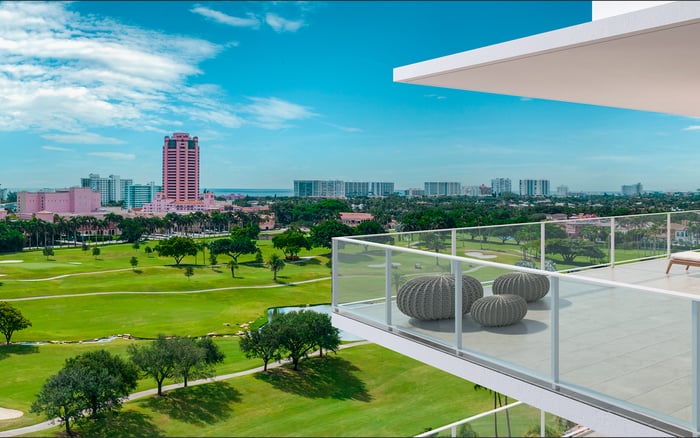
The same logic applies to outdoor-oriented living. A terrace may look seamless in presentation materials, but buyers should ask whether it is part of the network plan. Impact glass and exterior assemblies can limit signals, so adjacent indoor coverage should not be assumed to guarantee stable outdoor performance.
The modern Boca Raton owner is not merely checking email. High-bandwidth use cases can include 4K and 8K streaming, video conferencing, large file transfers, cloud surveillance, gaming, smart-home automation, security systems, and real-time financial platforms. Multiple people may be using the network at once, while guests and staff require controlled access.
For Boca Raton buyers comparing ultra-premium residences, the network plan should support both privacy and convenience. Guest networks, device segmentation, reliable roaming, and clean equipment placement can make a residence feel effortless. Poor planning, by contrast, reveals itself in small irritations: dropped calls, lagging cameras, offline thermostats, and inconsistent performance between bedrooms, offices, and entertainment spaces.
This is why whole-home Wi-Fi planning belongs beside architecture and interior design in the buyer conversation. A residence may be visually calm, but its digital layer must also be calm. The best result is not a conspicuous technology system. It is a home where technology quietly disappears because it works.
South Florida ownership requires a storm-aware mindset. Buyers should verify whether core switches, gateways, and in-unit network equipment have a plan for power backup or outage conditions. This does not mean every residence must operate indefinitely during an interruption. It does mean the owner should understand what remains functional, what shuts down, and how long critical network equipment may be supported.
For remote owners, this question is more than technical. If access control, cameras, climate systems, leak detection, and lighting controls depend on the network, then network resilience is part of property stewardship. A home that can be monitored and managed reliably offers a different level of confidence than one whose smart systems vanish whenever the connection falters.
Buyers should also ask how service providers reach the residence, how building risers are organized, and whether the infrastructure can support future upgrades. Bandwidth expectations will continue to rise. A carefully planned structured media environment gives the owner more flexibility as devices, security standards, and automation systems evolve.
A practical review for Glass House Boca Raton should begin with documents and end with testing. Ask for the in-unit cabling plan. Identify data drops in the office, primary suite, media room, bedrooms, and any automation-dependent spaces. Confirm access-point locations and whether they are wired. Ask how the network is expected to perform through reinforced concrete, impact-rated glazing, and dense partitions.
Then move from design to measurable performance. Buyers should request post-installation testing standards, not vague assurances. Coverage should be evaluated where life actually happens: at the desk, beside the bed, near the television, on the terrace, and in the areas where smart-home controls are most heavily used. The goal is not theoretical speed in one ideal location. It is dependable performance across the residence.
The most elegant outcome is preventative. By asking the right questions before closing, a buyer can avoid opening walls, compromising finishes, or adding visible workarounds after move-in. In the ultra-luxury market, the least glamorous infrastructure often protects the most glamorous experience.
Why is whole-home Wi-Fi due diligence important at Glass House Boca Raton? Because connectivity supports daily living, remote ownership, security, automation, streaming, and work. It should be verified as infrastructure, not inferred from renderings.
Can a rendering show whether a residence has proper Wi-Fi coverage? No. A rendering cannot show cabling, access-point locations, wired backhaul, channel planning, or performance in specific rooms.
What should buyers ask to see before closing? Buyers should ask for low-voltage drawings, cabling plans, access-point locations, internet-service options, and any performance testing standards.
Why are access points better than relying on one router? Properly placed access points can improve coverage and roaming across a large residence. A single router may struggle through dense walls, glass, and concrete.
What is wired backhaul? Wired backhaul means access points are connected by cable to the network, rather than repeating wireless signals. It generally supports more stable performance.
Why can South Florida construction affect Wi-Fi? Reinforced concrete, rebar, impact-rated glazing, low-emissivity glass, and dense partitions can weaken wireless signals and complicate coverage.
Should terraces be included in the Wi-Fi plan? Yes. Outdoor living areas should be tested or planned directly, rather than assuming indoor coverage will pass through exterior glass and assemblies.
How does remote ownership change the network conversation? Remote owners often depend on cameras, access control, climate systems, lighting, and monitoring. Those systems require resilient connectivity.
Is storm-related outage planning part of smart-home due diligence? Yes. Buyers should understand whether gateways, switches, and core in-unit network equipment have backup power or a defined outage plan.
What is the main risk if buyers do not verify the network? The main risk is a residence that looks refined but performs poorly in offices, bedrooms, terraces, or automation-dependent areas.
For a tailored shortlist and next-step guidance, connect with MILLION.
If branded residences are on your mind — as a home or as an allocation — we would be glad to share what we are seeing, privately.
Begin a quiet conversation