A discreet 2026 buyer checklist for evaluating porte-cochère design at Faena Residences Miami Downtown Miami, with emphasis on arrival flow, privacy, service separation, weather protection, staffing implications, and resale perception.
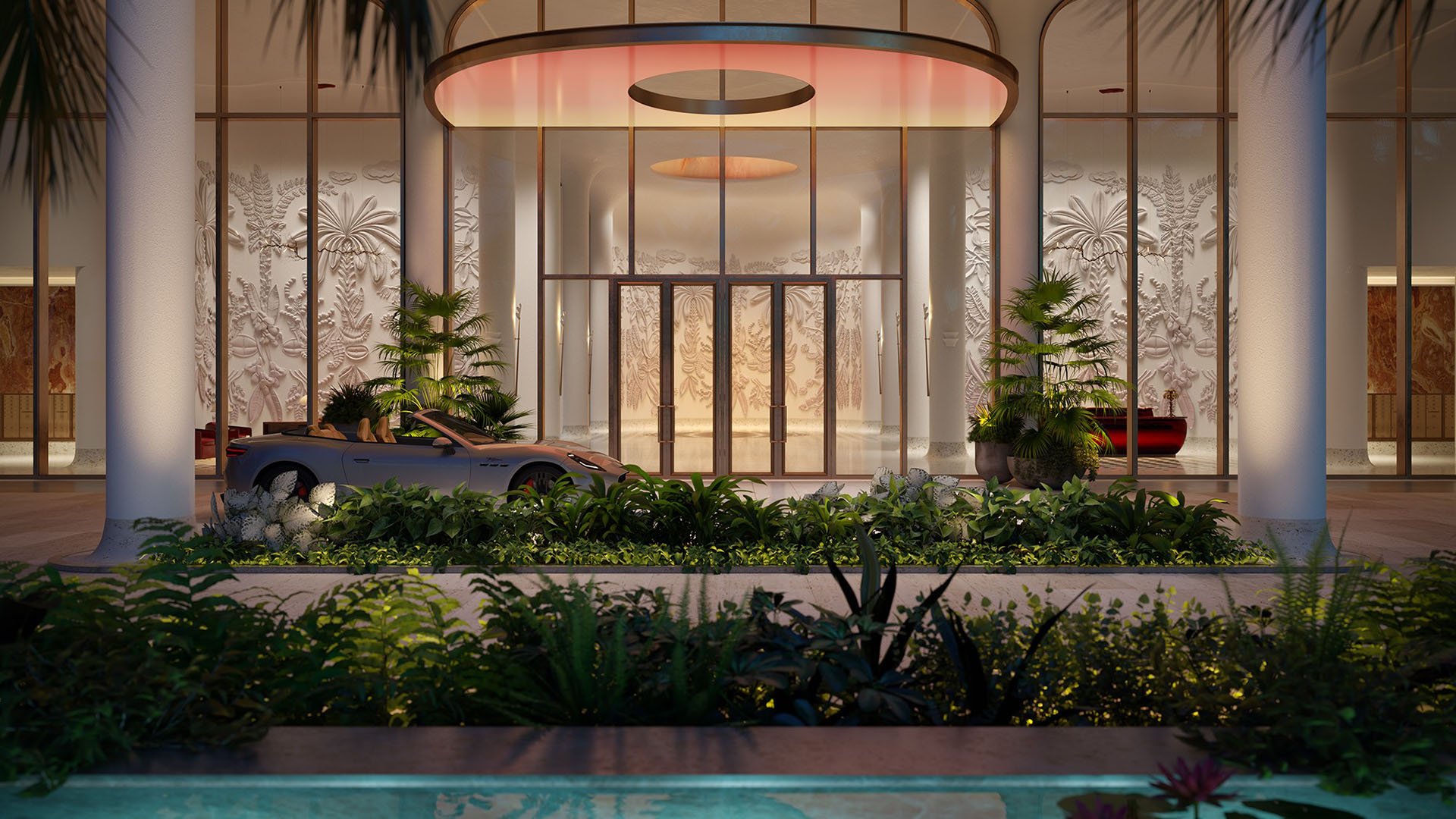
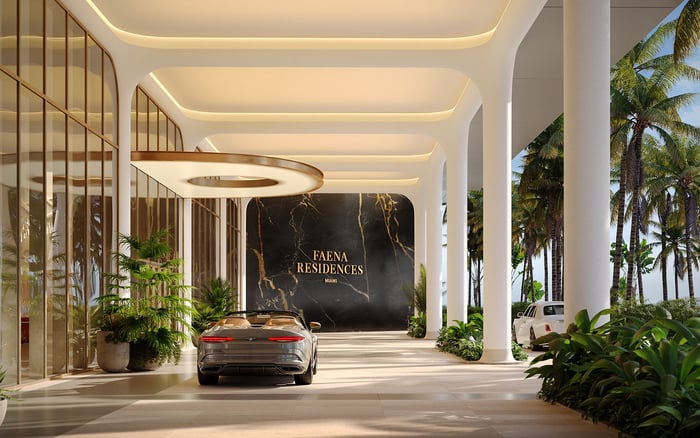
At Faena Residences Miami Downtown Miami, the porte-cochère should be evaluated less as an architectural flourish than as private infrastructure. In the ultra-luxury segment, arrival is not merely ceremonial. It is traffic management, discretion, valet efficiency, weather protection, security, luggage handling, and brand expression compressed into the first ninety seconds of daily life.
That matters in Downtown, where dense urban conditions can make curb access and vehicle stacking unusually consequential. A beautiful canopy that cannot absorb peak-period demand may read elegantly in renderings yet become a recurring operational weakness. For a buyer, family office, or advisor, the essential question is not whether the porte-cochère looks luxurious. It is whether it performs like a luxury hotel arrival court under real pressure.
In 2026 due diligence, this is especially relevant for Pre-construction and New-construction purchases, where certain details may still be reviewed through drawings, condominium documents, site-plan materials, traffic assumptions, and buyer consultations. The goal is not to second-guess the architecture. It is to understand how the arrival sequence will behave when residents, guests, chauffeurs, rideshare vehicles, deliveries, valet staff, and luggage all converge.
The first request should be site-plan clarity. Buyers should ask to review entry geometry, vehicle turning radii, queuing length, valet drop-off positions, and how vehicles enter and exit without awkward reversals or conflict points. If those details are not final or not fully public, they should be treated as diligence items, not assumptions.
A proper review should test multiple vehicle types. The arrival court should be assessed for private chauffeurs, full-size SUVs, Sprinter-style vans, ride-share vehicles, valet staging, and simultaneous luggage movement. The most revealing scenario is not a single car arriving on a quiet afternoon. It is several vehicles arriving while one guest waits, one resident unloads, one valet stages, and a service vehicle works to avoid the front-of-house path.
The checklist should also ask whether the porte-cochère can hold enough vehicles before congestion spills into the street or compromises the lobby threshold. In branded residences, the perceived quality of ownership is often shaped by these small, repeated moments. Smooth arrivals feel invisible. Failed arrivals become memorable for the wrong reasons.
A central diligence question is whether residents, guests, ride-share pickups, deliveries, move-ins, and back-of-house traffic are separated or pushed into the same circulation path. The answer may affect privacy, operational staffing, service timing, and the daily rhythm of the building.
Resident arrivals should feel composed and predictable. Guest arrivals should be intuitive without exposing private circulation. Deliveries and move-ins should be handled without disrupting the residential experience. Emergency access should be studied without relying on improvisation. If these flows overlap too heavily, the condominium association may need more valet, security, concierge, or traffic-management staffing to maintain the expected standard.
This is why the porte-cochère belongs in Investment underwriting. A buyer focused only on interior finishes may miss a recurring cost center outside the unit. Staffing inefficiency, guest overflow, and front-drive congestion can become association-level issues over time. In an ultra-premium building, the hidden expense is not merely labor. It is the erosion of effortlessness.
Privacy should be examined from the public street inward. A buyer should ask what is visible into arriving vehicles, the waiting area, the lobby threshold, and any concierge or elevator transition. The best arrival sequences manage exposure without feeling defensive. They create a sense of reveal, allowing the resident to move from city to sanctuary with minimal friction.
For Faena, the experience should also be assessed as part of the broader brand language. Lighting, materials, spatial drama, art, and hospitality-style choreography are not secondary gestures. They are part of the value proposition. A strong porte-cochère should connect logically to the residential lobby, concierge, elevators, valet operations, and branded service spaces so the arrival does not feel fragmented.
Buyers comparing Downtown with Brickell, Miami Beach, or other trophy submarkets should remember that the most impressive residences are judged as complete environments. The front drive is a daily stage. If the choreography is strong, the residence feels calm before the elevator doors open.
South Florida arrival design must be judged in rain, heat, wind, and post-storm conditions, not only in ideal weather. Buyers should request confirmation of canopy coverage at the arrival area, including how it protects residents during heavy rain, wind-driven rain, luggage transfer, and valet handoff. The concern is practical, not cosmetic. A soaked arrival weakens the promise of seamless living.
Drainage should also be part of the review. The porte-cochère should be evaluated for flood resilience, water management, wind durability, and continuity of operations after severe weather. This does not require a buyer to become an engineer, but it does require asking the right questions and having qualified advisors review the relevant materials.
The inquiry should include how staff would operate during adverse weather, where vehicles would queue, how luggage would be protected, and whether pedestrian circulation would remain safe. In a luxury residence, resilience is not just structural. It is operational continuity: the building still knows how to function when conditions are imperfect.
Before signing off, a buyer should request drawings and documents that clarify the arrival sequence. The questions should be direct: How many movements can the front drive support at once? Where do ride-share vehicles wait? How are private chauffeurs handled? Where does valet staging occur? How are move-ins, large deliveries, event traffic, guest overflow, and emergency vehicles managed?
The review should also include pedestrian conflicts. A porte-cochère that feels gracious to drivers but awkward to pedestrians is incomplete. Buyers should ask how residents move from car to lobby, how guests are received, and how service personnel avoid front-of-house interference.
Public-facing materials may not disclose proprietary dimensions, capacities, or final technical specifications. That is not unusual. It simply means buyers should verify design drawings, traffic studies, and condominium documents directly during diligence. For Faena Residences Miami Downtown Miami, the most sophisticated approach is to treat the porte-cochère as a measurable ownership feature, not a decorative promise.
Resale buyers often judge a building before entering the unit. If the arrival feels congested, exposed, or understaffed, the perceived quality of the asset can soften. If it feels controlled, private, and elegantly choreographed, it supports the premium narrative.
That is why this checklist is not just about convenience. It is about long-term positioning. In a market where branded residences compete on service, design, and emotional arrival, the porte-cochère becomes a recurring proof point. The strongest buildings make complex operations feel effortless.
Why is the porte-cochère so important at Faena Residences Miami Downtown Miami? It affects arrival flow, privacy, valet performance, weather protection, and the first impression of daily luxury.
Should buyers ask for exact porte-cochère dimensions? Yes. If dimensions are not publicly specified, buyers should verify drawings and technical materials during diligence.
What traffic details matter most? Entry geometry, turning radii, queuing length, valet positions, and separation from service routes are key items.
How does Downtown affect the checklist? Downtown density can make curb access, stacking, ride-share coordination, and valet flow more material to livability.
What vehicles should the arrival court be tested against? Buyers should consider SUVs, chauffeured cars, Sprinter-style vans, ride-share vehicles, valet movements, and luggage handling.
Is privacy part of porte-cochère due diligence? Yes. Sightlines into vehicles, waiting areas, the lobby threshold, and elevator transitions should be reviewed.
Why does weather protection matter? Heavy rain, wind-driven rain, and luggage transfer can expose weaknesses in canopy coverage and arrival planning.
Can a weak porte-cochère increase ownership costs? Potentially. Inefficient design may require more valet, security, concierge, or traffic-management staffing.
Should investors treat arrival design as a resale factor? Yes. Recurring congestion or privacy loss can weaken perceived quality in an ultra-luxury branded condominium.
What should buyers verify before committing? They should review design drawings, traffic studies, condominium documents, and operational plans with qualified advisors.
When you're ready to tour or underwrite the options, connect with MILLION.
If branded residences are on your mind — as a home or as an allocation — we would be glad to share what we are seeing, privately.
Begin a quiet conversation