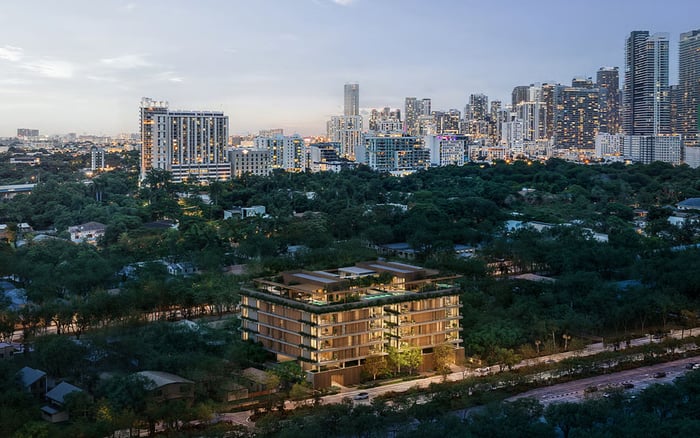
A discreet governance-first comparison of Colette Residences Brickell and The Well Coconut Grove, focused on operating simplicity, management complexity, recurring-cost discipline, and the diligence buyers should request before choosing either address.

For a certain South Florida buyer, the most persuasive amenity is not a dramatic lobby, a crowded wellness deck, or a social calendar built for display. It is calm governance. It is a building whose shared spaces, service promises, reserves, insurance assumptions, and management contracts feel legible before closing and durable after occupancy.
That is the most useful lens for comparing Colette Residences Brickell and The Well Coconut Grove. The two projects appeal to different instincts. Colette is framed as a boutique Brickell condominium concept, emphasizing intimacy, design, and neighborhood access rather than a very large amenity platform. The Well Coconut Grove is positioned as a wellness-branded residential option with a more sophisticated, hospitality-adjacent service program. For buyers who prefer governance over spectacle, neither profile is automatically superior. The question is whether simplicity or professionalized complexity feels more protective.
Colette’s potential governance advantage begins with its smaller-scale posture. A boutique residential environment can appeal to buyers who want fewer shared obligations and fewer heavily programmed spaces to operate. In governance terms, fewer flashy common areas may mean fewer contracts, staffing layers, replacement cycles, and daily management decisions.
That does not make Colette a low-risk choice. A compact building can also concentrate responsibility. If reserve needs, insurance costs, or special assessments arise, the way those obligations are shared among owners becomes especially important. A smaller ownership base may create a more intimate community, but it can also make budget shocks feel more personal.
For Brickell buyers, this is a tradeoff worth studying in detail. The appeal is not that governance disappears. It is that the governance profile may be easier to understand. If the association budget is clear, reserves are thoughtfully planned, and the amenity program remains disciplined, Colette may suit buyers who believe restraint is its own form of luxury.
The Well Coconut Grove approaches the same question from a different direction. Its wellness-branded concept is not designed as an amenity-light condominium. It is presented as a more layered residential environment, with a service and wellness orientation that may require more professionalized management, clearer operating controls, and deeper oversight.
For some governance-first buyers, that can be attractive. Complex buildings often need formal systems. A service-rich residence may force discipline around management agreements, staffing expectations, vendor standards, and operating protocols. If those systems are well defined, the result can feel more institutional, more polished, and less dependent on informal decision-making.
The risk is that polish can be expensive to maintain. Wellness, service, and hospitality-adjacent features may introduce more contracts, maintenance variables, labor considerations, and recurring-cost questions. The value proposition depends not only on whether buyers enjoy the common spaces, but on whether they understand what it takes to keep those spaces operating at the promised level.
The comparison should not be reduced to small versus large, or restrained versus indulgent. Governance quality is not measured by amenity count alone. A simple program can still be underfunded. A complex program can still be well controlled. What matters is the relationship between promises, budgets, reserves, insurance assumptions, and management accountability.
Colette may be the better fit for a buyer who wants a quieter governance profile, especially someone who values design and neighborhood access over extensive shared programming. The Well Coconut Grove may be the better fit for a buyer who accepts greater operating complexity in exchange for a wellness-led environment that likely demands more formal management architecture.
Investment discipline also matters. New-construction and pre-construction buyers often focus first on finishes, views, and lifestyle branding. A governance-first buyer reverses that order. The more important questions are how recurring obligations are structured, how service standards are funded, and how future assessments could affect ownership comfort.
Before choosing either project, a governance-minded buyer should request the association budget, reserve plan, insurance assumptions, management agreement, amenity operating-cost detail, and any brand or service agreements that shape recurring obligations. These documents are not decorative. They are the operating blueprint of the building.
For Colette, the focus should be concentration risk. Buyers should understand how costs are shared, what the reserve philosophy looks like, and how the building plans to handle future capital needs. For The Well Coconut Grove, the focus should be operational complexity. Buyers should study the wellness and service program through the lens of contracts, staffing, maintenance obligations, and cost control.
The more discreet conclusion is also the most useful one. Colette appears better aligned with buyers who prefer a simpler common-area governance profile. The Well Coconut Grove appears better suited to buyers who are comfortable with a more professionalized but more complex operating model. The better choice is the one whose documents confirm the lifestyle promise can be governed with discipline.
Is Colette Residences Brickell the clear governance winner? Not definitively. It may offer a simpler governance profile, but buyers still need to review reserves, insurance assumptions, and assessment exposure.
Why might Colette appeal to governance-first buyers? Its boutique positioning and more compact amenity emphasis may mean fewer operating components to fund and manage.
What is the main governance risk at Colette? Concentration risk. A smaller owner base can make budget shocks or reserve needs more meaningful for each owner.
Why might The Well Coconut Grove appeal to these buyers? Its wellness and service depth may require more professionalized management systems and clearer operating controls.
What is the main governance risk at The Well Coconut Grove? Operational complexity. More services can mean more contracts, staffing, maintenance, and recurring-cost variables.
Are flashy common spaces always a governance problem? No. They become a problem only when the operating costs, reserves, and management responsibilities are not clearly understood.
Should buyers compare monthly costs alone? No. They should also examine reserves, insurance assumptions, management terms, service agreements, and future capital obligations.
Does a wellness-branded residence require extra diligence? Yes. Buyers should understand how the wellness program is staffed, maintained, contracted, and funded over time.
Is Brickell better than Coconut Grove for governance-minded buyers? The neighborhood is secondary. The stronger choice depends on the project’s operating model and governing documents.
What is the practical takeaway? Choose Colette for a potentially simpler governance profile, or The Well Coconut Grove for a more service-rich model that demands careful oversight.
For a confidential assessment and a building-by-building shortlist, connect with MILLION.
If branded residences are on your mind — as a home or as an allocation — we would be glad to share what we are seeing, privately.
Begin a quiet conversation