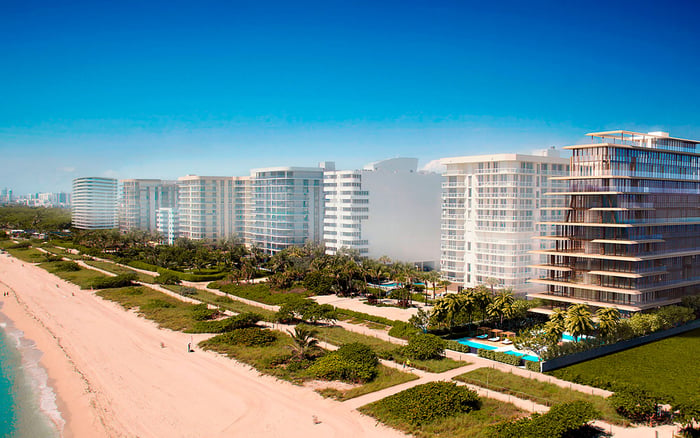
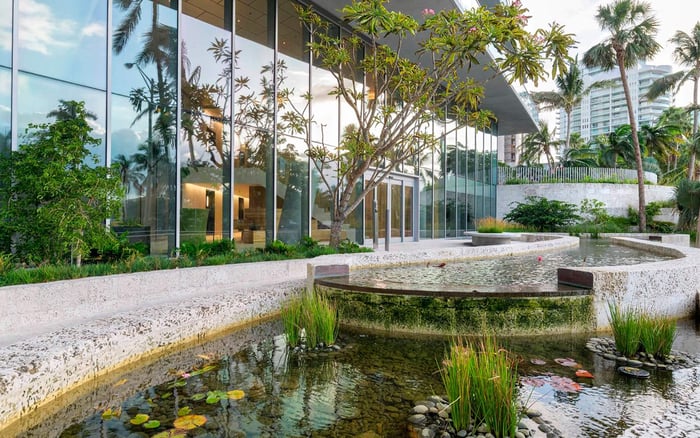
A discreet, buyer-focused examination of how to approach architectural review at Arte Surfside and The Grove at Grand Bay without relying on unsupported assumptions about private condominium rules.

The phrase “architectural review” carries particular weight in South Florida luxury real estate. For an owner considering a collectible residence, it is not simply a matter of taste, finishes, or the drama of a striking facade. It is a matter of governance: what may be changed, who approves it, how long approval may take, and whether a future purchaser will value the building’s discipline as much as its design.
That distinction is central to any comparison of Arte Surfside and The Grove at Grand Bay. Both names belong in the vocabulary of design-conscious buyers, yet public-facing project identity should not be confused with a complete set of alteration rules. An architectural statement may be legible from the street or skyline. Architectural review guidelines, by contrast, generally reside in condominium documents, association rules, board protocols, municipal files, design approvals, and owner-facing procedures.
For a buyer, the prudent position is simple: admire the architecture, but underwrite the governance.
Arte Surfside and Grove at Grand Bay can be discussed as two design-forward residential references within South Florida’s ultra-prime market. They should not, however, be treated as having publicly verified, directly comparable architectural-review rulebooks based only on general project materials. Doing so would blur the line between brand presentation and binding owner obligations.
Arte Surfside is best approached through the lens of Surfside’s boutique, design-led coastal condominium market. Terms such as Arte Surfside, Surfside, Boutique, and Ultra-modern help define market posture, not approval criteria. A residence may be visually disciplined and architecturally distinctive while still having owner modification rules that require separate confirmation.
The Grove at Grand Bay belongs to a different buyer context, one closely associated with the Grove lifestyle and a more tropical, residentially scaled luxury setting. Coconut-grove and Grove at Grand Bay are essential references for this discussion. Still, the same caution applies: the building’s architectural identity does not, by itself, disclose the complete pathway for interior alterations, terrace modifications, window treatments, mechanical work, or any other owner-driven change.
The correct comparison is therefore not “which building has stricter published guidelines,” because that cannot be responsibly established from project identity alone. The better comparison is how a buyer should interrogate each building before closing.
In the highest segment of the market, architectural control can protect value. A building that preserves visual coherence may age more gracefully, avoid haphazard exterior interventions, and maintain a more consistent resident experience. This is especially important in design-led towers, where the overall composition is part of the asset.
Yet control can also affect flexibility. A buyer who expects to combine spaces, rework millwork, install specialty lighting, add acoustic improvements, or commission a highly customized interior should understand the review process before assuming the work will be straightforward. In many luxury condominiums, the central questions are less about whether good design is welcome and more about procedure, timing, technical compliance, insurance, contractors, noise, working hours, elevator use, waterproofing, structural implications, and board approval.
This is where disciplined due diligence becomes part of the acquisition strategy. Buyers are not simply purchasing square footage or views. They are entering a private governance environment, and that environment can be as consequential as the amenity program.
Coconut Grove buyers often seek a particular balance: privacy, canopy, bay proximity, architectural authorship, and a softer relationship to the city than one finds in Miami’s more vertical corridors. The Grove at Grand Bay sits naturally within that conversation because its name and market perception are tied to the Grove sensibility.
Still, the topic itself requires precision. Arte Surfside is not a Coconut Grove project by name, while The Grove at Grand Bay is the more directly Grove-associated reference. For buyers comparing the two, the exercise is less about neighborhood equivalence than about how different luxury environments express design governance.
In Coconut Grove, architectural review may be influenced by multiple layers depending on the asset: condominium association rules, building-specific standards, municipal review, historic or neighborhood considerations where applicable, and the practical expectations of a design-conscious resident community. None of these should be assumed without document review.
For a buyer deciding between a Grove residence and a Surfside residence, the question is not only where one wants to live. It is how much design autonomy one expects after closing, and how much building-level coherence one wants protected over time.
Before treating any architectural-review framework as reliable, a buyer should examine the governing documents and owner-facing procedures that actually regulate changes. The most important materials typically include the declaration, bylaws, rules and regulations, alteration application forms, contractor requirements, insurance requirements, architectural committee procedures if applicable, board approval standards, and any municipal approvals relevant to the original design or later modifications.
For a high-design residence, the buyer’s advisory team should also review whether approvals differ for visible and non-visible work. Interior decoration may be treated differently from structural work. Flooring may be treated differently from millwork. Balcony or terrace elements may be treated differently from purely interior finishes. Mechanical, plumbing, electrical, waterproofing, and life-safety work often require a more rigorous technical path than cosmetic upgrades.
The key is not to assume strictness or leniency. The key is to understand the building’s operating culture and the written authority behind it.
A serious buyer should ask whether prior renovation approvals have been granted in the building, how long typical approvals take, which professionals must sign and seal submissions, whether deposits are required, and whether work is limited by season, hours, elevator reservations, or association staffing. They should also ask whether the board or management distinguishes between designer-led cosmetic updates and construction-level alteration projects.
For Arte Surfside, the questions should be framed around the expectations of a highly designed Surfside condominium environment. For The Grove at Grand Bay, they should be framed around the expectations of a Grove condominium whose architectural presence is part of its identity. In both cases, answers should come from controlling documents and current building administration, not assumptions drawn from photography or marketing language.
For international and second-home buyers, this is especially important. A residence renovated from afar demands clear approval timelines, trusted local representation, and a realistic construction calendar. The most elegant acquisition can become unnecessarily complicated if architectural review is left until after closing.
Architectural review is not only a constraint. In the best buildings, it is a form of long-term stewardship. A consistent approval culture may help protect the facade, common areas, acoustic quality, waterproofing integrity, and the lived experience of residents. Those qualities often matter deeply to buyers at the top of the market.
At the same time, the luxury buyer’s appetite for customization has never been more refined. Residences are expected to support art collections, wellness rooms, chef-level kitchens, hidden technology, staff circulation, and materials with international provenance. The stronger the customization goal, the more important it becomes to confirm whether a building’s review process can accommodate that ambition.
The elegant answer is not to avoid buildings with review standards. It is to align the buyer’s design intentions with the building’s governance before a contract becomes unconditional.
A responsible comparison of Arte Surfside and The Grove at Grand Bay should begin with architecture and conclude with documents. Public project identity may illuminate design intent, but it does not replace the legal and procedural framework that governs owner modifications.
For buyers, the winning strategy is to treat architectural review as part of valuation. A building with a disciplined approval process may offer confidence and continuity. A building with unclear or changing procedures may require more negotiation, more contingency planning, or a narrower renovation scope. Either way, the answer belongs in the due diligence file before closing, not in a post-closing surprise.
In South Florida’s most rarefied condominiums, beauty is visible. Permission is documented.
Are Arte Surfside and The Grove at Grand Bay architectural guidelines publicly comparable? They should not be treated as directly comparable without reviewing official condominium, association, and municipal documents.
Does a design-forward building always have strict alteration rules? Not necessarily. Design identity and owner modification procedures are related considerations, but they are not the same thing.
What should buyers review before planning renovations? Buyers should examine governing documents, alteration applications, contractor rules, insurance requirements, and approval procedures.
Is Arte Surfside a Coconut Grove building? The name Arte Surfside points to Surfside, while The Grove at Grand Bay is the more directly Grove-associated reference.
Why does architectural review affect resale value? Consistent review standards may help preserve building character, exterior coherence, and resident confidence over time.
Can interior designers determine whether work will be approved? Designers can help prepare a strong submission, but approval depends on the building’s governing authority and applicable rules.
Should buyers ask about prior renovation approvals? Yes. Prior approvals can reveal timing, expectations, documentation standards, and the practical culture of the building.
Are terrace or balcony changes usually treated differently? They often receive closer scrutiny because they can affect exterior appearance, waterproofing, safety, or neighboring residences.
When should architectural review be investigated? It should be investigated during due diligence, before closing and before committing to a detailed renovation program.
What is the best way to shortlist comparable options for touring? Start with location fit, delivery status, and daily lifestyle priorities, then compare stacks and elevations to validate views and privacy.
To compare the best-fit options with clarity, connect with MILLION.
If branded residences are on your mind — as a home or as an allocation — we would be glad to share what we are seeing, privately.
Begin a quiet conversation