A discreet look at what intercity rail access is doing to pricing, rents, and development patterns across South Florida’s most design-forward, buyer-driven neighborhoods.
In South Florida, proximity has always functioned as a form of currency: to the ocean, to a private club, to a private terminal, to the restaurant you can reach without a parking strategy. Brightline introduces a different kind of closeness, one defined by time rather than distance. It offers the ability to live in one city while keeping a real, repeatable relationship with the others.
For luxury buyers, that distinction matters. Rail is not being evaluated as “transportation” in the conventional sense. It is being evaluated as time design. The fastest route between two meetings is not always a car, and the most appealing second home is often the one that can perform like a primary residence when needed. When service is frequent enough to feel dependable, rail converts a multi-city map into a usable lifestyle.
In that frame, geography becomes more like a portfolio. You can hold Boca Raton as a calm center, keep Miami’s cultural calendar within reach, and treat West Palm Beach’s business energy and waterfront dining as an easy extension of the week. What used to feel like “another city” begins to feel like a familiar district, accessible without the friction of traffic planning.
This is not a purely theoretical shift or a marketing narrative in search of a buyer. Pricing and rents have been reacting in ways that suggest the market is assigning tangible value to station-adjacent living, even in places where waterfront and brand names traditionally held the top premium. In a region where convenience has always been monetized, Brightline is refining what convenience means.
A Wall Street Journal analysis of home prices around Brightline stations provides a clear quantitative anchor for the so-called station-area premium. In the Miami area, the analysis found property values near the MiamiCentral station rose about 83% from 2018, compared with roughly 38% for the broader Miami area. The implication is direct: the market treated station proximity as a multiplier, not a rounding error.
Fort Lauderdale showed a similar pattern. The ZIP code near the Brightline station reportedly rose about 67% since 2018, versus about 33% for Broward County overall. Even more telling for investors, the analysis also reported a rental premium near Brightline stations in Fort Lauderdale of roughly 28% above the market average. That point matters because it expands the rail thesis beyond resale. It suggests station access can show up in ongoing income potential, not only in exit pricing.
West Palm Beach appears more modest, but still directional. The station-area gain was reported around 37% since 2018 versus about 30% for the surrounding area. The difference is smaller, yet the direction is consistent. In an already desirable environment, rail access still appears capable of concentrating demand.
For an ultra-premium buyer, these percentages do not replace fundamentals like view corridors, building quality, privacy, and the intangible feel of a street. They do, however, signal that “near the station” has evolved from a utilitarian descriptor into a location thesis. That thesis becomes especially compelling when station proximity is paired with walkability, a polished streetscape, and a neighborhood that feels complete rather than transitional.
The key takeaway is not that every home within a radius is suddenly “better.” It is that a buyer pool is increasingly willing to pay for the option value of connectivity, and that willingness is showing up in measurable ways.
Luxury markets consistently reward reliability: staffed lobbies, predictable service, and the sense that the experience will still be there tomorrow. Brightline’s own network enhancements describe higher-frequency South Florida service, including 36 daily trains departing in South Florida and about 30-minute headways at peak times. That cadence is what allows rail to behave like an amenity.
In practical terms, frequency changes the psychological cost of travel. When trains arrive on a predictable cadence, you are no longer planning your day around a single departure. You are simply deciding whether to go. The decision becomes closer to choosing a neighborhood restaurant than booking a trip.
This is where the luxury interpretation becomes more nuanced. The value is not just in getting somewhere. The value is in removing the friction that makes people say no. If a buyer can reliably integrate Miami meetings, Fort Lauderdale dining, or West Palm Beach events without turning the day into a logistics exercise, the region’s cities become more interchangeable as lifestyle assets.
Ridership data supports the idea that this shift is becoming habitual. Brightline’s October 2025 Revenue and Ridership Report states October 2025 ridership was 260,370, up 20% year over year. For residential decision-making, rising ridership functions like a proxy for cultural adoption. The more the system is used, the more normal it feels to design life around it.
In luxury real estate, perceived normality is powerful. Buyers may not mention the train in the first conversation, but they respond to what a neighborhood makes possible. A station nearby is one of the rare amenities that can expand a life outward without expanding a commute.
The most complete expression of the Brightline thesis is MiamiCentral, a station that is also a mixed-use node. Brightline has marketed the district as a place where retail and daily services follow the riders. The company’s retail-focused communications around MiamiCentral have highlighted new tenants, reinforcing that the station environment is being curated as a neighborhood, not merely a platform.
That distinction matters for price formation. A station surrounded by blank walls and parking behaves like infrastructure. A station embedded in a district with retail, services, and activity behaves like a center. Luxury markets understand centers. Centers produce a premium because they compress daily life.
Residential inventory has followed. ParkLine Miami, publicly marketed with rents and floor plans, illustrates how housing can be integrated directly adjacent to the rail node. Rental product is not the same as ultra-luxury ownership, but it demonstrates the underlying dynamic that matters. When a station becomes a destination, it supports a consistent layer of demand, and that demand tends to spill into nearby streets.
Public-sector planning supports this pattern, too. Miami-Dade County promotes transit-oriented development as an urban planning tool, which is another way of saying that density and mixed-use entitlements are more likely near transit. For a buyer evaluating long-term value, that policy backdrop can matter as much as today’s restaurant scene. It influences what can be built next door and what the neighborhood could feel like in five to ten years.
This is where the luxury conversation becomes more precise. A station district can mature into a highly desirable, walkable environment with strong retail and a sense of place. It can also become a long-running construction zone as parcels redevelop and infrastructure is upgraded. The premium is real, but it is not frictionless. Buying well requires judging whether the district is already livable, or still in its “future promise” phase.
Boca Raton has long sold a particular kind of luxury: controlled calm, excellent dining, a polished retail experience, and a preference for understated design over spectacle. Brightline introduces a new layer to that identity. Boca can now function more credibly as a center point rather than a cul-de-sac, especially for buyers splitting time between business commitments and leisure.
That shift reads clearly in buyer behavior. The appeal is not simply that you can reach Miami. It is that you can maintain continuity across multiple calendars. A weekday can include a meeting in one city and a dinner in another without requiring a recovery day. In the luxury tier, the ability to protect personal time is often the real purchase.
The luxury pipeline in Boca reflects this movement toward hospitality-grade living in walkable contexts. Branded residential is part of the narrative, with The Residences at Mandarin Oriental Boca Raton often discussed as an example of how the city’s station-era momentum can pair with resort-level expectations.
At the same time, buyers who prefer a modern, gallery-like residential experience are increasingly attentive to new condo offerings woven into the downtown fabric. Projects such as Alina Residences Boca Raton speak to a market that values amenities, design, and the ability to step out into a curated streetscape without giving up privacy.
For those drawn to boutique scale, Glass House Boca Raton has been positioned as a more intimate entry into the same thesis: luxury that feels residential first, with walkability and rail-adjacent convenience acting as a quiet second feature.
The buyer takeaway in Boca is not simply “closer is better.” The premium tends to concentrate where the walk from home to dinner, to the station, and back again feels safe, pleasant, and architecturally coherent. In luxury, the route matters. A few blocks can be the difference between a lifestyle that feels effortless and one that feels theoretical.
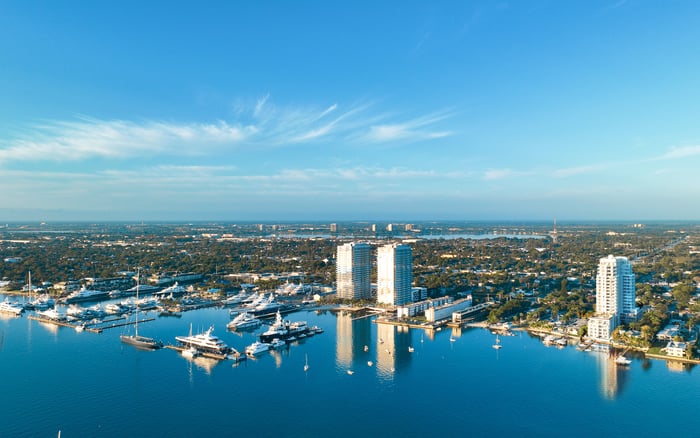
West Palm Beach has its own logic. The city’s appeal is not only connectivity, but also waterfront presence, cultural programming, and a sense of momentum that has been building for years. The Wall Street Journal station-area analysis suggests the premium exists here as well, though it appears more tempered than Miami and Fort Lauderdale.
That relative subtlety can be attractive for buyers with an investment mindset. A market that is not overheated by a single narrative is often easier to underwrite. When demand has multiple supports, waterfront, lifestyle, business activity, and connectivity, pricing can feel less dependent on any one storyline.
In West Palm, the luxury conversation frequently returns to waterfront adjacency and views, and the newest residential offerings speak directly to that preference. Forté on Flagler West Palm Beach sits naturally in the discussion for buyers who want a refined building experience in a location that keeps daily life close to the water.
For those drawn to the idea of Flagler Drive as an address identity, Shorecrest Flagler Drive West Palm Beach aligns with the broader theme of curated, walkable living, where downtown energy can be accessed on demand, not endured full time.
Here, the Brightline benefit can be understood less as a dramatic repricing event and more as a stabilizer. It offers a reason demand can remain resilient even as broader market conditions cycle. If convenience becomes part of a city’s baseline appeal, it can quietly support liquidity.
A prudent luxury buyer does not confuse momentum with certainty. Brightline’s story includes rising ridership and service enhancements, but it also includes ongoing scrutiny around financing, bonds, and fare strategy. Regional reporting has described investor concerns alongside the operational growth narrative, and trade coverage has similarly framed a cash-crunch dynamic even as riders and revenue increase.
Why does this belong in a real estate editorial? Because a portion of the station-area premium is effectively a bet on continuity. If service remains frequent and culturally adopted, the premium can become embedded in neighborhood identity, much like the lasting value of an established retail corridor or a consistently programmed arts scene. If service becomes less convenient, more expensive, or less predictable, the premium can soften.
This does not mean buyers should avoid rail-adjacent property. It means the rail thesis should be one pillar, not the entire structure. In luxury, the best acquisitions remain compelling even when a headline changes.
A disciplined buyer can hold two ideas at once: connectivity can be valuable, and the infrastructure behind that connectivity carries operational realities. Underwriting both is the difference between buying a trend and buying a location.
The most sophisticated purchases near transit read like any other trophy acquisition: disciplined, aesthetic, and deeply local.
First, separate “near the station” from “lives well without a car.” The station premium is strongest where the full daily loop works. Coffee, fitness, dinner, cultural venues, and the return walk all need to feel effortless. If you have to drive for every small errand, station adjacency becomes a talking point rather than a lifestyle.
Second, model the future neighborhood, not just today’s snapshot. Transit-oriented development policies can increase density near stations over time. That can elevate the district with better retail, stronger sidewalks, and more public realm investment, or it can introduce years of construction and changing sight lines. Both outcomes are consistent with the same policy direction.
Third, listen for the quiet issues that do not photograph well. Sound patterns, traffic flow at peak arrival times, and the difference between being adjacent to a vibrant street versus being adjacent to a service corridor can materially affect daily experience. Luxury value is often protected by what you do not notice.
Fourth, treat flexibility as a luxury attribute. The reported rental premiums near certain stations underscore demand from renters who value connectivity. Even if you never plan to rent, liquidity tends to follow the same pathways as tenant demand. A market with deep, consistent rental interest can support resale optionality.
Finally, ensure the home stands alone. In the upper tier, the property must remain compelling even if the rail narrative fades. Architecture, finish quality, privacy, and view corridors should carry the valuation in a world where the buyer never boards a train. Rail can enhance the story, but it should not be the story.
Is the Brightline premium real, or just marketing? A Wall Street Journal analysis reported meaningful pricing differences near station areas versus broader markets, suggesting the premium has shown up in actual market behavior.
Which cities appear to show the strongest station-area effect? In the reported analysis, Miami and Fort Lauderdale showed larger differentials versus their broader areas than West Palm Beach, where the premium appeared smaller but still present.
Does rail access help rentals as much as resales? In Fort Lauderdale, the analysis reported a rental premium near stations, indicating rail can influence ongoing housing costs and potentially support investment economics.
What is the biggest risk in buying on a “rail thesis”? Overreliance on service continuity. Brightline has reported strong ridership, but coverage has also highlighted financing pressures, so buyers should prioritize homes that remain desirable on their own merits.
To explore South Florida’s most compelling residences with an eye for design, location, and long-term value, visit MILLION Luxury.
If branded residences are on your mind — as a home or as an allocation — we would be glad to share what we are seeing, privately.
Begin a quiet conversation