A buyer-oriented comparison of in-tower vehicle logistics and EV-readiness, framed through the lens of luxury oceanfront living in Sunny Isles and Miami’s broader branded-residence market.
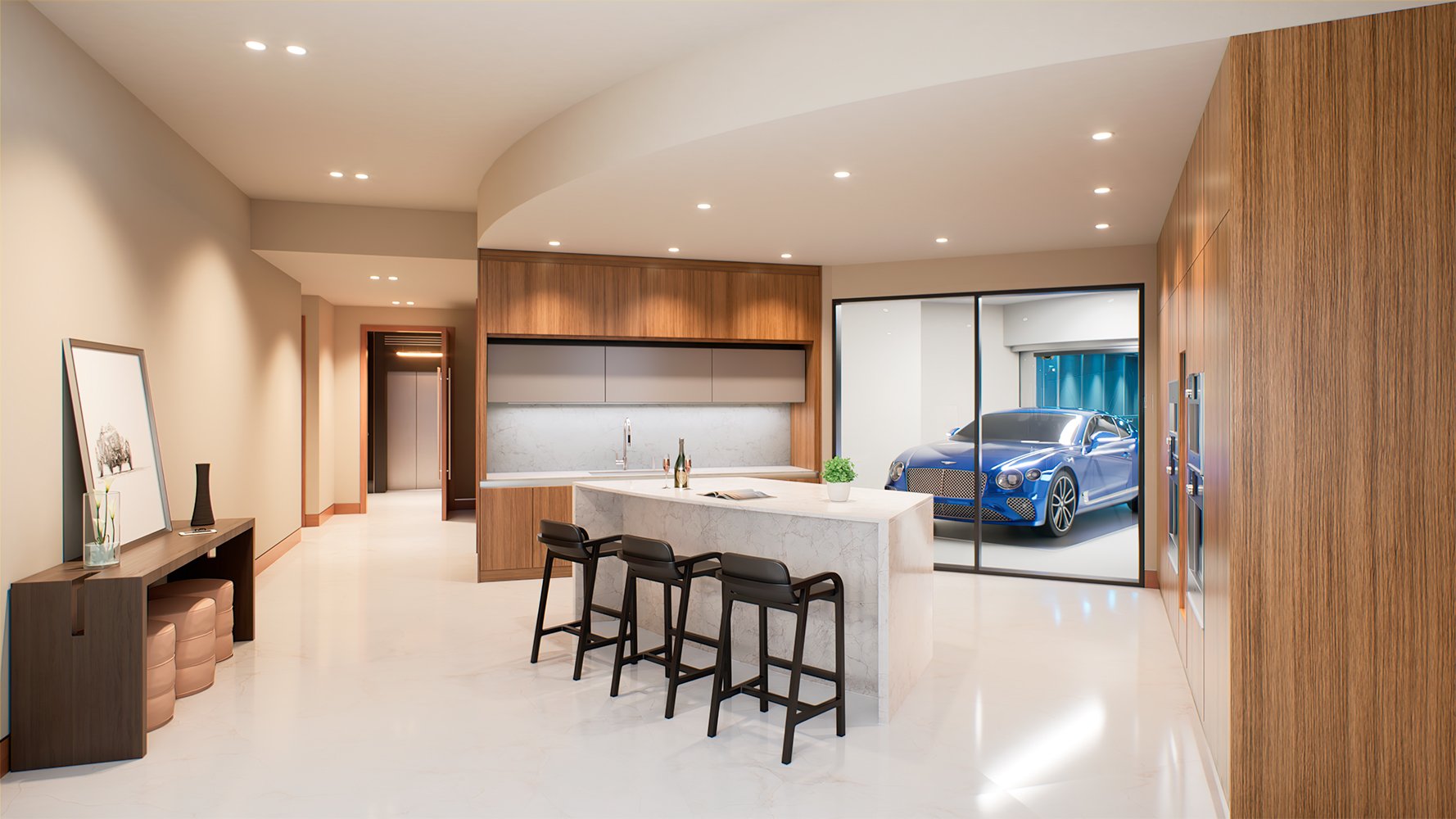
In South Florida’s ultra-premium condo market, parking is no longer a back-of-house afterthought. The most ambitious branded towers treat vehicle storage, arrival sequences, and charging as a direct extension of the home’s privacy, security, and daily rhythm. For buyers weighing an oceanfront lifestyle, that creates a new category of due diligence: not only views, finishes, and service, but the mechanics of how your car moves through the building.
The headline comparison in this space is Bentley Residences Sunny Isles versus the earlier benchmark of Porsche Design Tower, where bringing a car to the doorstep became equal parts theater and engineering statement. The lifestyle promise is straightforward: reduce friction between street and residence while maximizing control over who sees what-and when.
For decision-makers, the true differentiator is rarely the marketing language. It is the building systems: elevator logic, staging capacity, redundancy planning, noise and vibration control, and the way EV charging is integrated without compromising safety protocols or the resident experience.
A “sky garage” sounds like a single feature, but in practice it is a chain of interdependent systems.
First is arrival and handoff. In a conventional luxury tower, valet and resident self-parking are choreographed around ramps, gates, and circulation. In an automated or lift-based concept, the bottleneck shifts to interface points: the loading bay, the lift entry, and the dispatch logic that determines which vehicle moves next.
Second is throughput and queueing. Even in a low-density building, peak periods are real. Morning departures cluster. Weekend arrivals stack. Buyers should ask where vehicles wait when the lift cycle is occupied, and whether the building has sufficient staging to prevent back-ups that spill into the porte-cochere. The most livable systems feel invisible because they are designed to absorb congestion.
Third is privacy. Discretion is the selling point, yet it can erode if vehicles stage in public view, if residents routinely encounter other residents’ cars, or if staff and vendors can access sensitive zones without clear separation. For owners who treat the residence as a secure retreat, the garage functions as another front door.
Finally, there is reliability. The moment parking becomes mechanical, contingency planning becomes part of the luxury proposition. Buyers should understand what happens during maintenance windows, power interruptions, or a malfunction in a lift bay. The strongest solutions are built for graceful degradation-slower service rather than a total loss of access.
Sunny Isles has become a proving ground for high-concept residential engineering, supported by a market that rewards design-forward towers. If you are comparing oceanfront options more broadly along the same corridor, it can be useful to benchmark the overall resident experience against other luxury inventory such as Turnberry Ocean Club Sunny Isles and The Estates at Acqualina Sunny Isles, where priorities typically lean toward traditional valet operations, resort amenities, and privacy planning rather than car-to-residence theatrics.
Bentley Residences Sunny Isles
Is often framed as a next-generation branded tower that places the automotive lifestyle at the center of its identity. For buyers, the key is not the badge, but the intent: integrating vehicle movement into the daily pattern of residence life.
When a project is designed around a sky-garage narrative, the architecture and MEP coordination typically prioritize clear vertical pathways, controlled access zones, and predictable service sequences. That can translate into less resident exposure to everyday parking irritations: garage odors, ramp noise, headlight glare, and the sensation of entering a utility space.
The questions to ask are specific:
Where does the vehicle transfer from human control to building control, and who is allowed in that area?
How many lift cycles can the system realistically support during peak demand without creating a queue?
What redundancy exists if one bay is offline, and how are residents notified?
Even if you never plan to store your car “in the sky,” the underlying philosophy still matters. A building that over-invests in car logistics often over-invests in arrival experience, service routing, and resident separation-quality-of-life multipliers that show up daily.
For buyers who prefer branded luxury but are not car-centric, it is worth comparing with other brand-driven towers where identity is expressed through hospitality, wellness, or fashion rather than automotive engineering. Brickell’s branded pipeline offers a useful contrast point, including 888 Brickell by Dolce & Gabbana, where the conversation often begins with lifestyle programming, service culture, and interiors long before it gets to parking.
Porsche Design Tower remains the psychological baseline for the “car-to-residence” concept in Miami’s luxury consciousness. Regardless of the specifics a buyer has heard over the years, its lasting impact is that it normalized the expectation that a residential tower can treat the vehicle as a curated object rather than a necessity to hide.
For buyers today, the tower is less about novelty and more about lessons learned. Early adopters demonstrated that engineered convenience has real value-but also that mechanical systems must be evaluated like any other mission-critical component. Your lifestyle is only as smooth as the building’s operational discipline.
When comparing any two buildings with ambitious parking concepts, focus on what ownership actually feels like:
How often is the system serviced, and is it scheduled to minimize resident disruption?
Is there a culture of proactive maintenance, or is it reactive?
Do staff have the training to manage exceptions without improvisation?
These questions are not engineering for engineering’s sake. They protect time, privacy, and predictability-core luxury currencies in Miami Beach-adjacent living.
In 2026, EV readiness is not a single amenity. It is a building governance and electrical-capacity issue.
The first layer is capacity planning. A building can advertise chargers, but the lived experience depends on whether the electrical design anticipates growth in demand. As more households add EVs or plug-in hybrids, a charger count that looked generous at delivery can quickly feel scarce unless load management and expansion pathways were engineered from the start.
The second layer is allocation. Will charging be deeded, assigned, or shared? Shared systems can work well when paired with clear rules, monitoring, and enforcement. Without those, the charging area becomes the new version of a pool-chair dispute-except it affects daily mobility.
The third layer is compatibility with automation. If a tower’s parking experience relies on controlled movement and precise positioning, EV charging must be integrated in a way that avoids manual workarounds. Buyers should ask whether charging is provided where cars are stored, whether staff are involved, and how liability is handled for cable management and connector wear.
Finally, consider resilience and safety. EV infrastructure introduces additional considerations: fire-safety coordination, ventilation in enclosed areas, signage, and protocols for damaged vehicles. A truly luxury-grade implementation treats these as part of the overall risk plan-not an add-on.
For buyers evaluating EV readiness as part of a broader portfolio, it helps to compare how newer towers across submarkets approach building systems and resident services. West Palm Beach’s luxury new construction, for example, is increasingly systems-forward, and Alba West Palm Beach offers a contrasting lens on how a different waterfront city frames modern living without making the garage the headline.
The most useful comparisons are operational. When touring or reviewing disclosures, prioritize questions that force clarity.
What is the expected wait time during peak arrivals, and where do vehicles queue?
If a lift bay is offline, what is the fallback plan and what service level remains?
Who can enter the transfer area, and how is resident privacy protected?
How are mechanical vibrations isolated from residences and amenity floors?
Are chargers assigned or shared, and what rules exist for dwell time and fees?
Is there a defined pathway to add more charging capacity without major retrofits?
Is the building staffed and trained for high-touch exception handling, or is it self-service?
These questions also help buyers compare high-concept towers to more conventional ultra-luxury inventory in the same lifestyle bracket. In Sunny-isles, the distinction often comes down to whether you want the building to elevate the car into the residential narrative-or keep it efficiently invisible.
The influence of automotive-branded towers extends far beyond the number of units they deliver. They have pushed the market to treat engineering and logistics as part of the brand promise.
In Brickell, branding often shows up as interior language and hospitality cues. In oceanfront submarkets, branding is increasingly tied to privacy, arrival, and the choreography of daily life. The result is a buyer expectation that building systems perform at the same level as the finishes.
That expectation is quietly raising the bar everywhere. Even in towers without a sky-garage headline, the best new developments tend to optimize traffic flow, loading, service separation, and resident arrival. When done well, it reads as serenity: fewer micro-frictions, fewer public moments, and more control.
For the ultra-premium buyer, the strategic takeaway is simple. A sky garage is not only a feature-it is a declaration of priorities. If your priority is discretion, time efficiency, and a residence that accommodates a collector mindset, the garage concept may be central. If your priority is hospitality, wellness, and a more traditional sense of beachfront ease, you may prefer a tower where the car experience is refined but not performative.
Is a sky garage primarily a luxury feature or a practical one? It can be both, but its real value is time savings and privacy when operations are well run.
Do automated parking systems increase maintenance complexity? Yes, they add mechanical and software layers, so proactive maintenance and redundancy matter.
What should I ask about wait times for car retrieval? Ask about peak-hour handling, staging space, and the building’s typical cycle time expectations.
Can EV charging be added later if the building is not ready today? Sometimes, but capacity constraints can make retrofits costly; futureproofing is preferable.
Is assigned EV charging better than shared charging? Assigned is simpler for daily certainty; shared can work if rules and monitoring are strict.
Does EV charging change insurance or liability considerations? It can, especially if staff handle cables or vehicles; clarify protocols and responsibility.
How do I evaluate privacy in a car-elevator lifestyle? Look at access control to transfer zones, camera coverage, and how vehicles are staged.
Will mechanical parking affect resale value? It can add cachet for the right buyer profile, but only if reliability and operations are strong.
Are branded towers always better engineered than non-branded towers? Not automatically; judge the specific building systems, staffing, and operational track record.
What is the simplest sign a building’s car logistics are well designed? When arrivals feel calm and predictable, with no visible queueing or improvisation by staff.
For a confidential assessment and a building-by-building shortlist, connect with MILLION Luxury.
If branded residences are on your mind — as a home or as an allocation — we would be glad to share what we are seeing, privately.
Begin a quiet conversation