In Coconut Grove, the outdoor kitchen is no longer a luxury add-on. It is a planning problem, an architectural opportunity, and, for buyers, a litmus test for how a residence actually lives in summer. This editorial looks at the spatial footprint of a terrace-based summer kitchen with a gas grill through the lens of Ziggurat Coconut Grove, focusing on clearances, heat and smoke behavior, wind, materials, and the less-discussed realities of storage, noise, and service access. The goal is not to prescribe a single layout, but to help purchasers and designers evaluate whether a terrace can support a true cooking program without compromising comfort, finish durability, or neighborly discretion.
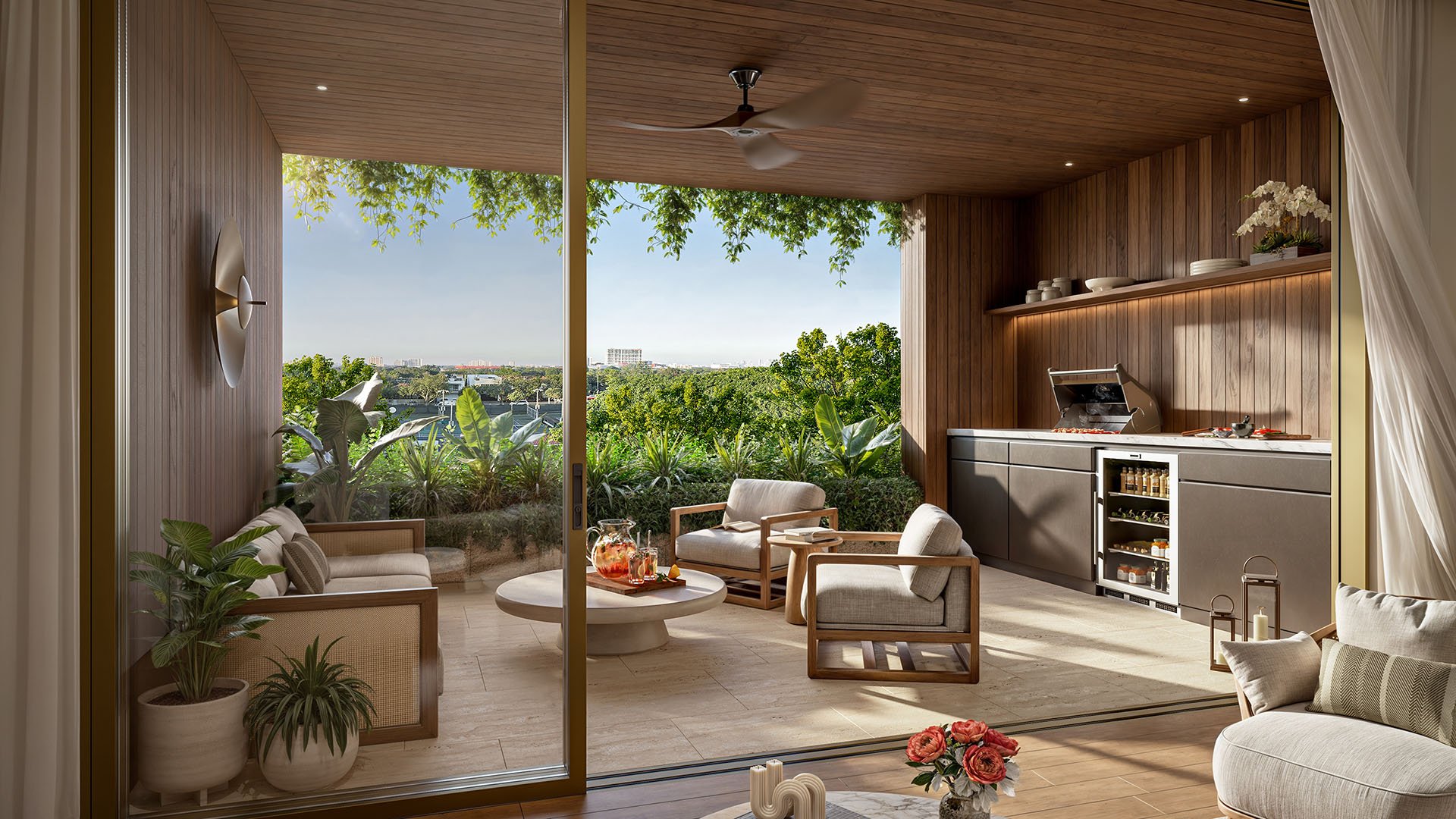
Summer in South Florida rewards homes that treat the terrace as a true living room. In Coconut Grove, where greenery, bay breezes, and a social dining culture shape daily life, the strongest outdoor kitchens feel inevitable-integrated, quiet, and scaled to the space rather than allowed to dominate it.
But “summer kitchen” can be a misleading phrase. The decisive question isn’t which appliance brand is specified. It’s whether the terrace can support the full operational footprint of cooking with gas: the heat plume, the smoke path, the working clearances, and the landing zones that keep guests out of the chef’s orbit.
For buyers assessing Ziggurat Coconut Grove, the terrace program becomes a fast way to read the project’s design discipline. A terrace that accommodates a gas grill with ease often reflects coherent structural planning, a clear service strategy, and exterior materials selected with the same rigor as the interior.
In luxury residences, the visible cabinet run can disguise the real space requirement. A functional outdoor-kitchen footprint includes:
The grill body and cart or built-in chassis
Combustible-free zones and separation distances
A primary landing zone (hot tray, platter, tools) adjacent to the grill
A prep zone (even if minimal) with a stable counter depth
Storage volume for tools, fuel shutoff access, and cleaning supplies
A circulation buffer so guests can pass without brushing hot surfaces
In practice, the “grill footprint” is often only half the space you need to reserve. The remainder is operational. If the terrace is tight, the kitchen can still work-but it should be intentionally minimal: a compact grill, a disciplined counter run, and storage that prevents clutter from living on the countertop.
A gas grill is a performance appliance. It’s also a controlled flame on a windy terrace. That pairing drives layout.
Start with human clearance: the cook’s stance, elbow room for tools, and a safe distance for anyone standing nearby. Then account for heat and smoke behavior. Grilling produces a rising plume that can stain soffits, haze glass, and migrate into interior spaces when door placement isn’t respected.
A discreet luxury terrace keeps the grill away from primary lounge seating, upholstered pieces, and high-touch circulation paths. The goal isn’t to isolate the cook-it’s to keep the experience social without pulling guests into the working zone.
Even when code and manufacturer requirements vary by model, the buyer’s logic stays consistent: confirm the terrace design anticipates clearances and safety, rather than relying on “we’ll be careful” as the plan.
Coconut Grove’s charm includes breeze. For grilling, wind is both an asset and a constraint.
Good airflow helps disperse smoke. Poorly considered airflow can push smoke toward sliding doors or neighboring terraces. On higher exposures, wind can also destabilize flame patterns and increase flare-ups.
A practical way to evaluate this is to stand where the grill would sit and think through the most common wind directions. If smoke is likely to travel into the interior, the kitchen will feel compromised. If smoke can lift and clear without crossing living zones, the kitchen reads as effortless.
In buildings where terraces function as real extensions of living space, this is where architecture does the heavy lifting: parapet heights, side walls, and soffit geometry can guide smoke away-or trap it overhead.
For buyers comparing outdoor-living philosophies across the market, it’s also useful to notice how different projects treat the terrace as a “room.” In Coconut Grove, residences like Park Grove Coconut Grove and The Well Coconut Grove often draw interest because indoor-outdoor expectations are high, which tends to raise the bar for terrace planning.
A terrace kitchen rarely fails loudly. It fails through discoloration, corrosion, and lingering odors.
South Florida’s humidity and salt exposure demand disciplined material choices. Stainless steel needs the right grade, with finishes that tolerate regular cleaning without becoming a fingerprint magnet. Counter surfaces should resist heat shock and staining from citrus, oils, and marinades. Cabinet hardware must truly perform outdoors, not merely look the part.
Also evaluate soffit and wall surfaces near the grill. Even with careful use, a grill can leave a fine film over time. If the design depends on pristine, light-colored surfaces directly above the cooking zone, maintenance becomes a lifestyle tax.
A strong terrace-kitchen plan anticipates cleaning access. It avoids unreachable corners where grease accumulates. It adds sensible splash protection without turning the cooking area into a commercial back-of-house.
Luxury isn’t the size of the grill. Luxury is the absence of visible disorder.
When storage is undersized, the terrace becomes a staging ground for accessories, covers, charcoal substitutes, platters, and paper products. That visual noise can make even an exceptional terrace feel temporary.
Service access matters, too. Gas shutoff access should be direct and intuitive-not hidden behind a puzzle of panels. If a future owner needs a technician, the plan shouldn’t require disassembling cabinetry or moving furniture.
During a walk-through, ask a simple question: where do the unglamorous things go? If the answer is “inside,” the outdoor kitchen is effectively decorative. If the answer is “here, invisibly,” the terrace was designed to be used.
Outdoor cooking has its own sound profile: lid clacks, utensils, vent hoods when present, and conversation gathering around the heat source.
In a refined building, the best terrace kitchens support sociability while preserving neighborly discretion. Placement away from shared boundaries, thoughtful shielding, and avoiding a “party corner” directly adjacent to another residence can be the difference between a joyful ritual and ongoing friction.
This discretion is part of the broader South Florida luxury conversation, especially as buyers weigh neighborhood lifestyles. In denser settings like Brickell, the calculus often shifts toward indoor amenity programming and acoustically controlled entertaining zones, where projects such as 2200 Brickell frame outdoor space differently than Coconut Grove.
The most usable outdoor kitchens function like compact galleys, supporting a clear sequence:
Set down and stage (cold tray, tools, ingredients)
Cook (grill zone with safe clearances)
Finish and serve (landing zone with room for platters)
Reset (trash, wipe-down, storage)
When any one of these zones is missing, the cook improvises. Improvisation is fine in a casual setting. It’s less acceptable in a residence positioned for elevated living, where the terrace should feel as controlled as the interior.
If the run is short, protect landing space. Many terraces can tolerate a smaller grill more easily than they can tolerate inadequate surface area. Landing space is what keeps hot trays from migrating to side tables, rail ledges, or upholstered seating.
Without assuming a specific appliance package, a buyer evaluating Ziggurat Coconut Grove can use the outdoor kitchen as a proxy for overall planning quality.
Look for proportion. A grill integrated into the terrace shouldn’t block the most desirable view corridor or compress circulation between indoor and outdoor seating. Look for adjacency. The ideal grill placement supports serving without dragging food through the main lounge zone.
Look for protection. Overhead conditions, wall proximity, and wind behavior should suggest smoke will dissipate-without staining finishes or migrating indoors. Look for durability. Exterior-grade detailing should read as intentional: drains, slopes, and surfaces that expect weather rather than pretending it won’t happen.
If the terrace kitchen reads as architecture, it’s likely to be used. If it reads as an appliance parked outdoors, it becomes a photo backdrop instead of a lifestyle anchor.
A polished evaluation can be done quickly during a tour:
Can two people pass behind the cook safely?
Is there a natural landing zone adjacent to the grill?
Do doors and windows nearby suggest smoke could enter the home?
Are there finishes above and around the grill that will tolerate heat and film?
Is storage adequate to keep the countertop visually clean?
Is the gas shutoff accessible and logical?
Does the layout keep the grill away from upholstered seating and high traffic?
This is also the moment to think about your broader portfolio of outdoor entertaining. If your calendar splits between Coconut Grove’s greenery and Miami Beach’s ocean exposure, remember that wind and salt behave differently across submarkets. In ocean-adjacent contexts, projects like 57 Ocean Miami Beach can sharpen your eye for how exterior detailing and material discipline become non-negotiable.
What is the “true footprint” of an outdoor kitchen with a gas grill? It includes the grill plus safety clearances, landing space, prep surface, storage, and circulation.
Where should a gas grill sit on a terrace for the best experience? Ideally where smoke can lift and clear, away from doors, primary seating, and tight circulation.
Does a larger grill always improve resale appeal? Not necessarily. Buyers tend to value a balanced layout and usable counter space over raw size.
How do I evaluate smoke risk during a daytime tour? Look at breeze behavior, door locations, and whether walls or soffits might trap smoke.
What materials hold up best for South Florida terrace kitchens? Exterior-grade metals, heat-tolerant counters, and hardware designed for humidity and salt exposure.
Is a vent hood required for an outdoor gas grill? It depends on the configuration, but many terraces prioritize open-air dispersion and smart placement.
How much storage is “enough” for a terrace kitchen? Enough to keep tools, covers, and cleaning supplies off the counter so the terrace stays composed.
What’s the biggest design mistake in outdoor summer kitchens? Underestimating landing space and circulation, which forces guests and hot surfaces too close.
How can a terrace kitchen stay discreet in a condo setting? Use placement, shielding, and a clean storage strategy to minimize noise, clutter, and smoke drift.
What should I ask before committing to a terrace kitchen upgrade? Confirm gas access, shutoff location, clearances, and whether the layout supports a complete cooking flow.
For a tailored shortlist and next-step guidance, connect with MILLION Luxury.
If branded residences are on your mind — as a home or as an allocation — we would be glad to share what we are seeing, privately.
Begin a quiet conversation