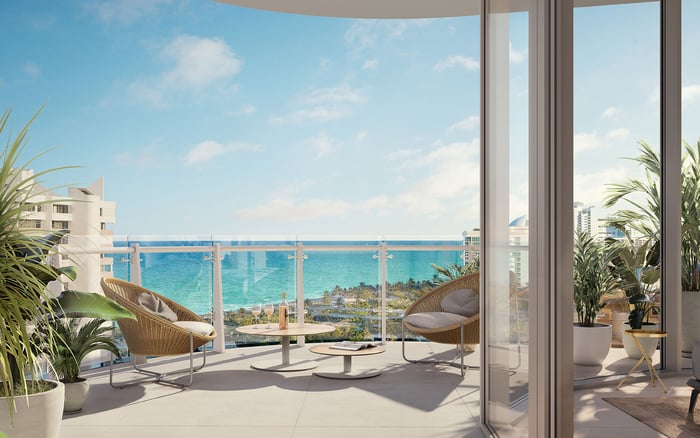
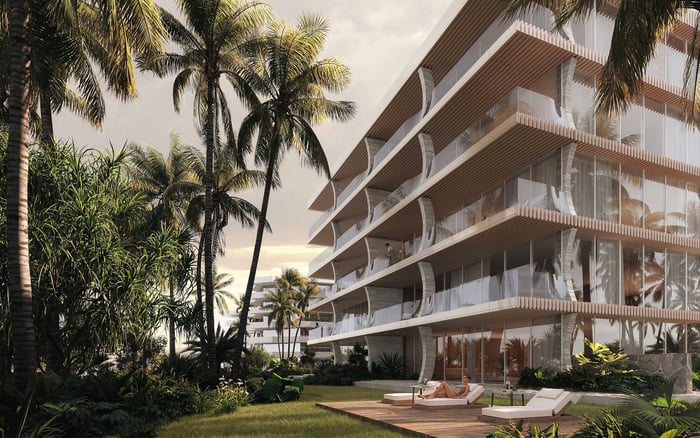
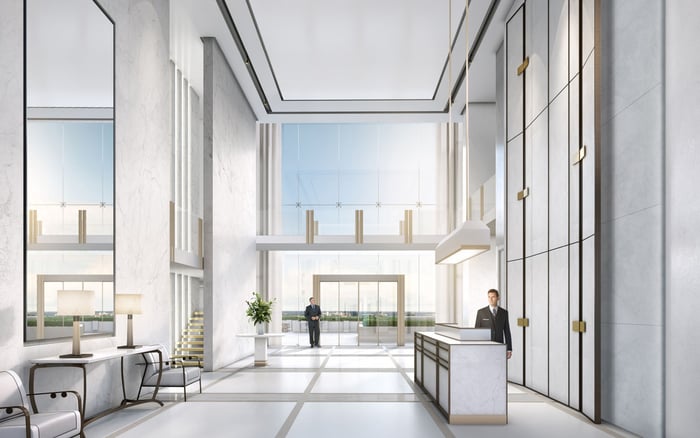
In Pompano Beach, two oceanfront-luxury narratives meet at the front door: the fashion-house signature of Armani/Casa and the service-first DNA of The Ritz-Carlton. This MILLION Luxury editorial assesses how each approach tends to translate into lobby execution, daily arrival, and long-term brand durability for owners.
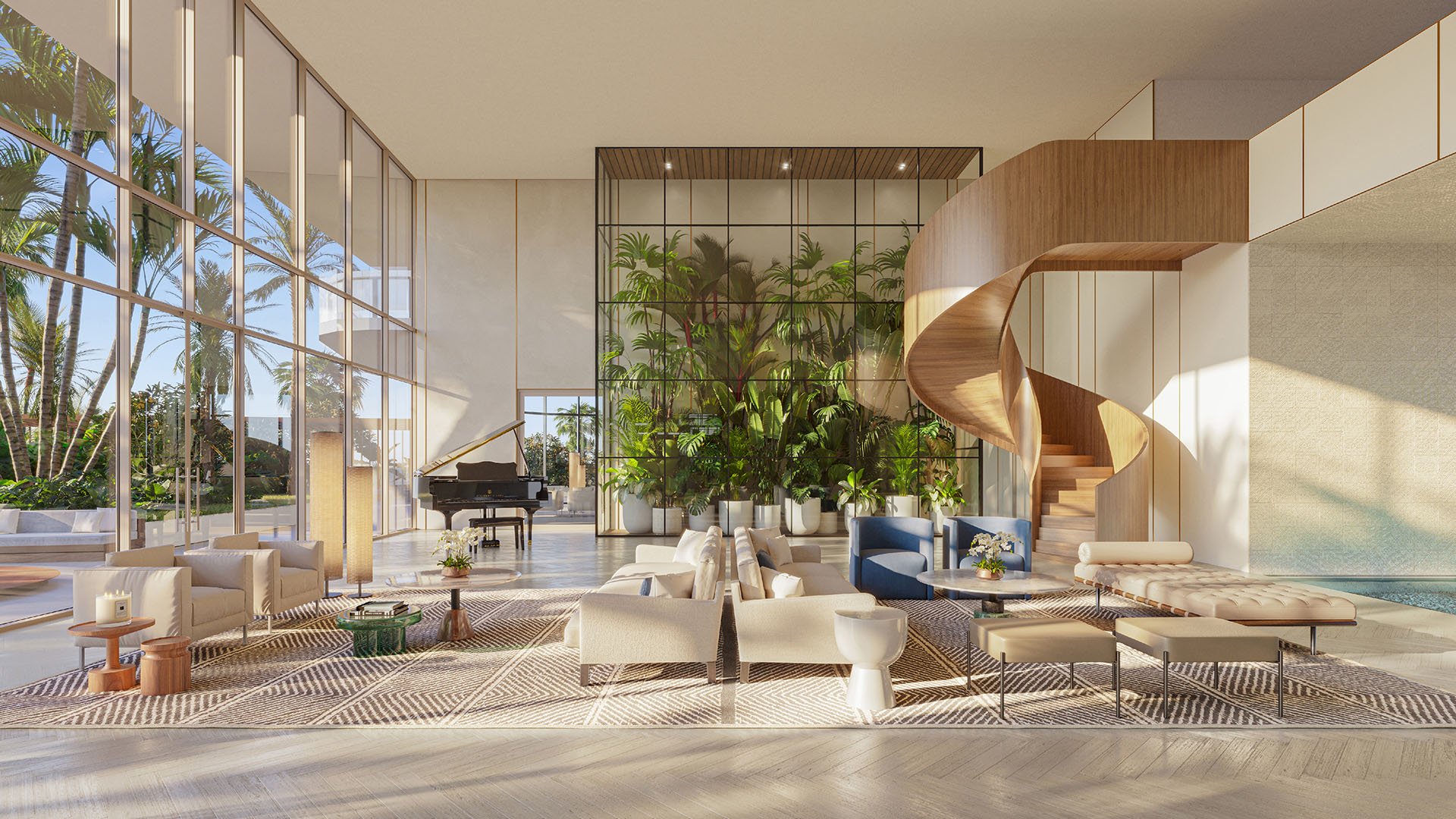
In ultra-premium coastal towers, the lobby isn’t a decorative prelude. It’s the building’s most repeated experience-the space owners and guests move through in daylight, after dark, in wet weather, in heels, with luggage, with children, with pets, or with a delivery in hand. In a branded project, the lobby is also the brand’s front-page signature: the place where expectations either settle into confidence or start to fray.
In Pompano Beach, Armani Casa Residences Pompano Beach and The Ritz-Carlton Residences® Pompano Beach share the same coastal conversation but come to “luxury” from different origins. Armani/Casa begins with aesthetic discipline: proportion, restraint, and a fashion-house logic translated into interiors. The Ritz-Carlton begins with hospitality: service choreography, arrival management, and the invisible systems that make a place feel effortless.
That difference matters because the best lobby execution is rarely about a single Instagrammable moment. It’s about repeatable performance: how the space holds up at peak times, how it protects privacy, how it sounds, how it smells, and how reliably it keeps owners oriented and calm.
Fashion-branded real estate succeeds when design codes become architectural behavior-not logo placement. At lobby scale, execution is typically judged through five buyer-relevant lenses:
Brand legibility without theatrics. The lobby should read as the house’s vocabulary, not a showroom.
Material honesty. Luxury audiences can feel the difference between stone and stone-look, wood and wood-look, metal and a coated substitute-especially in the first 30 feet.
Lighting discipline. The more minimal the palette, the more lighting must do: flatter skin tone, control gloss, and deliver an evening mood that still feels secure.
Acoustics and calm. Hard surfaces may look crisp, but they can also create harsh reverberation. High execution is quiet luxury-literally.
Back-of-house invisibility. Deliveries, staff movement, and service functions must be routed so the lobby remains a composed stage.
These criteria apply to any brand, but they’re especially unforgiving for fashion houses. A fashion brand trades in detail and fit; when a lobby is slightly off, it can read like an ill-tailored suit.
At its best, an Armani/Casa lobby is an exercise in restraint: tonal palettes, clean lines, and a controlled glamour that avoids visual noise. For buyers who value architecture as a personal signature, that restraint can be deeply compelling. The experience is often about entering a world where every surface feels intentionally edited.
From an execution standpoint, a design-led lobby has to satisfy two competing demands. First, it must deliver immediate recognition of the brand’s aesthetic. Second, it has to remain livable-at 7:30 a.m. with wet sandals and beach bags, at 10:30 p.m. with guests arriving, and at any hour when an owner simply wants to pass through without being “seen.”
In an Armani/Casa context, the most decisive success factors are often the least obvious: an entry sequence that slows you down without creating congestion; furnishings that read as sculptural yet feel genuinely comfortable; and a reception posture that comes across as discreet rather than performative. When those elements align, the lobby becomes a quiet statement of taste-not a set.
Because Pompano Beach is a true oceanfront lifestyle market, a design-first lobby also has to respect coastal reality. The highest execution isn’t “beachy.” It’s durable elegance: surfaces that can tolerate humidity and salt air, a layout that manages sand and water without degrading the aesthetic, and climate control that keeps the room feeling crisp.
A Ritz-Carlton-branded residential lobby is typically judged less like a gallery and more like a private hotel arrival-even when the building itself is purely residential in spirit. The value proposition isn’t just a look; it’s the predictability of being cared for.
That predictability shows up in micro-moments: the clarity of the drop-off, how arrivals are acknowledged, how quickly visitors are directed, and how discreetly staff operates when owners want anonymity. In other words, the “design” is also operational. The lobby functions as a control room for comfort.
For buyers comparing against a fashion-branded experience, the practical differentiator is that service-led lobbies are planned around people and patterns. Seating is positioned to support waiting without blocking flow. Sightlines are tuned so staff can monitor the room without making residents feel watched. Success is measured by how little residents have to think about the space.
In Pompano Beach, this can be especially appealing to second-home owners and frequent travelers who want logistics handled smoothly. A service-first lobby can feel like a buffer between oceanfront life and the outside world: not only beautiful, but managed.
When buyers ask MILLION Luxury to weigh “execution,” they’re usually asking whether the experience will still feel satisfying after the novelty fades. On that test, Armani/Casa and Ritz-Carlton often win in different ways.
Where Armani/Casa tends to win:
Aesthetic coherence. The lobby can read like the opening chapter of a fully designed home.
Taste signaling. For design collectors, the brand communicates recognizable restraint.
Photographic purity. Minimal, tonal environments tend to age well when materials are premium.
Where Armani/Casa can falter if execution is not exact:
Comfort vs. sculpture. If furnishings privilege form over function, the room can feel precious.
Acoustic hardness. Minimalism can become loud when softening elements are underweighted.
Operational friction. Without a hospitality-minded plan, peak-time movement can feel exposed.
Where Ritz-Carlton tends to win:
Arrival choreography. The lobby reads as a system, not merely a room.
Discretion by design. Privacy is supported through staffing and circulation.
Consistency. The experience is built to be repeatable, day after day.
Where Ritz-Carlton can falter for design purists:
Conservatism. Service-first spaces can feel safe rather than daring.
Over-programming. Too many “hotel cues” can dilute residential calm if the balance is off.
The best outcome, in either model, is when you stop thinking about the brand entirely and simply register that the building is exceptionally well run and beautifully composed.
Lobby tours are often rushed. For a meaningful comparison between Armani Casa Residences Pompano Beach and The Ritz-Carlton Residences® Pompano Beach, ask to experience the entry the way you would actually live it.
Do a full arrival loop. Approach from the street, pause at the door, walk to reception, then to the elevators. The best lobbies feel intuitive-without signage shouting at you.
Listen to the room. Stand still for 20 seconds. Is it quiet, or do footsteps and voices ricochet?
Watch the thresholds. The transition from exterior to interior should manage wind, moisture, and temperature without feeling like an airlock.
Check privacy zones. Can you wait without sitting in a spotlight? Can a guest be greeted without the entire room knowing why they’re there?
Ask about service routing. Where do packages go? Where do deliveries arrive? When routes are separated, the lobby keeps its composure.
Even for buyers focused on investment, these “soft” details shape renter and resale perception. A lobby that feels calm and expensive can support pricing power in a way amenities alone cannot.
Pompano Beach is increasingly discussed alongside other South Florida luxury nodes as branded execution moves north and west from legacy enclaves. Buyers cross-shopping the market often compare the Pompano beachfront experience to established benchmarks in nearby Fort Lauderdale or to branded design statements in Miami.
For a service-and-lifestyle reference point, Four Seasons Hotel & Private Residences Fort Lauderdale often enters the conversation-not as a direct substitute, but as a reminder of what hospitality DNA can do for everyday arrival and owner experience.
For buyers drawn to fashion-house identity, the market has also embraced more overt design branding in urban settings, such as 888 Brickell by Dolce & Gabbana in Brickell. The comparison helps clarify preference: are you buying the serenity of a refined interior language, or the energy of a more extroverted brand statement?
And for those who prioritize oceanfront quiet and a boutique feel, projects like Ocean House Surfside offer a different lens on lobby execution: less about a global brand stamp, more about residential intimacy and privacy. These comparisons are useful because they separate true execution from mere branding.
In practice, owners don’t live in a lobby. They live with it. The difference is subtle-and decisive.
Choose a design-led, fashion-branded lobby when you want your building to feel like an extension of personal style: edited, composed, and visually disciplined. The best executions make arrival feel like entering a private residence curated at a global standard.
Choose a service-led hospitality brand when you want your building to feel like an extension of personal rhythm: greeted when you want it, unseen when you don’t, and supported by operational fluency. The best executions make arrival feel like it has been quietly handled for you.
For the Pompano Beach buyer, both paths can be “luxury.” The better fit is the one that makes you exhale the moment the door closes behind you.
Is a branded lobby mostly about aesthetics? No. The best branded lobbies combine design with operations, privacy, and flow.
What makes a fashion-branded lobby feel authentic? When the brand’s design language is expressed through materials, proportion, and detail.
What makes a hospitality-branded lobby feel residential? Discreet service, quieter programming, and layouts that prioritize owner privacy.
Should buyers worry about lobby trends aging quickly? Yes. Timeless materials and disciplined lighting usually age better than novelty.
How can I judge lobby quality on a short tour? Walk the full arrival route and listen for acoustics, congestion, and staff visibility.
Do lobbies affect resale and leasing perception? Strong first impressions and calm operations can support pricing and buyer confidence.
What is the biggest risk in minimalist lobby design? If details and acoustics are off, the space can feel hard, loud, or unfinished.
What is the biggest risk in service-forward lobby planning? Overly hotel-like cues can dilute the sense of home if not balanced thoughtfully.
Does Pompano Beach attract second-home buyers who value service? Often, yes. Many buyers prioritize frictionless arrivals and managed day-to-day needs.
What should I ask about behind-the-scenes operations? Ask where deliveries, packages, and staff routes are located so the lobby stays composed.
To compare the best-fit options with clarity, connect with MILLION Luxury.
If branded residences are on your mind — as a home or as an allocation — we would be glad to share what we are seeing, privately.
Begin a quiet conversation