A buyer-oriented look at what “custom Italian cabinetry” and “Miele appliance suites” typically signal in a luxury residence, and how to evaluate them at Alma Bay Harbor Islands through materials, detailing, performance, and serviceability.
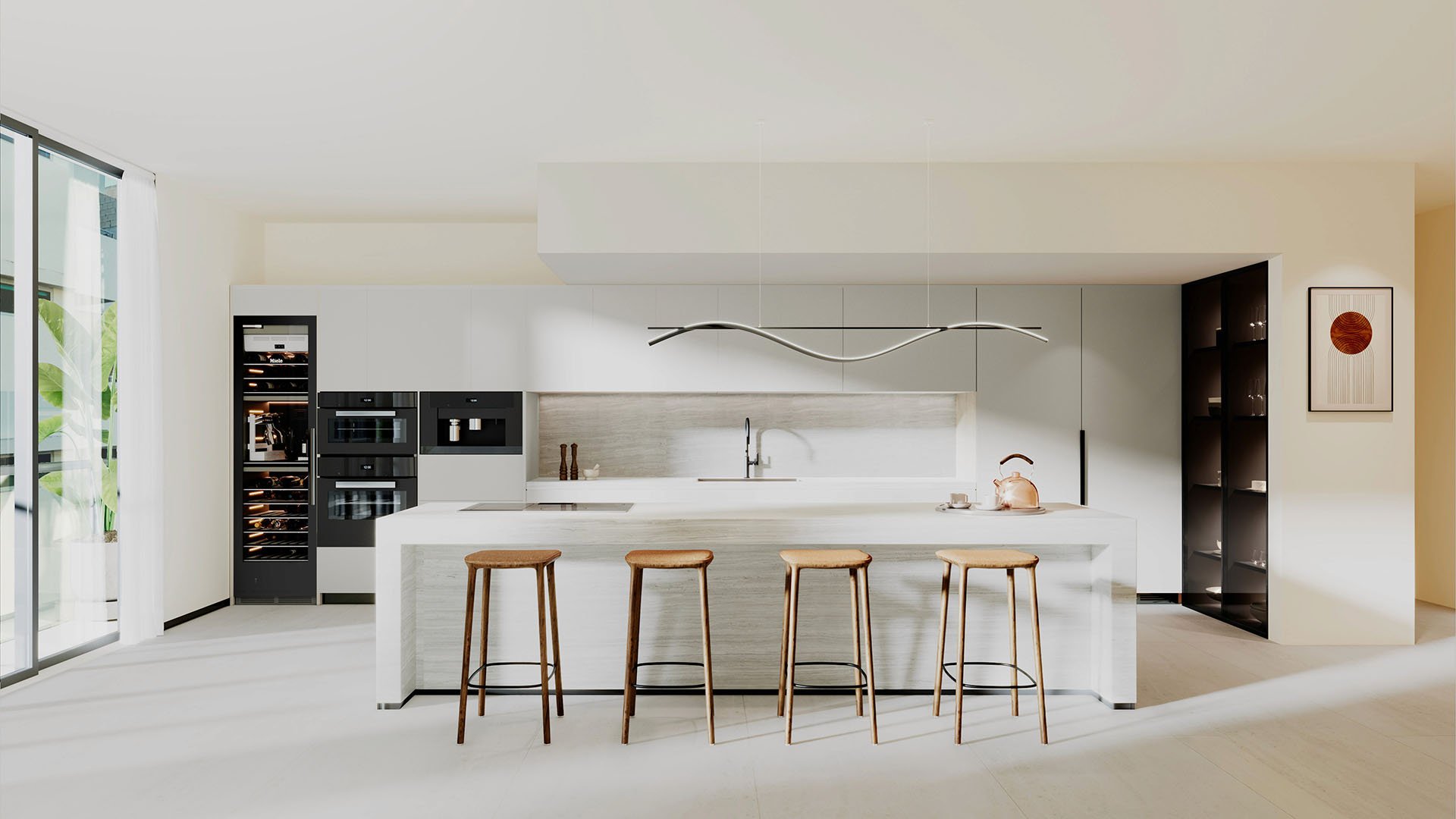
In Bay Harbor Islands, the kitchen has quietly become the most scrutinized interior investment after the view. Not because owners suddenly want to cook more, but because the kitchen now carries an outsized share of the home’s resale narrative: the tactile quality of the cabinetry, the coherence of the appliance suite, and the discipline of the detailing signal whether a residence was conceived as true luxury or merely packaged as such.
At Alma Bay Harbor Islands, the headline pairing of custom Italian cabinetry and Miele appliance suites reads like familiar luxury shorthand. The intelligent buyer goes a level deeper. “Italian” can describe anything from exceptional millwork culture to a marketing adjective. “Miele suite” can mean a fully integrated, correctly vented, correctly powered kitchen-or a beautiful lineup undermined by installation decisions that are expensive to unwind.
What follows is a practical framework to evaluate both, with the discretion and rigor expected in a boutique, design-forward submarket like Bay Harbor.
The difference between cabinetry that photographs well and cabinetry that lives well is usually invisible in a sales gallery. It shows up in the substrate, the tolerances, and how the system anticipates Miami’s humidity and daily use.
Ask what sits beneath the finish. The strongest systems typically rely on stable, moisture-resilient substrates with consistent density. Veneer and lacquer can be exquisite, but the underlying panel quality determines whether doors stay aligned and drawer fronts remain true over time. With “custom” programs, also confirm whether exposed edges receive a matching edge treatment that feels intentional-not merely sealed.
A simple buyer test during a walkthrough: study the shadow lines. Even reveals around doors and panels suggest consistent fabrication and careful installation. Uneven gaps, doors that “fight” soft-close, or drawer faces that sit proud of adjacent fronts point to misalignment that can become chronic in a high-use kitchen.
A premium Italian system often implies modular precision: clean interiors, thoughtful organizers, and hardware that feels quiet and controlled. The tell is how the cabinet behaves under load. Fully extended drawers should stay stable when pulled with weight inside, without lateral wobble.
Also evaluate the toe-kick and end panels. A luxury kitchen reads as a continuous piece of architecture when end panels are properly returned and toe-kicks align cleanly across runs-especially at islands.
South Florida is not a forgiving environment for fine interior woodwork. The kitchen’s performance depends on what you do not see: correct sealing at sink bases, protective liners where needed, and a ventilation strategy that limits lingering moisture and heat.
If you are comparing Alma to other boutique options in the neighborhood, it can be useful to calibrate expectations against nearby Bay Harbor offerings like Onda Bay Harbor or La Maré Bay Harbor Islands, where buyers often prioritize compact, design-centric layouts and demand a higher level of finish discipline.
Miele’s reputation rests on engineering consistency and integration-friendly design. But the suite only performs as intended when three practical issues are handled correctly: ventilation, electrical load, and service access.
If the cooktop is induction, ventilation is still crucial in Miami because humidity and odor management matter as much as smoke capture. If the cooktop is gas, ventilation becomes non-negotiable.
Verify whether the hood is ducted to the exterior or recirculating. Ducted systems generally deliver stronger performance and reduce long-term residue on surrounding cabinetry. If it is recirculating, confirm filter access and replacement cadence; neglected filters can turn a beautiful kitchen into a persistent odor trap.
Luxury buyers increasingly arrive with expectations formed in places like Brickell’s newest towers. In high-rise contexts, induction, steam, speed ovens, wine storage, and integrated refrigeration can push electrical demands and panel planning. A “Miele suite” should feel effortless: ovens that do not trip breakers, refrigeration that is properly leveled and ventilated, and dishwashers that are quiet because they are correctly mounted and sealed.
If you are cross-shopping to benchmark appliance integration norms, note how strongly kitchen systems are positioned in more vertical lifestyle product such as 2200 Brickell, where buyers often expect a polished, gallery-like appliance wall and seamless paneling. The lesson is transferable: integration is not just aesthetics; it is the coordination between trades.
In a luxury residence, the most frustrating failure is not an appliance issue-it is an appliance issue that requires dismantling cabinetry to solve. Look for:
Access panels where appropriate.
Sensible clearances around built-ins.
A refrigerator installation that can be serviced without damaging panels or flooring.
When cabinetry is truly “custom,” it should anticipate servicing realities rather than treat appliances as permanent sculpture.
The best kitchens do not announce brand names. They read as a unified composition of planes, reveals, and proportions.
Integrated refrigerators and dishwashers should align with adjacent cabinet fronts. Pay attention to handle alignment and vertical reveals. Inconsistent handle height or misaligned panels may be minor individually, but they disturb the calm that defines luxury.
If the kitchen uses a tall bank for ovens and refrigeration, the ergonomic logic matters. Ideally, the daily-use oven sits at a comfortable height, and the sequence of storage, prep, cook, and clean follows a coherent path. In compact boutique footprints, poor sequencing can make an otherwise gorgeous kitchen feel tight.
Italian cabinetry often leans toward refined sheen levels, whether lacquered or satin. Pair that with Miami daylight and you need lighting discipline: under-cabinet task lighting that is even, not spotty; warm temperature selection that does not fight the cabinetry’s undertone; and reflective surfaces placed intentionally so the kitchen feels luminous rather than glaring.
Without drifting into construction jargon, you can ask a few high-signal questions that reveal the quality of the build-out and the developer’s priorities.
What is the cabinetry program specifically, and what parts are truly custom versus standard modules?
How is ventilation handled for the cooktop, and is it ducted?
Are the Miele components fully integrated with matching panels where applicable?
What provisions exist for service access, especially for refrigeration and built-in ovens?
What is the warranty and service pathway for both cabinetry hardware and appliances?
These questions are less about negotiating and more about avoiding surprises after closing.
Bay Harbor Islands tends to reward restraint. Many buyers here are not chasing the loudest amenity stack; they want a quieter version of luxury: polished detailing, privacy, and the sense that the building is curated rather than crowded.
In that context, a custom Italian cabinetry and Miele suite combination is best understood as a signal of intent. It suggests the kitchen is expected to perform at a high level while remaining visually composed. The critical variable is execution: the same brand names can yield wildly different outcomes depending on installation discipline and the decisions made at corners, fillers, and appliance transitions.
If your search expands slightly while staying in a boutique lane, it is worth contrasting the Alma proposition with other nearby residential narratives, from the design-forward positioning of Origin Bay Harbor Islands to the wellness-tilted conversation around The Well Bay Harbor Islands. Even when the styling differs, the most durable value tends to come from the same place: interior decisions that are hard to replicate later.
In any luxury purchase, prioritize what is hardest to re-create post-closing.
Cabinetry systems are among the most expensive and disruptive upgrades. If the boxes, hardware, and alignment are correct, you can alter the look later with pulls, lighting, or select surface changes. If the cabinetry is flawed, cosmetic improvements rarely resolve the underlying issues.
Appliance suites are comparatively easier to swap, but only if the cabinetry and utility planning support it. A perfectly integrated Miele suite is valuable, but an adaptable kitchen architecture is often more valuable long term.
The ideal result is a kitchen that feels inevitable: nothing calls attention to itself, everything works, and the room supports the way the residence is actually lived in-whether that means daily use or impeccably low-maintenance second-home ownership in Bay Harbor.
What does “custom Italian cabinetry” usually mean in a new luxury condo? It typically signals an Italian-made or Italian-designed cabinet program with upgraded finishes and precise modular detailing, but “custom” should be confirmed in scope.
Is a full Miele suite automatically a premium upgrade? It is a strong indicator, but real value depends on correct ventilation, power planning, and installation quality.
Should buyers prefer integrated appliances or professional-style stainless? Integrated suites favor a calmer, more architectural look; stainless favors visual statement and sometimes larger capacities, depending on the model mix.
What is the quickest way to spot high-quality cabinetry during a tour? Check for consistent reveals, smooth drawer action under pull, and doors that align cleanly across runs.
How important is ducted ventilation in South Florida? Very important for controlling humidity, odors, and residue, especially in residences that are closed up part of the year.
Can cabinetry be repaired if panels swell or doors go out of alignment? Minor adjustments are common, but chronic movement can indicate substrate or installation issues that are costlier to correct.
Does a Miele dishwasher require special installation considerations? Yes, proper leveling, sealing, and mounting reduce noise and prevent steam from impacting adjacent cabinetry.
Are handleless cabinet designs practical for everyday use? They can be, but they need well-designed finger pulls or push-to-open hardware and finishes that resist fingerprints.
What should I ask about appliance service access? Confirm that built-ins can be removed for servicing without dismantling surrounding panels or damaging floors.
How do I compare kitchen specs across Bay Harbor Islands projects? Look past brand names and focus on detailing, integration, ventilation approach, and how the kitchen functions in the actual floor plan.
For a confidential assessment and a building-by-building shortlist, connect with MILLION Luxury.
If branded residences are on your mind — as a home or as an allocation — we would be glad to share what we are seeing, privately.
Begin a quiet conversation