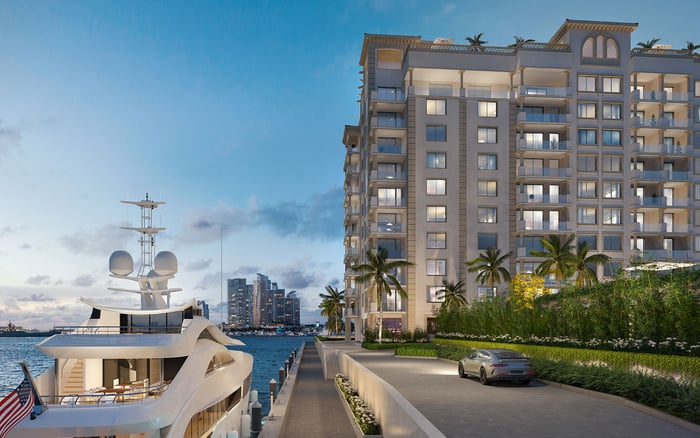
For waterfront estate owners moving into a condominium, the real luxury is not simply scale. It is whether a residence preserves the choreography of a fully staffed household through discreet service access, true staff quarters, prep kitchens, private lobbies, smart-home control, and building operations that can absorb daily logistics without friction. This article ranks the South Florida settings and residence types that best suit that transition, then outlines the planning details sophisticated buyers should verify before committing.

A certain South Florida buyer is not looking to simplify in any ordinary sense. They are leaving behind a waterfront estate, but not the standards estate living made nonnegotiable: privacy, gracious entertaining, dependable household support, and the ability to leave for weeks without operational anxiety. In today’s market, that reality has made the upper tier of the condominium landscape especially relevant.
More owners are moving from single-family homes into turnkey luxury residences, and the appeal is easy to understand. The lock-and-leave format reduces maintenance while preserving an expectation of service. But downsizing from a dockside compound to a tower or boutique building works only when the residence has been planned for staff as carefully as it has been planned for the owner.
That distinction matters. A very large apartment is not automatically a staff-ready apartment. The strongest candidates combine water views, substantial square footage, and genuine service infrastructure. In practical terms, that means separate staff circulation where available, service elevators, private or semi-private arrival, prep kitchens or butler’s pantries, and a floor plan that integrates household support without intruding on family life.
In areas such as Miami Beach, Bal-harbour, Brickell, Coral-gables, Edgewater, and Palm-beach, this is increasingly the dividing line between a cosmetic downsize and a successful lifestyle transition.
1. New-construction waterfront condominiums with true back-of-house design
For most estate downsizers, this is the clearest first choice. New construction is generally more likely to incorporate private lobby arrival, modern service access, discreet delivery handling, and smart-home systems that allow an owner to delegate lighting, climate, security, and access control to staff or remote management.
The real advantage is coherence. In the best buildings, household operations are not improvised after the fact. They are designed from the outset so entertaining, housekeeping, and daily living unfold with the ease one expects in a well-run home.
2. Large-format flow-through residences with a distinct staff suite
A buyer coming from a waterfront estate is often less concerned with bedroom count than with household choreography. Flow-through units remain compelling because they preserve separation between formal rooms, private family space, and service functions. The crucial detail is whether the floor plan includes a true staff bedroom and bath rather than a den presented with suggestive language.
This category often suits owners who still maintain a house manager, nanny, chef, or rotating domestic support and want those roles accommodated gracefully.
3. Full-service branded or hospitality-oriented buildings with robust operations
Former estate owners are accustomed to managed systems, even when those systems were privately organized. Buildings with valet, concierge, engineering support, and housekeeping coordination often offer the smoothest transition because they absorb a meaningful share of day-to-day logistics.
That can be especially important for second-home owners who value ease as much as prestige. In this tier, service culture is not an amenity. It is central to the residential proposition.
4. Boutique waterfront buildings with oversized residences and lower density
Not every downsizer wants the scale of a major tower. Some prefer a more discreet setting with fewer neighbors, quieter common areas, and a stronger sense of privacy. Boutique buildings can be excellent choices if they still deliver meaningful service infrastructure and layouts large enough to preserve staff-ready planning.
The question is whether intimacy has come at the expense of operations. A low-density building without proper service circulation can feel elegant on paper and cumbersome in practice.
5. Palm Beach and adjacent lower-density luxury residences
For some buyers, the answer is not a taller building but a quieter one. Palm-beach remains a compelling alternative for those who want prestige, water orientation, and service in a setting that feels more restrained than Miami’s tallest skyline product.
This can suit owners accustomed to established social patterns and a more residential cadence, provided the building’s staffing, vendor access, and household logistics are clearly workable.
The phrase is often used loosely, but sophisticated buyers should be exacting. A residence should not be considered staff-ready simply because it is large. The planning must support domestic help without compromising discretion.
Start with the floor plan. A distinct staff bedroom and bath is more credible than a generic flex room. If an owner expects live-in help, overnight support, or even frequent rotating staff, that distinction is essential. Next, study the service sequence. Is there a prep kitchen, a butler’s pantry, or a secondary corridor that keeps entertaining polished and the main kitchen uncluttered? Can staff move through the residence without crossing ceremonial spaces every time a tray, garment bag, or grocery delivery arrives?
In newer product, smart-home systems add another layer of utility. Access permissions, lighting scenes, climate control, and security can all be delegated with greater precision, making the apartment easier to run when the principal is away.
This is why some buyers are drawn to projects such as Rivage Bal Harbour or The Perigon Miami Beach, where the broader conversation centers on contemporary luxury living, privacy, and modern planning rather than simply raw size.
Miami Beach and Bal-harbour remain natural targets for owners who still want a deeply water-oriented life. Ocean or bay views continue to matter even after a move away from private waterfront land. The emotional substitution has to be convincing: if the estate’s dock and grounds disappear, the residence must answer with horizon, light, and ease of service.
Brickell attracts a different version of the buyer, one that values proximity to business, travel, and urban convenience but still expects a formal standard of living. In that context, developments such as St. Regis® Residences Brickell or The Residences at 1428 Brickell align with the preference for new-construction, service-oriented residences that support a lock-and-leave lifestyle.
Coral-gables deserves attention for buyers who prioritize privacy, tradition, and proximity to established domestic staffing networks. It offers a different expression of luxury, with a more residential cadence and practical appeal for those who want refined surroundings without surrendering household support systems. A project such as Ponce Park Coral Gables fits naturally into that discussion.
Palm-beach and West-palm-beach appeal to buyers who want prestige with a lower-density rhythm. In that orbit, residences such as Alba West Palm Beach can speak to the preference for water, service, and a more measured scale.
For this audience, the inspection process should extend well beyond finishes and view lines. Buyers should verify the legal configuration of the residence, including whether the marketed layout and square footage correspond to public records. That is particularly important when a listing implies staff quarters that may function more like an office or den.
It is also wise to review transaction history and building context to understand whether a premium is being attached to a genuinely rare large-format residence or simply to branding. In parallel, association rules deserve careful scrutiny. Domestic employees, deliveries, vendors, move-ins, and service access are governed differently from one condominium to another, and those differences directly affect daily life.
Older resale inventory can still be attractive, especially in iconic waterfront buildings, but buyers accustomed to estates should be alert to one recurring issue: some older properties do not provide the service elevators, separate circulation, or concealed back-of-house flow that staff-dependent households require. Resale can be beautiful. It is just not always operationally graceful.
The best downsizing decisions do not feel like compromise. They feel like editing. The residence becomes easier to manage, more secure, and more effortless to leave, while preserving the rituals that matter: proper arrival, formal entertaining, morning light over the water, and a household that runs discreetly in the background.
For that reason, the most compelling South Florida residences are not merely oversized condominiums. They are homes calibrated for service, privacy, and continuity. For the waterfront estate owner who still expects staff-ready planning, that calibration is the whole point.
What is the single most important feature for a staff-ready condo? A true staff bedroom and bath is usually the clearest sign that the residence was designed for household support rather than casual overflow use.
Are newer buildings usually better for this buyer? Yes. Newer buildings are generally more likely to include service access, private arrival sequences, and modern automation from the outset.
Can a resale condo still work after leaving a waterfront estate? It can, but only if the building’s service circulation and operational rules are as strong as its finishes and views.
Why do water views still matter to downsizers? Buyers leaving waterfront homes often still want bay, ocean, or Intracoastal outlooks as part of the lifestyle continuity.
Is a den enough to count as staff quarters? Usually not. Staff-ready planning is more credible when the layout includes a distinct bedroom and bath.
What building services help most with the transition from estate living? Valet, concierge, engineering support, and housekeeping coordination tend to create the smoothest operational shift.
Should association rules be part of the buying decision? Absolutely. Rules for domestic employees, vendors, and deliveries can materially affect convenience and privacy.
Are boutique buildings better than large towers for privacy? They can be, provided they still offer the service infrastructure needed for a staff-supported household.
Does smart-home technology really matter in this segment? Yes. It helps owners delegate access, climate, lighting, and security functions to staff or remote oversight.
What defines a successful downsize in this market? A residence that preserves service, privacy, and water-oriented living while reducing maintenance and operational burden.
When you're ready to tour or underwrite the options, connect with MILLION.
If branded residences are on your mind — as a home or as an allocation — we would be glad to share what we are seeing, privately.
Begin a quiet conversation