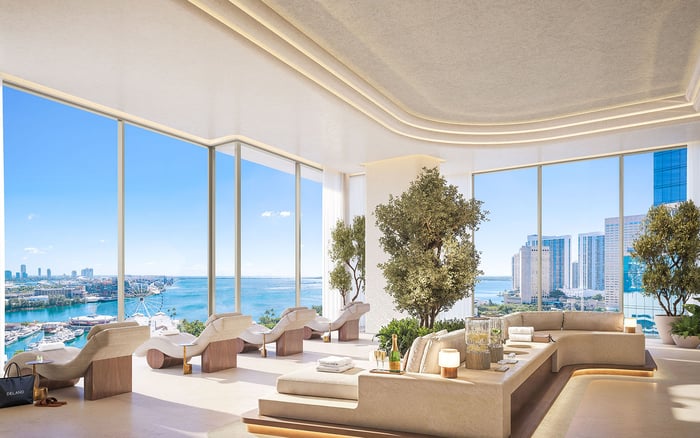
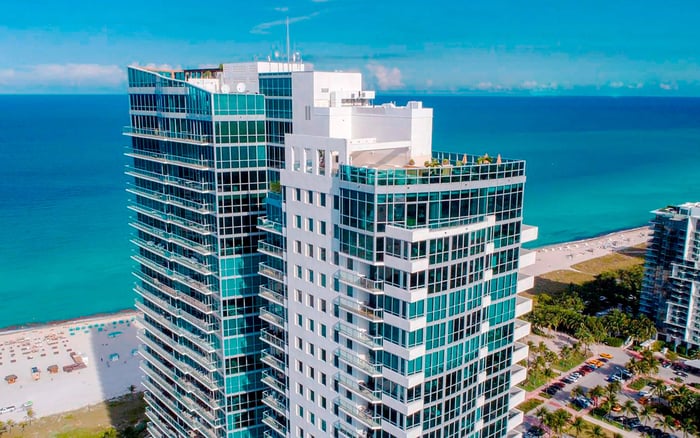
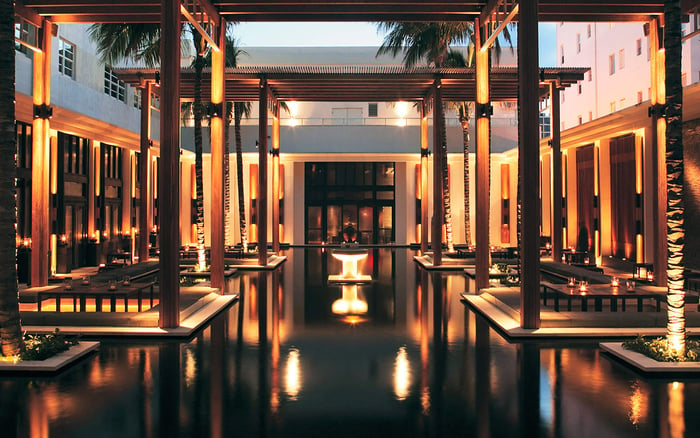
Aman’s planned Miami Beach debut combines the restoration of the 1940 Versailles Hotel with a new Kengo Kuma designed residential tower, bringing a rare 22-residence, 56-key hotel program to an oceanfront address in the Faena District.
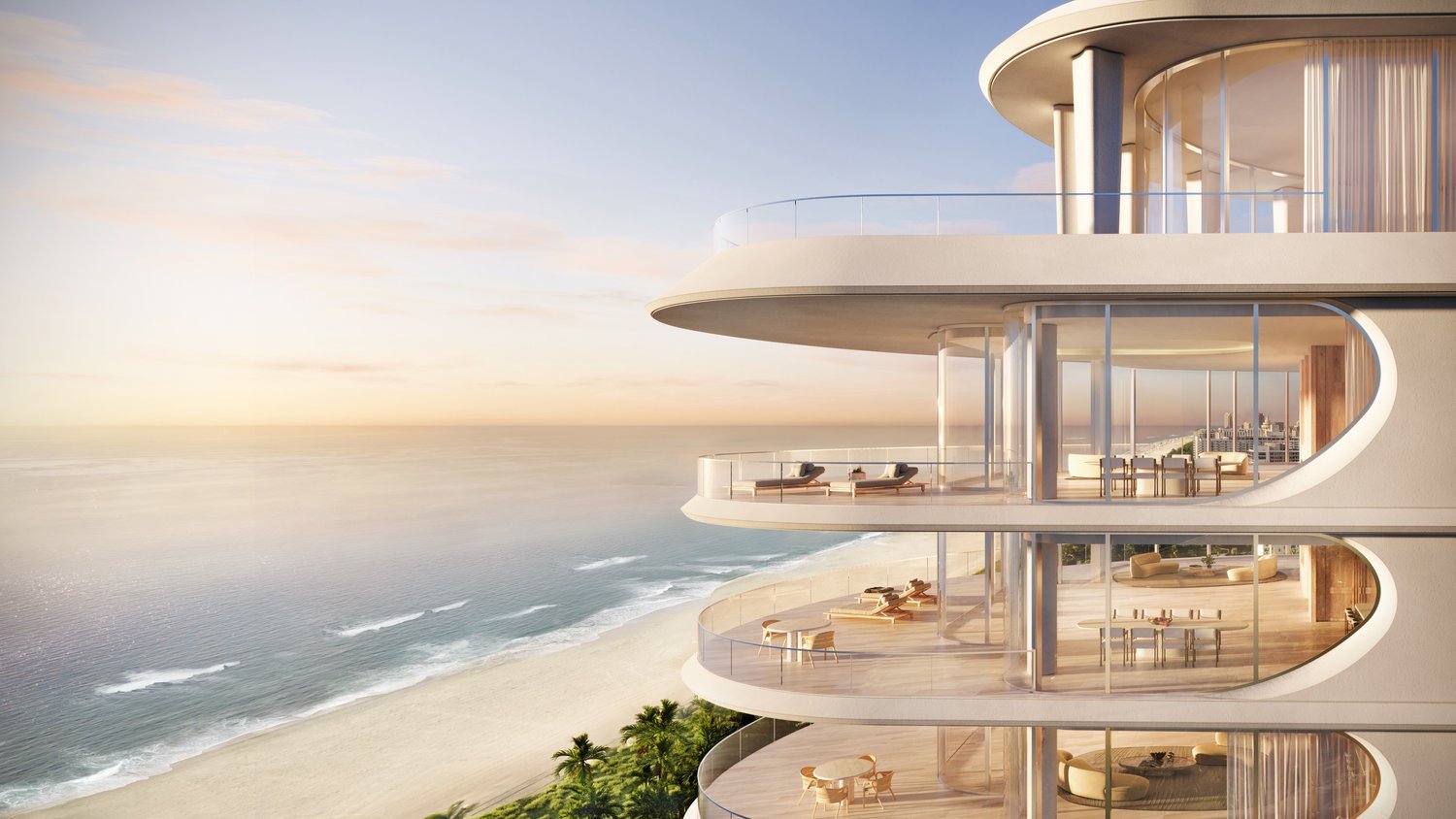
Miami rarely runs short on new luxury inventory, yet truly differentiated offerings remain scarce. Aman Miami Beach, planned for 3425 Collins Avenue in the Faena District, reads less like another launch and more like a directional marker for where the Miami Beach buyer is moving: toward quieter scale, deeper design authorship, and a stronger sense of place.
The headline is not only the Aman name. It is the project’s dual mandate: restore the historic Versailles Hotel and pair it with a new Aman-branded residential tower on the same oceanfront site. That blend speaks to a specific buyer profile that wants privacy and service, but also longevity, architectural integrity, and an arrival experience that feels rooted in Miami Beach rather than interchangeable.
Public reporting also indicates the residences were fully presold in 2021 at an average reported price of about $5,000 per square foot. The absorption question, at least at launch, was answered early.
The Faena District is often described as spanning Collins Avenue from around 32nd to 36th streets, with cultural anchors that include Faena Forum and Faena Theater. For buyers, this compressed geography matters. Mid-Beach can feel more measured than South of Fifth while still delivering a walkable, ocean-oriented routine.
The neighborhood’s programming also helps smooth out seasonality. Instead of experiencing the area as strictly hotel-driven peaks and lulls, owners tend to benefit from a calendar that supports dining, performance, and events without needing to cross multiple neighborhoods.
Here, “oceanfront” functions as the organizing principle, not a marketing adjective. Days start on sand and water, and evenings can shift from private terrace to a cultural venue with minimal friction.
As a reference point, the established ultra-luxury baseline nearby is often associated with Faena House Miami Beach. Aman Miami Beach arrives with a different thesis: a smaller residential count, an embedded hotel component, and a preservation-forward identity.
The Versailles Hotel is central to the project’s positioning, not decorative context. The building dates to 1940 and was designed by Miami Beach architect Roy France, tying the site to a recognizable local architectural lineage.
Integrating a restored historic structure with a new residential tower does more than add charm. It materially changes how the site is experienced, especially the entry sequence and the sense of arrival. A preserved facade can communicate permanence in a way that new construction sometimes struggles to achieve, particularly in a market where glass-and-terrace profiles can start to blur.
From a technical standpoint, redevelopment documentation has described the use of exterior bracing and shoring to keep the historic facades in place while interior structural work proceeds. For buyers who value preservation as an exacting process, that detail signals complexity and intent, not a superficial nod to history.
The new residential tower is designed by Japanese architect Kengo Kuma of Kengo Kuma & Associates. Architecture press has described it as Kuma’s first U.S. residential tower, a point that resonates with buyers who track architectural authorship with the same attention they give art provenance.
Plans call for an 18-story tower rising about 250 feet. Renderings and published descriptions emphasize a facade language that includes wood lattice or louver elements and ultra-thin terrace edges, forming a wave-like profile. The material read is intentionally warmer than Miami’s typical high-gloss palette, and the restraint suggests a focus on filtered light, layered privacy, and controlled views rather than maximal reflection.
For buyers weighing Miami Beach’s branded options, the Kuma approach offers clear separation from sharper, more overtly “statement” silhouettes along the sand. Not every buyer will prefer that sensibility, but in the ultra-luxury tier, distinctiveness itself is often the asset.
The reported program includes 22 private residences and a 56-key Aman hotel. Scarcity is engineered here, not incidental. At 22 residences, the ownership community tends to be smaller, circulation is lighter, and the building can feel closer to a private members’ environment than a high-volume condominium.
The hotel component is equally strategic. It supports the service layer many buyers expect from branded living, and it clarifies the operating identity as a condo-hotel style ecosystem. Even for owners with no intention to rent, an active hospitality platform can influence staffing depth, amenity consistency, and long-term maintenance standards.
For a different angle on service-forward living in Miami Beach, buyers often compare The Ritz-Carlton Residences® Miami Beach. Aman Miami Beach is positioned in a narrower lane: fewer homes, a more design-authored exterior expression, and an emphasis on secluded, resort-level calm.
Public reporting has identified the development team as including Vladislav Doronin (OKO Group and Aman) and Len Blavatnik (Access Industries). Bank OZK publicly announced a $277 million construction loan in January 2023. Additional reporting in August 2025 indicated an $85 million mezzanine loan from a GoldenTree Asset Management affiliate.
Construction coverage has referenced extensive ground and foundation work, including deep soil mixing, underscoring the demands of coastal building when modern performance expectations are non-negotiable. Vertical construction was reported underway as of August 2025, with completion targeted for 2027. Suffolk Construction is the general contractor, and reporting has noted a goal of completing roughly one floor every two weeks during the vertical phase.
For buyers, these disclosures move the project from concept to deliverable: identifiable financing, a named contractor, and a timeline that can be evaluated against personal and portfolio planning.
New construction in Miami Beach often falls into two familiar archetypes: the large-format trophy tower and the boutique, design-led beachfront building. Aman Miami Beach aligns more closely with boutique in residence count, yet it brings a global hospitality platform and a preservation narrative that adds depth to the proposition.
It also lands in a district where luxury is not only about size. It is about cultural proximity, elevated dining, and the ability to host privately without leaving the neighborhood. In that context, the Faena District setting is not incidental. It is part of the lifestyle promise.
For buyers benchmarking against established hospitality-driven patterns, Setai Residences Miami Beach offers a different rhythm. The contrast is instructive: Setai’s identity is rooted in a long-standing hotel experience, while Aman Miami Beach is building its Miami presence through new architecture paired with a restored historic anchor.
Ultra-luxury decisions rarely turn on a single attribute, but Aman Miami Beach concentrates several that sophisticated buyers tend to prioritize.
Discretion is the first. A 22-residence program typically reduces lobby traffic, elevator frequency, and the ambient “hotel feel” that can dilute privacy in certain branded buildings.
Durability of concept is the second. Restoring a 1940 Roy France building suggests the project is not simply chasing the current style cycle. Preservation can function as a hedge against aesthetic obsolescence because it connects the property to a story that cannot be replicated next door.
Price psychology is the third. With residences reported as fully presold in 2021 at an average around $5,000 per square foot, the top of the market effectively validated the positioning early. That does not guarantee future resale performance, but it does indicate the asset was framed as global in appeal from the outset.
Finally, neighborhood fit. Mid-Beach’s oceanfront cadence can be calmer than South Beach without feeling remote, an equilibrium many second-home buyers seek.
As you compare Miami Beach options with similar ambitions, Shore Club Private Collections Miami Beach offers a useful counterpoint within the broader branded landscape. The strongest choice is rarely the most famous name. It is the building whose privacy, service culture, and location align with how you actually live in Miami.
Where is Aman Miami Beach planned? It is planned for 3425 Collins Avenue in Miami Beach’s Faena District (Mid-Beach).
What is being built on the site? The plan pairs restoration of the historic Versailles Hotel with a new Aman-branded residential tower.
Who is the architect for the new tower? The tower is designed by Kengo Kuma and Kengo Kuma & Associates.
How tall is the new building expected to be? Plans have called for an 18-story tower rising about 250 feet.
How many residences and hotel keys are planned? Public reporting has cited 22 private residences and a 56-key Aman hotel.
Who has been reported as developing the project? Developers reported include Vladislav Doronin (OKO Group and Aman) and Len Blavatnik (Access Industries).
Were the residences offered for sale publicly? They were reported as fully presold in 2021.
What financing has been disclosed? A $277 million construction loan was announced in January 2023, and an $85 million mezzanine loan was reported in August 2025.
What is the construction status and target completion? Vertical construction was reported underway as of August 2025, with completion targeted for 2027.
Why is the Versailles Hotel portion significant? It dates to 1940, was designed by Roy France, and its integration adds a preservation-driven layer to the overall development identity.
For tailored guidance on Miami Beach oceanfront new construction and condo-hotel opportunities, speak with MILLION Luxury.
If branded residences are on your mind — as a home or as an allocation — we would be glad to share what we are seeing, privately.
Begin a quiet conversation