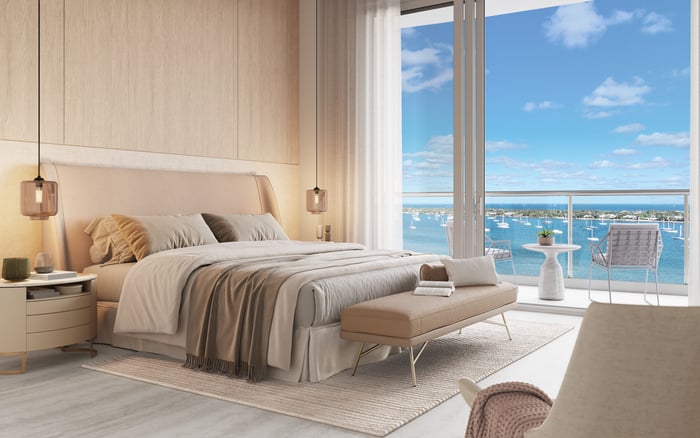
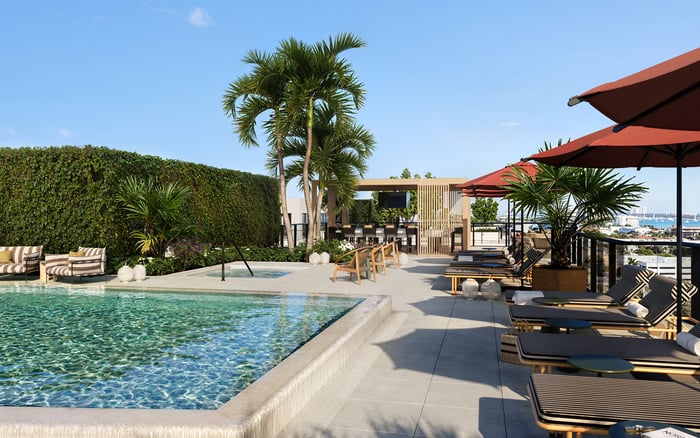
In Boca Raton’s most design-forward condo corridors, “privacy” has become as valuable as square footage. Yet privacy is not one thing. In downtown Boca Raton, ALINA Residences expresses privacy through architecture and circulation: fewer homes per floor, a campus-style layout, and, in select residences, direct elevator entry that minimizes shared spaces. The Residences at Mandarin Oriental, Boca Raton approaches the same goal through operations: hospitality-driven living where staff, concierge protocols, and a service ecosystem can quietly manage arrivals, guests, and daily logistics. For buyers weighing ALINA against Mandarin Oriental, the more useful question is not which is “more private” in the abstract, but which kind of privacy matches your lifestyle. If you want fewer neighbors, fewer moments in hallways, and a building that behaves like a residential enclave, ALINA’s planning is the headline. If you want discretion that feels more like a five-star hotel where requests and comings-and-goings are handled for you, Mandarin Oriental’s brand standard is the differentiator. Below, MILLION Luxury breaks down the two models of privacy, how they show up in day-to-day living, and what to ask on a tour so you can choose with clarity.
In South Florida’s ultra-premium condo market, privacy has moved well beyond a quiet unit and a good view. Today, it’s a composite of planning, staffing, and the way a building choreographs movement. For some buyers, privacy means low density and minimal shared circulation. For others, it means a hotel-caliber service framework that can manage visibility - who enters, where they wait, and how requests are handled.
That’s what makes the comparison between ALINA Residences Boca Raton and The Residences at Mandarin Oriental, Boca Raton so instructive. Both target the same end goal, but they pull different levers. One is fundamentally spatial. The other is procedural.
ALINA is a three-tower, campus-style development in downtown Boca Raton with 303 residences across ALINA 200, 210, and 220. That campus concept is more than branding: instead of funneling every resident and guest through a single vertical stack, multiple towers on one master site can distribute arrivals, amenity use, and everyday circulation.
Within the ALINA collection, ALINA 210 is positioned as the most privacy-oriented building. It is marketed with only 30 corner residences and a maximum of four residences per floor - a structural privacy advantage that registers immediately. Fewer neighbors per landing typically means fewer incidental interactions and less “lobby theater.”
ALINA 210 also highlights direct, private elevator access for residences, a feature that changes the rhythm of daily life. The practical benefit isn’t only convenience; it’s less time in shared corridors and fewer moments inside an elevator cab with unknown guests. For buyers who prioritize separation and predictability, this is among the most tangible, repeatable forms of privacy.
For those drawn to a wellness-anchored lifestyle, ALINA 220 is marketed with extensive wellness amenities and staffed lobby features. Importantly, ALINA’s Phase 2 messaging frames wellness as a core differentiator rather than positioning the experience primarily around hotel-style services. In other words, it can read as residential-first - amenities that support recovery and routine, without a constant hospitality overlay.
Buyers tracking deliverability will note that El-Ad National Properties announced ALINA 220 received a temporary certificate of occupancy (TCO) in January 2025, a milestone that signals meaningful progress toward occupancy.
In the Boca Raton conversation, ALINA’s privacy case is strongest when you care about density, circulation, and the simple math of how many front doors share your floor.
The Residences at Mandarin Oriental, Boca Raton is an upcoming Mandarin Oriental-branded residential project in Boca Raton, associated with the Via Mizner district, a mixed-use development by Penn-Florida Companies.
Mandarin Oriental’s value proposition is not merely a name on the door. Its public positioning emphasizes “legendary” service and hospitality-driven living. In privacy terms, that often translates to operational discretion: staff who can arrange, coordinate, and quietly buffer daily life. Where architectural privacy reduces touchpoints, service-driven privacy manages them.
For certain households, that distinction is decisive. A concierge-forward environment can reduce friction and visibility at moments that matter: guest arrivals, deliveries, vendor access, and day-to-day requests. When the operating culture is hospitality-first, the expectation is that residents aren’t required to personally manage every interaction in shared spaces.
A third-party listing source places the project at or near 105 E Camino Real within the Via Mizner area. Without over-reading exact siting, the broader implication is walkable proximity to downtown Boca Raton’s dining and cultural energy - paired with a residential experience designed to feel curated rather than exposed.
If ALINA’s privacy argument is “fewer shared moments,” Mandarin Oriental’s argument is “better-managed moments.”
Most tours fixate on finishes, views, and amenity decks. For privacy-first buyers, the smarter move is to define your privacy profile before comparing buildings.
If you value architectural privacy, you are likely to care about:
If you value operational privacy, you are likely to care about:
In that sense, ALINA and Mandarin Oriental are not direct substitutes. They sit at two ends of a spectrum: one reduces shared contact by design; the other smooths shared contact through service.
When privacy is your priority, the elevator journey is the tell.
At ALINA 210, the marketing emphasis on direct/private elevator access is the headline because it compresses public exposure. You move from arrival to home with fewer intermediate steps. Less time in shared corridors can translate into a more controlled personal environment.
At Mandarin Oriental, the elevator experience is more likely to be defined by how the building operates. Hospitality-driven living can mean staff-mediated flow and protocols around guest handling. Rather than eliminating shared spaces, it aims to make them feel calm, intentional, and discreet.
Ask to walk the full route as if it were a normal day: arrival, elevator, the transition onto the residential level, and the path to the front door. If a building feels private, you’ll sense it in the choreography.
Amenities can either protect privacy or quietly dilute it, depending on how they’re programmed.
ALINA’s positioning, particularly in ALINA 220, puts wellness forward with recovery-oriented spaces and a staffed lobby experience. For many buyers, wellness amenities are privacy-compatible because they support quieter, routine use. They can feel like personal infrastructure rather than a stage.
Mandarin Oriental’s hospitality DNA can create a different amenity tone. Service-oriented living can bring a polished social rhythm: curated common areas, staff presence, and a sense that entertaining and hosting are part of the lifestyle. That can still be private, but it’s a different kind of privacy - you’re seen less because the experience is orchestrated, not because the building is sparse.
For those also considering a West-palm-beach lifestyle, the same privacy question appears in a new setting. Some buyers gravitate toward a boutique, residential cadence like Alba West Palm Beach, while others prefer brand-forward service expectations such as The Ritz-Carlton Residences® West Palm Beach. The right match is rarely about which is “better,” and more about how you live.
Downtown Boca Raton offers a particular kind of luxury: proximity to dining and culture without the full intensity of a global urban core. ALINA is positioned along SE Mizner Boulevard as a landscaped, park-like enclave near that energy. That park-like framing matters; landscape and setbacks can create a psychological buffer even when you’re close to the action.
Mandarin Oriental’s association with Via Mizner similarly benefits from a district concept. Mixed-use environments can feel lively, but hospitality operations can also impose order: defined arrival moments, controlled access, and staff-led handling that keeps residential life from feeling exposed.
If you want to widen your comparative lens while staying within South Florida’s top tier, it can be useful to tour a hospitality-driven Boca counterpart such as The Residences at Mandarin Oriental Boca Raton and then contrast it with a distinctly residential West Palm experience like Forté on Flagler West Palm Beach. The contrast clarifies your preferences quickly.
Privacy is easiest to evaluate when you turn it into a few quiet questions:
For ALINA, concentrate on density and circulation, especially in ALINA 210. For Mandarin Oriental, concentrate on operational protocols - and how staff presence supports discretion without adding exposure.
For some buyers, the deciding factor isn’t the building at all, but the household’s rhythm. If you’re in residence seasonally, entertain frequently, or keep a full calendar, service-driven privacy may feel more protective. If you live quietly, value routine, and prefer to self-manage, architectural privacy may feel more authentic.
In 2026’s South Florida market, privacy is no longer an abstract promise. It’s a lived experience you can test in a single visit.
ALINA’s advantage is legible: a campus-style plan, and in the case of ALINA 210, a low count of residences per floor and direct elevator access that reduces shared circulation. Mandarin Oriental’s advantage is cultural: a hospitality-led operating model designed to manage the very moments that can erode discretion.
The correct choice is the one that aligns with your definition of privacy, not someone else’s. When you tour, focus less on the headline amenity and more on the quiet mechanics: circulation, staffing, and how the building behaves when you’re simply coming home.
Which feels more private day-to-day, ALINA or Mandarin Oriental Boca Raton? ALINA tends to feel more private through lower-density living and elevator flow, while Mandarin Oriental can feel private through staff-managed operations.
What makes ALINA 210 the most privacy-oriented within ALINA? It is marketed with only 30 corner residences and a maximum of four residences per floor, plus direct/private elevator access.
Is ALINA a single tower or multiple buildings? ALINA is a three-tower, campus-style development with residences across ALINA 200, 210, and 220.
How does a campus-style layout affect privacy? Multiple towers can distribute resident traffic and reduce the feeling that everyone shares one lobby and one vertical core.
What is the privacy advantage of direct elevator access? It can minimize time spent in shared elevator cabs and corridors, reducing incidental interactions.
What kind of privacy does Mandarin Oriental’s brand typically emphasize? It emphasizes operational privacy through hospitality-driven service, concierge support, and staff-mediated handling of daily needs.
Is The Residences at Mandarin Oriental, Boca Raton tied to Via Mizner? It is associated with the Via Mizner district, a mixed-use development by Penn-Florida Companies.
Where is ALINA located within Boca Raton? It is in downtown Boca Raton along SE Mizner Boulevard, positioned as a landscaped, park-like enclave.
What is the status update on ALINA 220? ALINA 220 was reported to have received a temporary certificate of occupancy (TCO) in January 2025.
What should I prioritize on a privacy-focused tour? Walk the full arrival-to-front-door route, then ask about guest handling, deliveries, and how amenities intersect with residential circulation.
For a confidential assessment and a building-by-building shortlist, connect with MILLION Luxury.
If branded residences are on your mind — as a home or as an allocation — we would be glad to share what we are seeing, privately.
Begin a quiet conversation