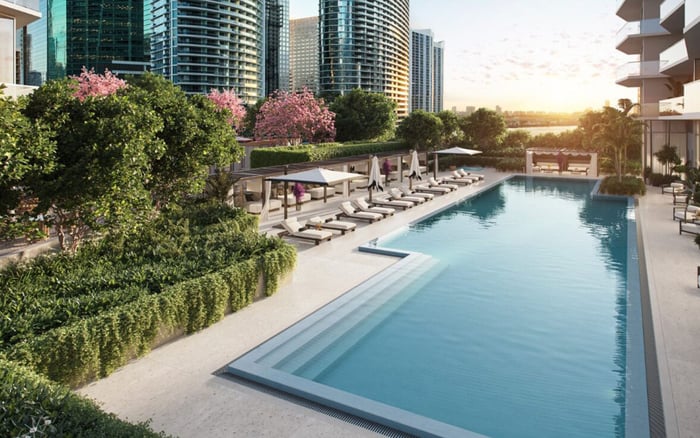
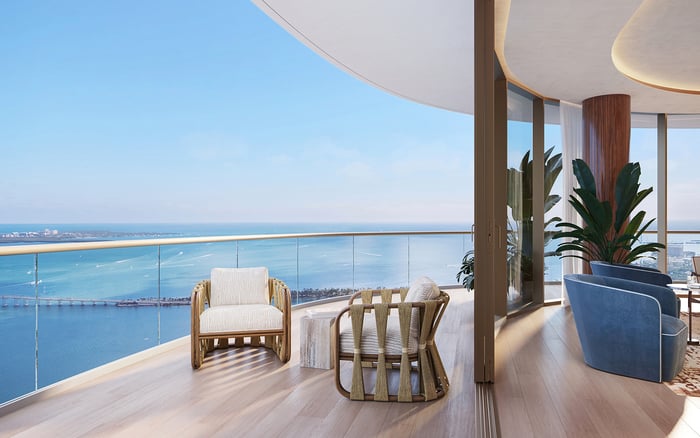
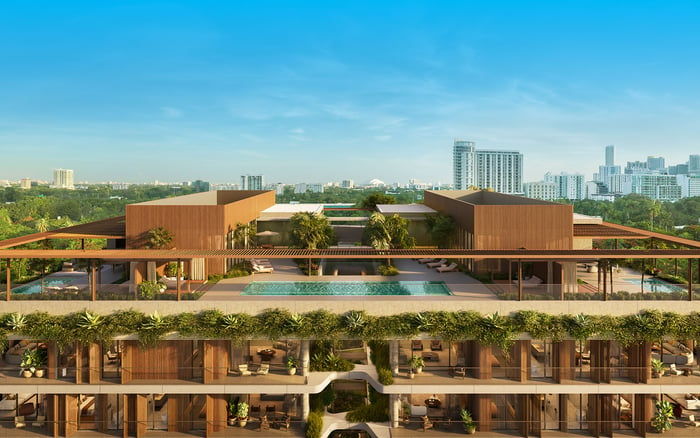
In South Florida luxury real estate, terrace depth often determines whether outdoor space feels decorative or genuinely livable. Deep terraces accommodate dining, lounging, shading, privacy, and climate resilience in ways broad but shallow balconies rarely can. For buyers in Miami Beach, Brickell, Coconut-grove, and beyond, depth is the measurement that most directly shapes daily use and long-term value.
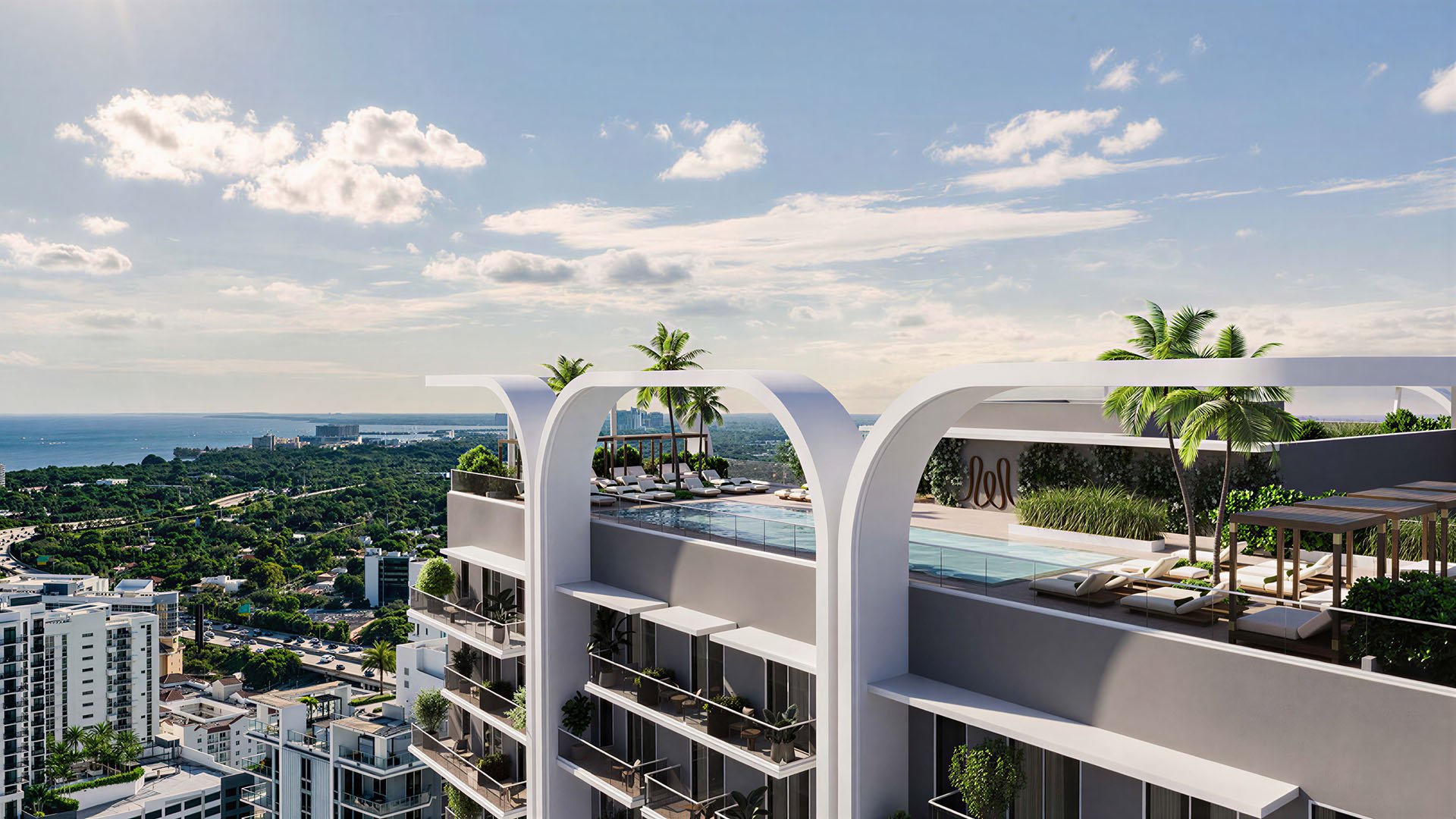
In South Florida, terrace square footage is an easy headline number. It photographs well, markets well, and sounds generous in sales language. Yet in daily living, a terrace’s most important dimension is usually not its total size. It is its depth.
A very wide but shallow terrace can look dramatic on a floor plan and still feel constrained in practice. It may allow for a row of chairs against glass or a narrow circulation path along the railing, but little more. A deeper terrace changes the experience entirely. It creates enough front-to-back space for furniture, movement, shade, and a sense of separation between the residence and the open edge.
For luxury buyers, this distinction matters because outdoor living in South Florida is not secondary. It is part of the home’s main program. The terrace is where morning coffee, winter dining, sunset entertaining, and private retreat converge. When that outdoor room is too shallow, the square footage remains nominal. When it is deep enough, it becomes a true extension of the interior architecture.
Depth is what allows a terrace to perform more than one function at once. A shallow balcony may be suitable for stepping out, standing, or placing two compact chairs. A deeper terrace can support a full dining table, a lounge grouping, planters, and still preserve a clear walking path.
That distinction becomes especially important in the premium market, where buyers expect seamless indoor-outdoor living rather than symbolic exterior space. If a terrace cannot comfortably fit furniture away from the building line and still allow circulation, it behaves more like an architectural ledge than a living area.
This is why discerning buyers often begin with a practical question: how many usable rows can the terrace accommodate from sliding glass to guardrail? One row usually means limited use. Two or three well-proportioned zones suggest a terrace that can genuinely host daily life.
At projects such as 57 Ocean Miami Beach, the appeal of the outdoor experience is tied not simply to large exterior square footage, but to space that feels inhabitable, layered, and calm. In Miami Beach, where the horizon is part of the residence, the terrace must do more than frame a view. It must support the way owners actually live beside it.
Depth also matters because South Florida is a climate market before it is a style market. Heat, sun angle, humidity, salt air, and seasonal wind all shape whether a terrace feels inviting at noon or only at sunset.
A deeper terrace tends to offer better self-shading. The covered portion close to the façade can reduce solar gain at the glass line and create a more comfortable microclimate for seating. This can also make the adjacent interior feel more temperate, especially in residences with expansive glazing.
Depth also allows for layering. A dining setting may sit closer to the residence, where it is more protected, while lounge seating occupies the outer portion when conditions are milder. Planters or screening elements can be added without consuming the entire footprint. In practical terms, more depth gives owners more options across changing weather conditions.
In Brickell, where vertical living, sun exposure, and skyline views intersect, this distinction is especially visible. A project like The Residences at 1428 Brickell speaks to a buyer who expects outdoor space to function with the same intentionality as the interior, not merely accompany it. In Brickell, a terrace that cannot be used through much of the day quickly loses relevance.
Luxury is often defined by what a space lets you forget. On a terrace, that means wind turbulence, visual exposure, and the subtle discomfort of feeling too close to the edge. Depth helps address all three.
A deeper terrace creates a psychological buffer between the living room and the perimeter. When seating is positioned several feet back from the rail, the space feels more grounded and less performative. That matters on upper floors, where views are spectacular but exposure can be intense.
Depth can also improve privacy. Even when neighboring terraces are nearby, a deeper outdoor room allows furniture placement that is less visible from adjacent sightlines. This is especially relevant in dense waterfront settings, where architecture is often transparent and closely composed.
For buyers drawn to Coconut-grove, where greenery and softer urbanism shape expectations, this sense of shelter is equally valuable. At Vita at Grove Isle and Park Grove Coconut Grove, the most compelling outdoor spaces are those that feel less like appendages and more like private verandas suspended within a landscape.
A large terrace figure can disguise compromised proportions. Two terraces may offer similar square footage while living very differently. One may be wide and shallow, impressive in gross area but difficult to furnish. The other may be slightly smaller overall yet far more comfortable because it supports multiple functions.
This is where sophisticated buyers gain an advantage. Rather than asking only how big the terrace is, they ask how the space is shaped, where the covered zone begins, whether furniture can sit naturally without blocking circulation, and how the terrace connects to the principal rooms.
In practical terms, a deep 300-square-foot terrace may outperform a shallow 400-square-foot one. The larger number is not meaningless, but geometry determines whether that area is usable or residual. In South Florida, residual outdoor space carries limited value at the top end of the market.
At Rivage Bal Harbour, the conversation around luxury outdoor living naturally centers on proportion, exposure, and livability. In Bal-harbour and other oceanfront locations, terrace design is not cosmetic. It is central to the home’s comfort profile.
When touring a residence, buyers should resist being guided by terrace area alone. Instead, focus on six practical checks.
First, stand near the glass and imagine a dining table, then a lounge grouping, then the circulation path around both. If the arrangement feels tight, the terrace is likely shallow in the only way that matters.
Second, consider the covered depth rather than the fully exposed outer edge. The most usable part of the terrace is often the portion that can be enjoyed through more hours of the day.
Third, evaluate how the terrace aligns with interior rooms. Outdoor space connected only to a secondary bedroom rarely carries the same everyday value as a deep terrace extending directly from the great room.
Fourth, notice wind behavior. If the terrace feels turbulent during an ordinary visit, its furniture layout may always be constrained.
Fifth, assess privacy while seated, not only while standing at the rail. Luxury is experienced at rest.
Sixth, look at whether the terrace can host distinct moments: dining, reading, sunning, conversation. If everything must happen in one compressed strip, the size figure has overstated the lifestyle.
There was a time when sheer exterior square footage carried the conversation. Today, more discerning buyers understand that proportion is the rarer luxury. A terrace should not merely photograph as expansive. It should feel composed, shaded, and intuitive to inhabit.
That is why depth matters more than size in South Florida. It supports climate comfort, furniture planning, privacy, and the kind of gracious outdoor living that defines the region’s best residences. In the upper tier of the market, depth is not a technical detail. It is the difference between having outdoor space and truly using it.
Why is terrace depth more important than terrace size? Depth determines whether outdoor space can be furnished and used comfortably, while size alone can conceal awkward proportions.
What is considered a shallow terrace? Any terrace that feels more like a narrow strip than an outdoor room is effectively shallow, even if the total square footage sounds large.
Why does this matter so much in South Florida? South Florida living depends on outdoor comfort, shade, airflow, and year-round usability, all of which improve with better depth.
Does a wider terrace not solve the same problem? Width helps views and frontage, but without enough front-to-back dimension it rarely supports multiple functional zones.
How does depth affect furniture layout? It allows dining, lounging, planters, and circulation to coexist without crowding the façade or rail.
Is depth especially important for Oceanfront homes? Yes. Oceanfront residences benefit from deeper terraces because wind, sun, and exposure are typically more pronounced.
Do higher floors make depth more valuable? Often yes, because upper levels can feel more exposed and benefit from a stronger buffer between seating and the edge.
What should buyers ask during a showing? Ask for the usable depth, the covered depth, and how the terrace is intended to function with the main living areas.
Can a smaller terrace be better than a larger one? Absolutely. A smaller but deeper terrace can outperform a larger shallow one in everyday livability.
Which South Florida areas especially reward this feature? Miami Beach, Brickell, Coconut-grove, and other waterfront neighborhoods tend to reveal the value of depth most clearly.
For a confidential assessment and a building-by-building shortlist, connect with MILLION.
If branded residences are on your mind — as a home or as an allocation — we would be glad to share what we are seeing, privately.
Begin a quiet conversation