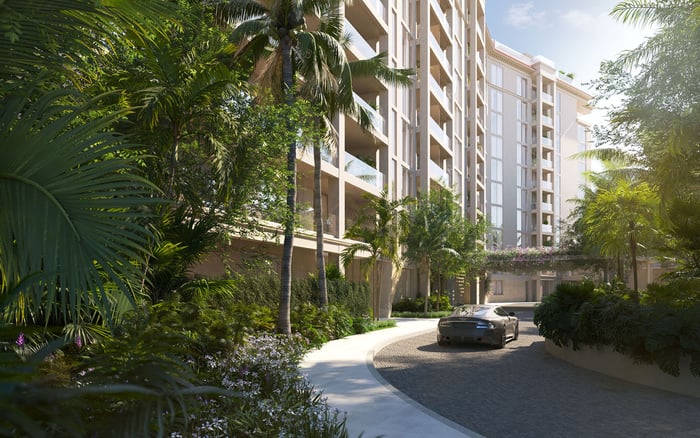
Guest parking can affect daily livability, resale confidence, and the practical review process for financed condo buyers across South Florida’s luxury markets.

In South Florida luxury real estate, parking is often framed around the owner: deeded spaces, assigned spaces, private garages, lifts, valet privileges, electric charging, and elevator proximity. For financed buyers, however, the quieter question can be just as consequential: where do guests park, and under what rules?
Guest parking is not merely a convenience. It can shape how a residence lives on weekends, how comfortably family can visit, how smoothly staff and service providers arrive, and how future purchasers perceive the building. In markets where social life, seasonal residency, multigenerational visits, private chefs, caregivers, and visiting friends are common, the guest parking policy becomes part of the home’s daily choreography.
The issue is especially important before signing because financed buyers typically move through a timeline with more parties involved. The buyer, lender, association, insurance reviewer, underwriter, and closing team may all rely on documents, approvals, and representations. A guest parking rule discovered late can create friction at precisely the moment a buyer wants certainty.
Cash buyers may absorb lifestyle surprises as a matter of preference. Financed buyers have less room for ambiguity because timing, documentation, and approval conditions matter. A parking policy may not determine whether a buyer loves the view, floor plan, or location, but it can influence whether the property fits the way the buyer intends to live.
Before signing, a buyer should understand whether guest parking is included, limited, valet-only, subject to fees, available only during certain hours, or dependent on association approval. The answer may differ from one building to another, even within the same neighborhood. A tower in Brickell can have a different guest arrival strategy than a boutique waterfront building in Bay Harbor Islands, a beach residence in Miami Beach, or a low-density community in Boca Raton.
For example, a buyer considering 2200 Brickell may be thinking about urban access, walkability, and a highly vertical lifestyle. In that context, guest parking questions should include peak-hour arrival, rideshare zones, valet coordination, and whether visitors can be accommodated without disrupting daily building circulation.
The most important question is not simply whether guest parking exists. It is what the governing documents and building policies actually permit. Buyers should ask to review the current rules rather than rely on informal descriptions. A polished sales conversation can describe the experience, but the documents govern the reality.
Key points include whether guest spaces are self-park or valet, whether overnight parking is allowed, how many guests may park at once, whether registration is required, whether residents must be present, and whether charges apply after a certain period. Buyers should also ask whether guests may park during holidays, special events, board meetings, construction periods, or building maintenance windows.
In luxury buildings, the answer is often service-driven rather than space-driven. A valet program can be seamless when well managed, but buyers should understand whether valet access applies equally to residents, guests, vendors, family members, and long-stay visitors. For a seasonal owner, a guest staying for two weeks is a different practical scenario than a dinner guest staying for three hours.
The guest parking conversation changes by neighborhood. In Miami Beach, the issue often intersects with beach access, social hosting, and a limited urban-island environment. Buyers drawn to The Perigon Miami Beach may be prioritizing design, privacy, and coastal living, but they should still ask how visiting family, private drivers, and service providers are handled during busy periods.
In Sunny Isles Beach, the luxury experience is frequently connected to oceanfront living, larger residences, and international ownership patterns. At a tower such as Bentley Residences Sunny Isles, buyers may naturally focus on automotive design, residence scale, and amenities. Even so, the guest protocol remains distinct from owner parking and should be confirmed in writing.
In Fort Lauderdale, where boating culture, beach access, Las Olas dining, and airport convenience all shape buyer behavior, guest parking can affect how easily a residence supports entertaining. A buyer studying St. Regis® Residences Bahia Mar Fort Lauderdale should think not only about arrival elegance, but also about the practical guest sequence from vehicle to lobby to residence.
In Boca Raton, buyers often compare condominium living with estate-style privacy and club-influenced convenience. At Alina Residences Boca Raton, the guest parking review should fit into a broader lifestyle audit that includes family visits, caregivers, private trainers, and dinner guests.
A residence can be architecturally compelling and still lose practical appeal if guests find arrival difficult. Resale buyers often evaluate how a property will live for their own family and social patterns. If the guest policy feels restrictive, unclear, or dependent on informal favors, it may become a negotiation point.
That does not mean more guest parking is always better. In dense luxury districts, a highly managed valet model may feel more refined than a large self-park inventory. The issue is alignment. A buyer who hosts frequently may prefer a building with a generous and predictable visitor protocol. A buyer who values privacy above all else may welcome tighter controls.
For financed buyers, resale perception matters because the home is both a lifestyle asset and a financed property. If a rule could affect future buyer enthusiasm, it deserves attention before signing, not after closing.
The best approach is a written question set delivered early. Ask whether guest parking is controlled by association documents, house rules, valet policy, developer policy, or a combination. Ask whether the current policy can be changed by the board or management. Ask whether any guest parking rights are appurtenant to the unit or simply privileges granted under current rules.
Buyers should also separate resident parking from guest parking. A unit may include excellent owner parking while offering a limited visitor experience. Conversely, a building may have a superb guest arrival protocol while owner parking is governed by a different allocation structure. Treat each category independently.
If financing is involved, share parking-related documents with the advisory team as part of the broader contract review. The goal is not to overcomplicate the purchase. It is to prevent late-stage surprises from becoming emotional or logistical leverage.
Before contingencies are waived, buyers should know what they are accepting. If guest parking is central to the purchase decision, the buyer’s representation should help clarify whether it can be addressed within the review period. Verbal assurances are rarely enough when the issue affects daily use.
A prudent buyer does not need to turn guest parking into a dramatic negotiation. The more elegant move is to ask early, document the answer, and decide whether the building’s operating culture fits the household. In the best buildings, the response will be clear, professional, and consistent with the level of service the property presents.
The guiding principle is simple: luxury is not only what happens inside the residence. It begins at arrival, and for guests, that begins with parking.
Why does guest parking matter for financed buyers? Financed buyers often have more documentation and timing considerations, so lifestyle issues should be clarified before the purchase process becomes compressed.
Should I rely on a sales presentation about guest parking? No. Use the presentation as a starting point, then confirm the policy in the current building rules or association documents.
Is valet-only guest parking a concern? Not necessarily. A well-run valet system can be highly convenient, but buyers should understand hours, fees, overnight rules, and guest registration.
Can guest parking rules change after I buy? They may change depending on the governing documents and association authority, so ask how policy changes are approved.
Are guest spaces the same as resident spaces? Usually they should be reviewed separately. Owner parking rights and guest privileges can be governed by different rules.
What if I often host family for long stays? Ask specifically about overnight parking, length-of-stay limits, guest passes, and whether repeat visitors require separate approval.
Should my lender care about guest parking? The lender may not focus on lifestyle fit, but financed buyers should still review parking rules as part of prudent purchase diligence.
Does guest parking affect resale? It can. Future buyers may value a predictable guest arrival experience, especially in dense or highly serviced luxury buildings.
When should I ask for the guest parking rules? Ask before signing when possible, or at minimum during the earliest document review period before major contingencies are waived.
What is the simplest due diligence step? Request the written guest parking policy, confirm it matches your lifestyle, and keep the answer with your contract materials.
If you'd like a private walkthrough and a curated shortlist, connect with MILLION.
If branded residences are on your mind — as a home or as an allocation — we would be glad to share what we are seeing, privately.
Begin a quiet conversation