A buyer-focused guide to evaluating kitchen ventilation in luxury South Florida homes, from exterior exhaust and noise control to layout, maintenance, and resale relevance.
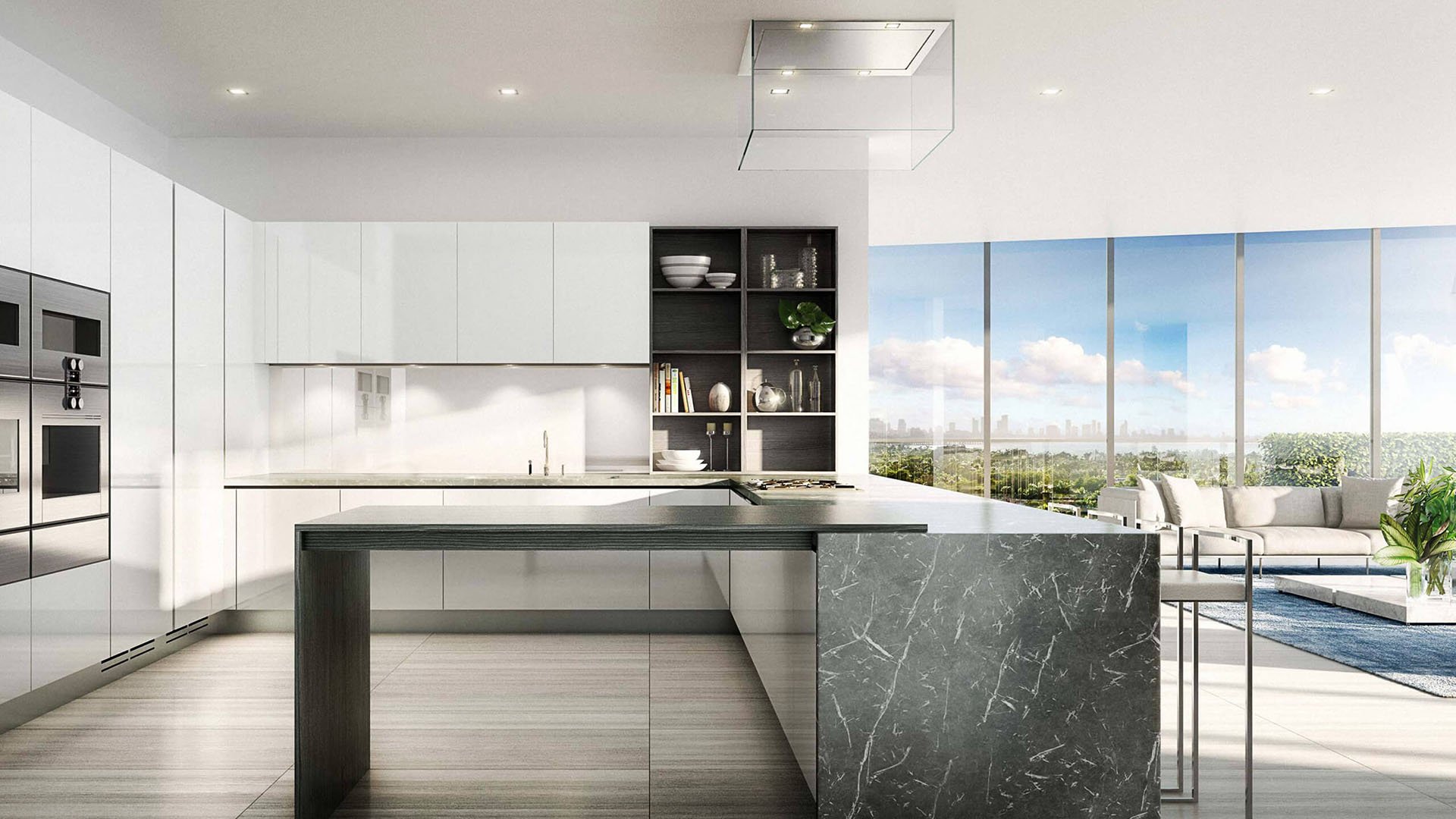
In a luxury residence, the kitchen is rarely a back-of-house room. It is where school mornings begin, guests gather before dinner, and weekend cooking spills into the living area. For family buyers, ventilation is more than an appliance specification. It is a question of comfort, maintenance, and resale, all tied to one architectural decision.
Even the most beautiful range hood can underperform if it is poorly placed, too loud to use, difficult to clean, or dependent on recirculation when the household cooks seriously. Families should evaluate ventilation with the same discipline they bring to ceiling heights, primary suites, school access, and outdoor space. In South Florida, where open plans, terraces, and indoor-outdoor entertaining define much of the lifestyle, the kitchen’s air strategy should feel deliberate rather than decorative.
For buyers comparing Brickell high-rises, Miami Beach waterfront residences, Coconut Grove townhomes, new-construction condos, terrace-forward layouts, and single-family homes, the essential question is the same: will the kitchen remove cooking air effectively while preserving the calm of the home?
The first demand is simple: understand where the air goes. A premium kitchen should not rely solely on a handsome hood that filters air and returns it to the room. Recirculating systems may have a place in certain layouts, but family buyers who cook frequently should ask whether the system exhausts outdoors and how directly it does so.
This is especially important in open living spaces. Odors from searing, roasting, frying, or heavily seasoned cooking can move quickly into sofas, draperies, rugs, and bedrooms if the air is not captured early. In a condominium, the route may be constrained by building design. In a single-family residence, there may be more flexibility, but that does not guarantee a better result. The value lies in a coherent path from cooktop to exterior, not merely in a prominent hood.
Buyers should request a demonstration during a private showing or inspection period. Turn the hood on. Listen. Stand beside the cooktop, then in the adjacent living area. A ventilation system that is too loud may never be used at the setting required for real cooking, which makes its theoretical performance less meaningful.
Families often hear ventilation discussed in terms of power, but capture matters just as much. The hood should be positioned and proportioned so steam, smoke, and grease-laden air are drawn upward rather than drifting sideways. A dramatic island cooktop can be visually elegant, but it may require especially thoughtful capture because air moves around it from several directions.
Wall-mounted cooking zones often give designers more opportunity to frame a proper hood and duct path, while downdraft systems can be more layout-sensitive. None of these choices is automatically right or wrong. What matters is whether the system suits the way the family actually cooks.
A household that mostly reheats, boils water, and prepares light meals has different needs from one that sears steaks, cooks with high heat, hosts holidays, or has a private chef. Buyers should avoid being seduced by a single specification. The stronger question is whether the hood, cooktop, cabinetry, ducting, and room volume work together.
In family homes, noise determines behavior. If the hood overwhelms conversation, disrupts homework at the island, or makes the family room feel mechanical, it will be turned down or turned off. Quiet operation is therefore not a soft preference. It is a functional requirement.
Ask to experience the system at more than one speed. The lowest setting may be pleasant but insufficient for meaningful cooking. The highest setting may be powerful but unrealistic for daily life. The most livable homes have ventilation that can be used consistently without making the kitchen feel like a utility space.
Control placement also matters. A family member should be able to activate the hood easily while cooking, without reaching awkwardly across heat or leaning over pans. In a luxury kitchen, the experience should feel intuitive. If the ventilation requires too much effort to operate, the design has failed in practice even if it looks correct in photographs.
Ventilation quality often hides in places buyers cannot immediately see. The visible hood is only one component. Duct route, turns, termination point, service access, and cabinet integration all influence the result. During diligence, buyers should ask what can be accessed for maintenance and what would require opening walls, ceilings, or custom millwork.
Grease filters should be removable without drama. Replacement parts should not depend on an obscure or discontinued system. If the kitchen has custom paneling or a concealed hood, the concealed details should still be serviceable. Luxury should not mean fragile.
This is particularly relevant in renovation-grade homes, where a kitchen may have been redesigned for appearance without a full reconsideration of mechanical performance. A newly installed hood is not automatically a complete ventilation solution. Family buyers should look for alignment among the appliance package, the cabinetry plan, and the air path.
A strong hood moves air out of the residence. That is its purpose. But the home must also be able to accommodate that air movement comfortably. In larger residences, and particularly in tightly finished new construction, buyers should ask how the kitchen ventilation interacts with air conditioning, exterior doors, fireplaces if present, and overall comfort.
The point is not to turn a showing into an engineering seminar. It is to make sure the developer, builder, owner, or representative can explain the design in plain language. If the answer is vague, the buyer should slow down. A refined home should have a refined explanation.
In South Florida, where the kitchen may sit near sliding glass walls, terraces, and summer kitchens, buyers should also consider how indoor cooking and outdoor entertaining overlap. A good layout prevents smoke and odors from being pushed back into the residence when doors are open. The kitchen should support the lifestyle, not compete with it.
Ventilation should be evaluated regardless of cooking technology. Gas cooking, induction cooking, and mixed appliance packages all create cooking byproducts such as steam, grease, and odors. The absence of a flame does not remove the need for an effective hood when real cooking is happening.
Induction can offer a cleaner, sleeker experience for many households, while gas remains preferred by some serious cooks. Family buyers should avoid treating the cooking surface as the entire decision. The more sophisticated question is how the cooktop, hood, backsplash, cabinets, and adjacent living area perform as a complete system.
For buyers who entertain often, the kitchen may need to work in two modes: quiet breakfast with children and high-output dinner preparation. Ventilation should be flexible enough for both. The best systems disappear into daily life until they are needed, then perform without spectacle.
Before committing, family buyers should ask several practical questions. Does the hood exhaust outdoors? Where is the termination point? Can the system be tested at multiple speeds? Are filters easy to remove and clean? Is there documentation for the appliance and any concealed components? Has the kitchen been altered since the residence was first delivered? If so, was the ventilation redesigned with the renovation?
Buyers should also ask who will maintain it. A family that cooks every day will treat filters and surfaces differently from an owner who uses the residence seasonally. The correct standard is not perfection on day one. It is durability, serviceability, and confidence over years of use.
In the ultra-premium market, ventilation is part of the invisible architecture of ease. It protects finishes, supports comfort, preserves the living room experience, and signals whether the residence was designed for real life or only for presentation.
What is the first ventilation question a family buyer should ask? Ask whether the hood exhausts outdoors and how the air moves from cooktop to exterior. A beautiful hood that only recirculates should be treated as a limited solution.
Is a powerful hood always the best choice? Not by itself. Placement, capture area, duct path, noise, and ease of use are just as important as raw power.
Why does noise matter so much? Families are unlikely to use a hood consistently if it disrupts conversation or daily routines. Quiet performance is what turns ventilation from a feature into a habit.
Should buyers test the hood during a showing? Yes, when possible. Running it at multiple speeds can reveal noise, vibration, control issues, and whether it feels practical for daily cooking.
Are concealed hoods a concern? They can be excellent if properly designed and serviceable. Buyers should confirm that filters and components can be accessed without damaging custom finishes.
Do induction kitchens still need ventilation? Yes. Steam, grease, and cooking odors still need to be captured, especially in open-plan family homes.
What matters in an island cooktop layout? Island cooking needs careful capture because air can drift from several directions. The hood should be sized and positioned for the way the family cooks.
How should buyers think about ventilation in condos? They should understand the building’s allowed exhaust path and any limitations created by the original mechanical design. Assumptions are not enough.
Can poor ventilation affect resale appeal? Yes. Sophisticated buyers notice whether a kitchen works as well as it photographs, particularly in open living spaces with high-end finishes.
What is the luxury standard for kitchen ventilation? It should be effective, quiet, easy to maintain, and visually integrated. The best systems support family life without calling attention to themselves.
For a discreet conversation and a curated building-by-building shortlist, connect with MILLION.
If branded residences are on your mind — as a home or as an allocation — we would be glad to share what we are seeing, privately.
Begin a quiet conversation