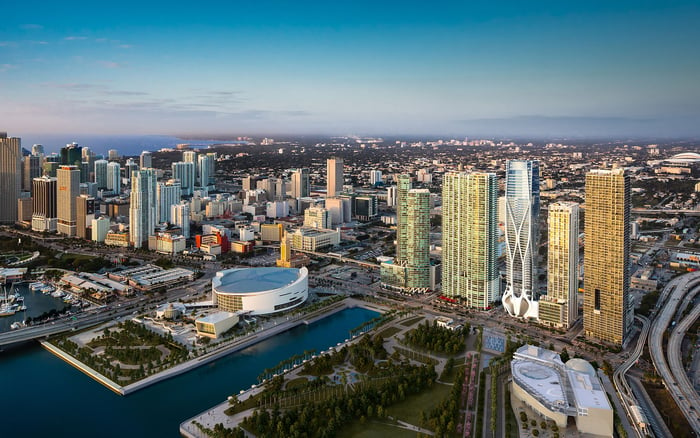
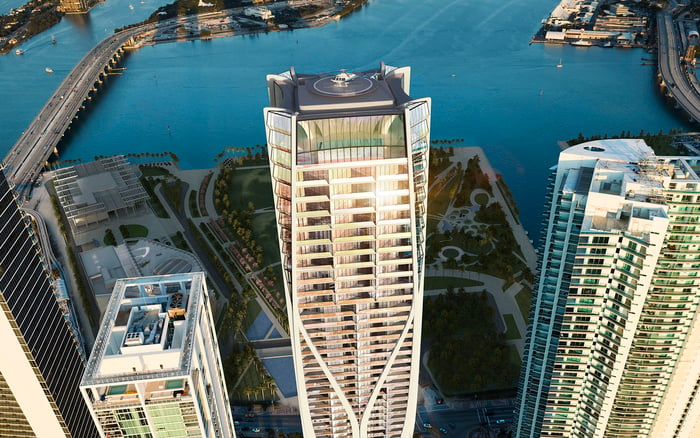
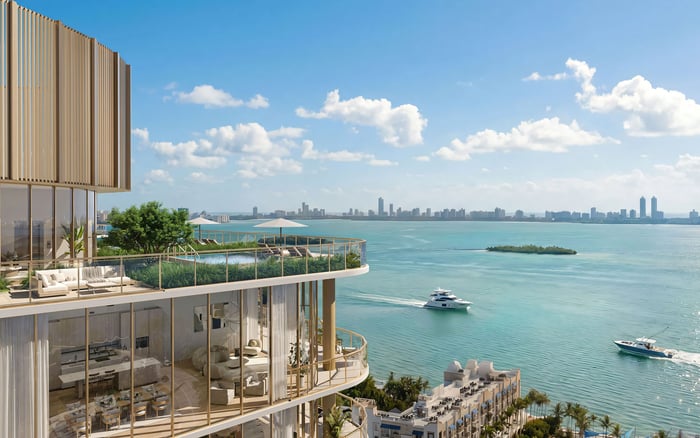
Miami’s luxury condo market is increasingly being evaluated through a finance lens: time efficiency, risk management, governance, and long-horizon value. As more high-earning professionals split their weeks between New York and South Florida, the most sought-after residences tend to prioritize privacy, turnkey living, and amenities that function like an extension of a modern office. This editorial looks at how that mindset can influence product preferences across Brickell, Downtown, and Edgewater, and how buyers can underwrite a condo purchase with discipline without losing the lifestyle magic.

Miami has long appealed to people who value optionality. What feels newly pronounced is the kind of optionality driving a growing share of luxury condo interest: the ability to operate at a high level from South Florida while remaining close to capital, clients, and airports. Whether the shorthand is “Wall Street South” or simply a new rhythm of executive mobility, the underlying mindset is easy to recognize.
Many of today’s buyers are not approaching Miami as a traditional second-home purchase. They are approaching it with an allocator’s temperament. They want to know what is durable, what is liquid, what is controllable, and what will still feel right when sentiment shifts. The goal is not to strip away the lifestyle. The goal is to keep the lifestyle while reducing friction points, protecting time, and making day-to-day living more predictable.
Viewed through that lens, Miami’s luxury condo market can read less like a set of floorplans and more like a menu of operating systems. Brickell, Downtown, and Edgewater can each work, but they tend to work differently depending on schedule intensity, travel frequency, family needs, and tolerance for noise, visibility, and operational variability.
This is not a claim that one buyer profile now defines the entire market. It is an observation that finance-trained decision-making is increasingly visible in how certain buildings are evaluated, how quickly some listings convert, and which features are treated as non-negotiable.
A buyer coming from finance, or shaped by finance culture, often brings a set of instincts that can change the way a condo search unfolds.
First, time has an explicit cost. The residence is expected to remove steps, not add them. Buyers pay attention to the arrival sequence, the consistency of front-of-house service, and whether operations feel calm and reliable. In that context, “quiet luxury” often means a building that gives time back through competence and predictability.
Second, governance is treated as part of the purchase, not an afterthought. Condo living is not only a home purchase. It is an agreement to coexist under shared rules. Board culture, management quality, enforcement consistency, and overall operational discipline can shape the daily experience as much as the finishes inside the unit. Buyers who are accustomed to reading documents, asking pointed questions, and tracking risk do not treat the operational layer as background noise. They treat it as value.
Third, the exit is considered even when the plan is to hold. Many luxury buyers in South Florida are not focused on short-term flipping, but they still want the asset to behave with dignity. That usually means thinking about buyer-pool depth, scarcity, and whether a building’s positioning will remain coherent for the next cohort.
The net effect is that “luxury” increasingly signals more than design. It signals competence, especially in the aspects of ownership that only become visible after the excitement of closing.
Brickell resonates with buyers who place a premium on proximity to offices, meetings, and a social scene that can compress an evening into a few high-quality hours. For a finance-driven schedule, that compression is a feature. A few blocks can separate a seamless weekday routine from one that feels unnecessarily demanding.
The most persuasive Brickell narratives are often about practicality wrapped in elegance. Buyers respond to a true lock-and-leave lifestyle, discreet arrivals, and amenity programs that support a full day without requiring the owner to leave the building unless they choose to. “Turnkey” here is not just about finishes. It is about how quickly you can land, reset, and be operational. The ideal is arriving late, waking up, and moving through the morning with minimal friction.
Brickell is also where preferences around new development versus established inventory can diverge. Some buyers favor mature operations, a proven resident profile, and the predictability that comes with time. Others want the clean slate of a new concept that aligns with current expectations around wellness, hospitality, and technology. The distinction is less about age and more about identity. A building that knows exactly what it is, and delivers it consistently, tends to earn confidence.
For a neutral reference point while exploring the Brickell conversation, consider The Residences at 1428 Brickell.
If Brickell functions as the weekday engine, it can also act as the social switchboard. That dual role tends to favor buildings that balance energy with privacy, allowing owners to choose visibility rather than be pulled into it.
Downtown and Edgewater often appeal to buyers who want city scale, expansive views, and the feeling of Miami as a global destination, not only a business address. For some, it reads as a more design-forward lifestyle. For others, it is a strategic choice that captures a certain urban intensity while keeping commutes and logistics within reach.
Edgewater, in particular, can register as a deliberate middle position: close to the action without living in the center of it. The neighborhood can feel like a buffer between full-throttle nightlife and a calmer residential cadence. For buyers with early starts, frequent travel, or young children, that buffer can be meaningful. It can also matter to anyone who wants the skyline and water adjacency while maintaining a steadier day-to-day tempo.
In these areas, the underwriting mindset often narrows to a few practical questions.
One, how does the building interface with the street? A tower can be visually iconic and still feel exposed at ground level. Buyers who value discretion look closely at drop-off logic, the visibility of entrances, and how predictable arrivals and departures will feel.
Two, how predictable is daily life once you own? This includes the tone and upkeep of common spaces, elevator reliability, staff culture, and whether the rules align with intended use. Buyers who see a condo as both home and capital rarely treat “house rules” as a footnote.
Three, does the lifestyle hold up outside peak weekends? A neighborhood can feel electric on Saturday and less compelling on Tuesday. Finance-minded buyers often test for that Tuesday reality, because it is where a home becomes either a refuge or a source of friction.
Without making specific promises, you can still see a directional shift in what many luxury condo shoppers ask for when they come from high-pressure careers.
Privacy-first planning tends to move to the top of the list. Buyers increasingly prefer residences that can host quietly and live comfortably even when the owner is “on” professionally. That can mean layouts with separation between public and private zones, circulation that allows guests to move without crossing intimate areas, and acoustic comfort that supports calls, rest, and family life. These are not flashy features, but they can materially shape whether a residence feels livable at scale.
Hospitality is another theme, but not nightlife. Service. Many buyers are not chasing spectacle; they are chasing reliability. They value a front desk that handles details with discretion, amenity spaces that feel curated rather than crowded, and operations that run with the smoothness of a well-managed boutique hotel while still preserving the boundaries of a private home.
Wellness has also shifted from trend to baseline. Even when a buyer is not explicitly searching for a “wellness building,” expectations have risen. The heavier the workload, the more the residence is asked to support recovery. The most compelling amenity sets are those that reinforce a routine: movement, quiet, light, and a sense that coming home is genuinely restorative.
Finally, technology is increasingly evaluated through a luxury lens. The best systems are effectively invisible. Buyers want secure access, dependable connectivity, and smart-home capabilities that reduce friction. The goal is not gadgetry. The goal is calm.
A finance-influenced buyer cohort can shape the market in subtle but meaningful ways.
Liquidity can concentrate. When many buyers share a similar checklist, a smaller set of buildings becomes the natural shortlist. Demand can intensify around specific product types and operational profiles, while other inventory competes harder through concessions or storytelling.
Scarcity can also be redefined. Traditional scarcity in Miami often emphasizes waterfront frontage, signature architecture, or a rare floorplan. A newer form of scarcity is operational: a building that is genuinely well managed, with rules aligned to luxury use and a resident culture that protects discretion. Those qualities are harder to replicate than finishes, and they often become more valuable over time.
Pricing power, in this context, tends to accrue to buildings that deliver confidence. Not only confidence in materials and design, but confidence in how the place will live on an ordinary week. Buyers who spend their professional lives measuring risk are often willing to pay for reduced uncertainty.
At the same time, this profile can be less tolerant of ambiguity. If a building’s positioning feels unclear, if documentation is inconsistent, or if the lifestyle promise reads as marketing rather than reality, interest can drop quickly.
For Miami, the opportunity is straightforward. As more high-income professionals treat South Florida as a true home base and not only a getaway, expectations around “primary residence quality” rise across the condo landscape.
If you are approaching a Miami condo through the “Wall Street South” lens, you can align the romance of the purchase with the rigor of an Investment decision by following a few pragmatic steps.
Start with use-case clarity. Are you buying for frequent weekday occupancy, or primarily for weekends and holidays? Will you host clients or colleagues, or is the home strictly personal? Those answers should drive priorities such as proximity, privacy, entertaining flow, or quiet.
Next, treat governance as due diligence, not paperwork. Read the rules and disclosures with the seriousness you would apply to any binding agreement. Confirm what matters to you, including how the building handles move-ins, renovation policies, and other operational details that can become friction points after closing. Pay attention to how clearly policies are written and how consistently they appear to be applied.
Then, evaluate lifestyle resiliency. Ask whether you will still love the neighborhood if your routine changes. A building can be perfect for one chapter and less suited for the next. Buyers who plan well often favor layouts and amenity sets that can adapt, supporting different seasons of life without forcing a full reset.
Also consider narrative durability. In Miami, trends can move quickly. Buildings with a coherent identity often hold attention longer than those riding a momentary wave. Look for a concept that feels grounded and repeatable, not only exciting.
Finally, plan for discretion. If your profile is public or your work is sensitive, confirm how privacy is handled in daily operations. This is not paranoia. It is modern luxury, and it is worth validating early.
If finance’s migration continues to influence Miami, the luxury condo market is likely to reward competence, service, and privacy as much as it rewards views and finishes. Brickell can remain the default for buyers who want the city to operate like a weekday instrument. Downtown can deliver a more expansive skyline identity. Edgewater can offer a calmer cadence while staying connected.
The throughline is not any single neighborhood. It is a standard. Luxury buyers who think like stewards of capital want a residence that performs, emotionally, operationally, and over time. Miami is increasingly capable of meeting that standard, and the next generation of towers will compete as much on management and livability as on design.
If you are evaluating the market now, the practical takeaway is simple: treat operations as a luxury feature. In a city where beauty is abundant, the differentiator is often how smoothly a building supports real life.
How should I choose between Brickell, Downtown, and Edgewater if I split time between New York and Miami?
Start with your weekly pattern. If you want the shortest distance between home, meetings, dining, and a high-energy social grid, Brickell often aligns with that cadence. If you want a more panoramic skyline identity and a sense of living in a global city core, Downtown may fit. If you want proximity without living in the center of the intensity, Edgewater can feel like a measured buffer, especially for quieter mornings and more residential routines.
What building documents and rules should I review before making an offer?
Treat the governing documents and disclosures as part of the asset. Review the rules that shape day-to-day living, including policies that can affect move-ins, renovations, and general operations. Pay attention to clarity, consistency, and whether the building’s approach aligns with how you plan to use the residence.
Which features best support a true lock-and-leave lifestyle in a luxury condo?
Look for operational reliability: a smooth arrival experience, dependable staff, and building systems that reduce friction. On the residence side, privacy-forward layouts, secure access, and technology that works without demanding attention tend to matter more than novelty. The goal is to leave and return without turning homeownership into a project.
How do I evaluate a condo purchase as both lifestyle and Investment?
Define your use case, then underwrite the building’s operations. Consider governance quality, the durability of the building’s identity, and whether the lifestyle holds up on ordinary weekdays, not just peak weekends. You can still prioritize beauty and views, but pair that with confidence in how the asset will live and how it is likely to be perceived by future buyers.
Want a private shortlist aligned with your schedule and standards from MILLION Luxury?
If branded residences are on your mind — as a home or as an allocation — we would be glad to share what we are seeing, privately.
Begin a quiet conversation