Autonomous vehicles are not yet a default reality in South Florida luxury living, but the supporting ecosystem is already influencing how sophisticated buyers assess condominium value. The most durable premium is likely to accrue to buildings that treat charging, curb management, and power capacity as core infrastructure, rather than as a cosmetic amenity. For developers and associations, the decision is less about predicting a single technology winner and more about underwriting flexibility: electrical headroom, conduit pathways, software-ready metering, and a garage and drop-off that can evolve from valet-driven to self-parking and, eventually, self-charging. For owners, the question becomes whether the building’s physical plant can keep pace without disruptive special assessments. Below, MILLION Luxury outlines the value drivers, the risk factors, and the design and governance signals that tend to separate future-forward residences from buildings that will have to retrofit under pressure.
In South Florida’s ultra-premium condominium market, value is often assigned to what feels effortless: arrival, departure, security, and the quiet confidence that a building can absorb change. Autonomous vehicle charging infrastructure sits at the intersection of those priorities. Even before full autonomy becomes commonplace, the requirements to support it are already visible in a building’s fundamentals: power capacity, garage design, connectivity, and curb choreography.
For the luxury buyer, the question isn’t simply, “Are there chargers?” It’s whether the property can deliver a seamless mobility experience without compromising aesthetics, circulation, or privacy. For boards and developers, the question is whether today’s decisions minimize tomorrow’s retrofit friction-and whether infrastructure can scale without destabilizing operating budgets.
Luxury towers have long treated the porte-cochere as theater: a controlled moment with valet, staff, and security. Autonomy changes the script. As vehicles gain more self-parking capability, and as ride services become more integrated with residential lifestyles, the curb becomes an operational asset with direct value implications.
Well-managed arrival zones reduce queuing, limit noise and headlight spill at the entry, and protect resident privacy. In practice, this pushes buildings to plan for dedicated staging space, clear separation between resident and service traffic, and discreet technology that can coordinate drop-offs. The most forward-looking schemes treat curb management like a concierge system: visible in its outcomes, invisible in its hardware.
In core urban settings such as Brickell, where curb space is inherently constrained, this matters even more. A building that can move cars efficiently-whether guided by valet or coordinated by software-tends to preserve the calm luxury buyers are paying for.
In luxury condominiums, buyers increasingly distinguish between “installed chargers” and “charging infrastructure.” The former may be a handful of stations that photograph well. The latter is building-wide capability: the capacity, pathways, and policies to support meaningful adoption without drama.
Value-adding charging tends to share three traits:
Scalability: A clear path from limited stations to broader coverage without tearing into finished garages.
Fairness and metering: Cost allocation that is transparent and appropriate, preventing common-area electricity from becoming a recurring political issue.
Reliability: Power design that avoids chronic downtime and reduces the risk of tripped breakers when multiple vehicles charge at once.
For resale, buyers often pay for confidence: that electrical rooms, risers, and conduit pathways were planned with expansion in mind. Conversely, a building with visible chargers but little headroom for growth can face a quieter discount-the sense that future owners are inheriting a retrofit project.
The most consequential component of autonomous charging readiness is often the least photogenic: electrical capacity and distribution. In a high-rise, upgrading power is rarely a simple “add more chargers” decision. It can involve transformers, switchgear, feeders, fire-stopping, ventilation strategy, and code compliance.
For buyers, that becomes a practical underwriting question: if charging demand doubles, does the building have a clean path to scale, or does it require major capital work? In ultra-premium communities, the difference can show up as day-to-day disruption. Extensive retrofits can mean prolonged construction, garage closures, and special assessments that feel out of sync with the ownership experience.
A sophisticated due diligence process looks beyond the current charger count and toward governance and planning: Is there an established policy for charger installation, load management, and vendor selection? Are reserve strategies realistic for future electrical upgrades? In luxury, predictability itself is a form of value.
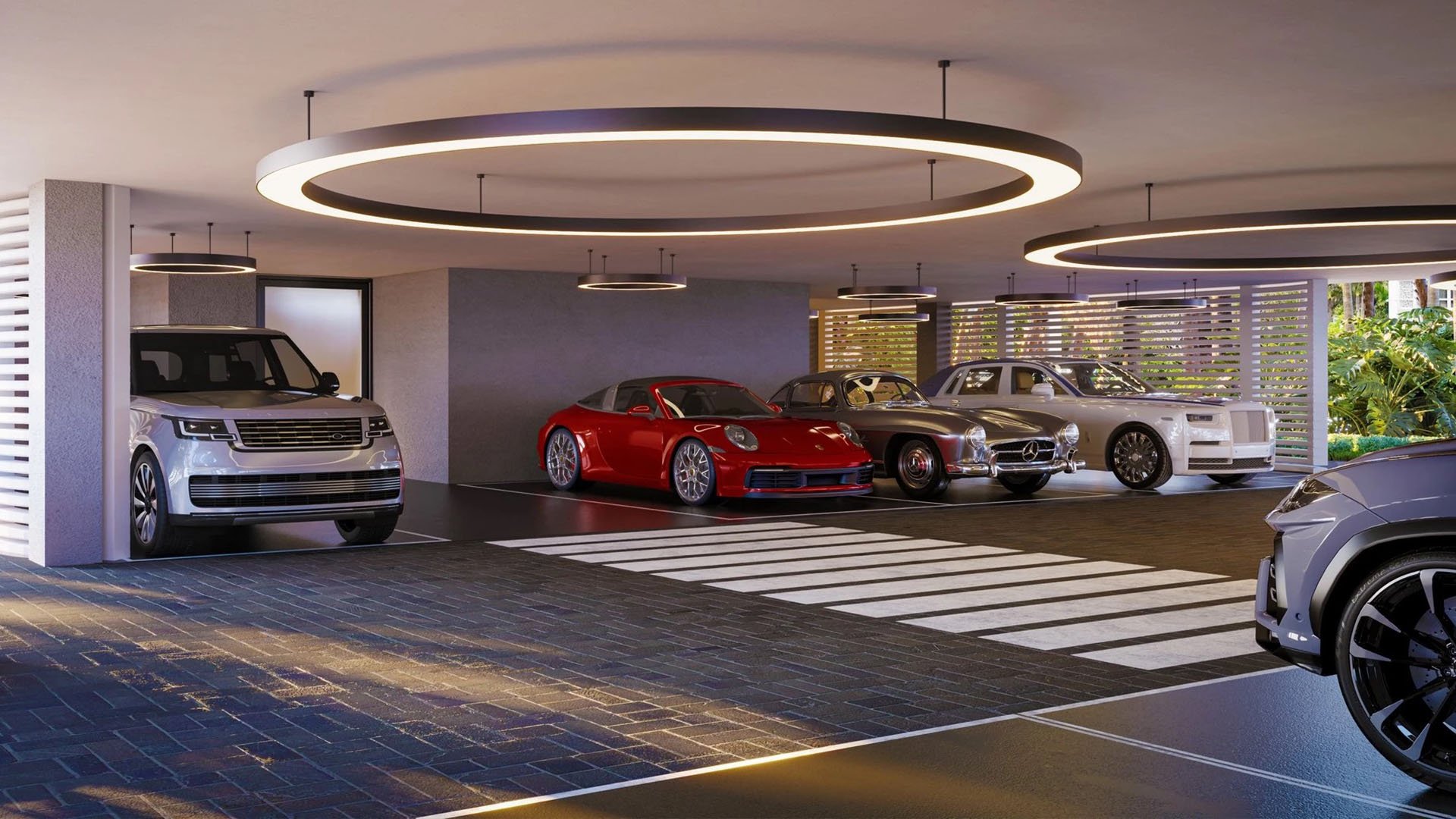
Garages in many luxury towers were designed around valet circulation, with tighter turns, narrower aisles, and an expectation that trained staff would handle complexity. As vehicles become better at assisted or autonomous parking, garage geometry becomes a determining factor in how smoothly those systems can function.
Autonomy-ready garages tend to be:
Clear in sightlines and lane marking
Generous in turning radii and stall access
Built with logical wayfinding that supports both humans and machine interpretation
Designed for safe pedestrian movement with fewer conflict points
Even if a building never markets itself as “autonomous,” these design choices influence daily convenience. A garage that is easy to navigate can reduce minor damage, insurance friction, and resident irritation. In luxury, these aren’t small details-they shape the lived experience of the home.
Charging infrastructure is increasingly software-mediated: access control, billing, load balancing, and user authentication. Autonomous mobility adds another layer: vehicles and building systems may need to coordinate entry, routing to a charging bay, and departure.
For the ultra-premium buyer, the value signal isn’t “more apps.” It’s elegant control paired with appropriate privacy. Buildings that treat mobility as part of the security perimeter-integrating it with resident authentication and camera coverage-can deliver convenience while protecting anonymity.
This is especially relevant in Miami-beach, where privacy, discreet arrivals, and controlled access often command an outsize premium. The objective is a mobility experience that feels like a private club: seamless, secure, and unremarkable.
In the luxury condo market, value moves through comparative storytelling: what a building represents, how it lives, and how resilient it feels. Charging readiness can influence that story in three ways.
First, it can elevate positioning from “beautiful” to “future-ready,” a subtle but meaningful distinction for buyers who view residences as multi-decade holds.
Second, it can reduce buyer objections. In a market where many buildings compete on finishes and views, removing a foreseeable infrastructure concern can shorten decision cycles.
Third, it can support liquidity. Homes that feel aligned with the next wave of mobility tend to resonate with a broader slice of affluent buyers, including international owners accustomed to advanced urban infrastructure.
None of this requires speculation about adoption timelines. It’s simply the logic of premium assets: the less forced future spending feels, the more confident a buyer can be today.
In condominium living, infrastructure can be present and still fail to translate into value if governance is unclear. Charging touches common elements, electricity allocation, safety, and aesthetics. Poorly defined rules can lead to inconsistent installations, visual clutter, and disputes over cost.
High-performing buildings tend to define, early and clearly:
Where chargers may be installed and how conduit is routed
Whether parking spaces can be reassigned to support shared charging
How electricity is billed and whether load management is required
Vendor standards to support long-term serviceability
From a resale standpoint, the most desirable outcome is a predictable framework that allows an owner to add charging without triggering a building-wide debate.
Luxury buyers often fall in love with the view and the lobby, then discover the operational reality later. When it comes to autonomous charging readiness, a few practical checkpoints can prevent surprises.
During a tour, note whether charging areas are integrated discreetly, whether signage and circulation feel calm, and whether the entry sequence is protected from congestion. In the garage, look for evidence of forethought: consistent conduit routing, clean installation, and cues that expansion was anticipated.
During document review, prioritize whether the association has a written policy for charger installations and billing. Clarity here can matter as much as hardware. Also consider the building’s reserve posture and recent capital projects-not because charging is the only future expense, but because it indicates whether the community plans for infrastructure proactively.
In evolving urban corridors such as Downtown and Edgewater, where new construction and adaptive reuse create a wide range of building ages, the difference between “retrofit-ready” and “retrofit-required” can be decisive.
In ultra-premium South Florida, mobility is lifestyle. The ability to move between a primary residence and a second home, to transition from office to marina, to arrive privately at a restaurant, or to depart for the airport without friction is part of why buyers choose certain buildings and neighborhoods.
As charging becomes more prevalent and as autonomy gradually expands, mobility becomes another layer of service design. Buildings that can integrate charging without sacrificing valet excellence, security, and visual restraint will be best positioned to hold premiums.
The most durable value is likely to accrue not to the building with the most chargers today, but to the building that treats power, circulation, and governance as a coherent system.
Will autonomous vehicle charging increase luxury condo prices immediately? It is more likely to reduce buyer objections and support premiums over time than to create an overnight pricing jump.
Is having a few EV chargers enough for resale value? A small number helps, but buyers increasingly value scalable infrastructure and clear installation policies.
What matters more: charger count or electrical capacity? Electrical capacity and a credible expansion path usually matter more than the current number of stations.
Can a condo association restrict private charger installations? Yes, many associations regulate common elements and aesthetics, so written policies are a key due diligence item.
Do shared charging bays hurt or help luxury living? Done well, shared bays can improve efficiency and reduce clutter, but they require strong management and billing.
How does curb design affect value in an autonomous future? Efficient curb management protects privacy, reduces congestion, and supports a calmer arrival experience.
Are retrofits always disruptive in high-rise garages? Not always, but major electrical upgrades can be invasive, which is why pre-planned pathways and headroom matter.
Will valet service become obsolete in luxury buildings? Valet may evolve rather than disappear, with staff focusing more on orchestration, security, and service.
Should buyers ask for building plans or engineering details? Buyers can request policies, recent capital project records, and information on electrical readiness to understand upgrade risk.
What is the simplest signal of future readiness? A building-wide plan that combines scalable power, orderly installations, and fair metering is the clearest indicator.
To compare the best-fit options with clarity, connect with MILLION Luxury.
If branded residences are on your mind — as a home or as an allocation — we would be glad to share what we are seeing, privately.
Begin a quiet conversation