A measured comparison of The Perigon Miami Beach and Regalia Sunny Isles Beach for buyers weighing wellness-oriented new design against established full-floor privacy, natural light, humidity management, and long-term building performance.
The comparison between The Perigon Miami Beach and Regalia Sunny Isles Beach is not simply a contest between two oceanfront names. It is a more nuanced choice between two residential models. One is positioned as a newer-generation Miami Beach oceanfront luxury development with contemporary wellness and lifestyle language. The other is an established ultra-boutique Sunny Isles Beach tower defined by privacy, scale, and a one-residence-per-floor format.
That distinction matters because wellness in South Florida cannot be judged by vocabulary alone. A residence may promise serenity, spa culture, fresh air, and natural light, yet the daily experience is shaped by glazing, humidity control, air movement, balcony design, privacy, noise, maintenance, and building governance. For a sophisticated buyer, the right question is not which brand feels more elevated. It is which environment will feel better after a humid August afternoon, a bright winter morning, and several years of coastal exposure.
This is especially important for buyers comparing Miami Beach and Sunny Isles addresses, where oceanfront living is both the prize and the technical challenge.
The Perigon Miami Beach is best understood as a newer-generation oceanfront development rather than an established resale tower with a long operating record. Its appeal is tied to contemporary design language, hospitality-inflected programming, and a wellness-oriented residential proposition. For buyers who want the feeling of a highly serviced, current, design-forward coastal residence, that positioning is meaningful.
The advantage of a newer-generation project is that wellness can be considered from the beginning: daylight, arrival sequence, amenity culture, air quality, and the relationship between interiors and the ocean setting. The caution is that design intent and lived performance are not the same. Until a building has operated through real seasons, ownership cycles, service demands, and maintenance intervals, a buyer should separate the promise of wellness from the evidence of performance.
That does not diminish The Perigon’s appeal. It simply means due diligence should be technical as well as aesthetic. Buyers should ask how the residence manages humidity, how daylight is moderated, how private indoor and outdoor spaces feel at different times of day, and how building systems are expected to perform in a marine climate.
Regalia Sunny Isles Beach approaches the question from a different angle. Its defining feature is the one-residence-per-floor configuration, which supports a high-privacy living experience. In an ultra-luxury market where density is often softened by amenity language, this is a tangible architectural advantage. Privacy is not merely a social preference. It affects sound, circulation, elevator experience, arrival, staff movement, and the psychological ease of being at home.
Regalia’s identity is also tied to sculptural balcony design. In South Florida, balconies are not decorative extras. They mediate sun, wind, glare, and the transition between conditioned interiors and the oceanfront exterior. Their depth, shape, exposure, and usability can influence how often a buyer truly enjoys outdoor space.
As an established boutique tower, Regalia offers a different type of evidence. Buyers can evaluate maintenance culture, building governance, common-area condition, service consistency, and long-term performance. The tradeoff is that an existing building requires close review of modernization, mechanical maintenance, and the condition of systems that influence comfort in a salt-air environment.
Luxury buyers often ask for abundant natural light, but in South Florida, more light is not always better. The quality of light matters. So do exposure, glare, glass performance, balcony shading, and the way sunlight interacts with stone, wood, fabrics, art, and daily routines.
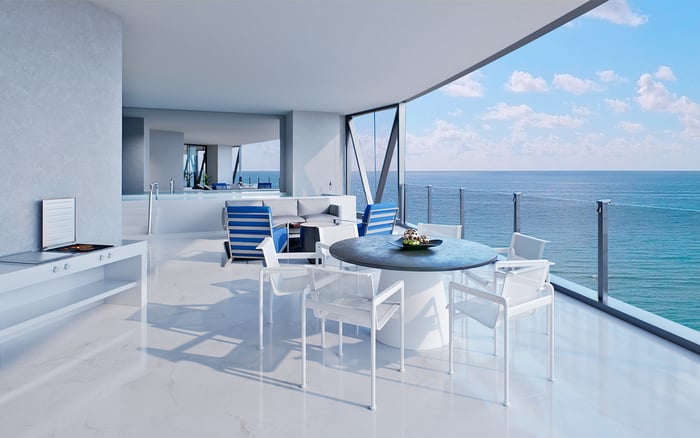
At The Perigon, the question is how the new design proposition translates into livable daylight. Expansive glazing and ocean orientation can create drama, but buyers should understand where morning brightness, afternoon heat, and reflected glare may appear. A residence that photographs beautifully can feel very different during peak sun if shading and air control are not well resolved.
At Regalia, the full-floor model may give buyers more exposure and separation, while the sculptural balconies become part of the light-control equation. A buyer should visit at different times of day whenever possible. The ideal residence is not the brightest one on paper. It is the one where brightness feels calm, usable, and compatible with everyday life.
Humidity is one of the least glamorous and most important factors in coastal ownership. In Miami Beach and Sunny Isles Beach, marine air can challenge interiors, glazing systems, HVAC performance, finish durability, closets, millwork, and art storage. A calm, beautiful residence depends on invisible systems working consistently.
For The Perigon, the wellness proposition should be evaluated through concrete questions about air quality, humidity control, and building systems. Because it is positioned as a newer-generation development, buyers should focus on specifications, commissioning standards, service protocols, and how performance will be verified after occupancy.
For Regalia, the inquiry is more historical. How has the building performed over time? How proactive is maintenance? How disciplined is governance? Have common areas and systems been cared for in a way that supports long-term comfort? In an existing tower, these questions can often be answered through observation and document review, a meaningful advantage for a buyer who values evidence over promise.
The Perigon is likely to resonate with a buyer who wants a contemporary wellness-forward environment, a Miami Beach oceanfront setting, and the feeling of a new residential experience shaped around lifestyle and design. The ideal buyer is comfortable evaluating projected performance and wants to be early in a newer-generation building story.
Regalia will speak to a buyer who prioritizes privacy, full-floor living, lower perceived density, and the ability to study an existing building’s real behavior. Its luxury is less about new wellness branding and more about spatial independence, discretion, and the lived performance of an established tower.
Neither model is inherently superior. The better choice depends on whether the buyer places more value on contemporary wellness intent or proven private operation. The most refined decision comes from looking past labels and asking how each residence will handle light, air, humidity, maintenance, privacy, and daily rhythm.
Is The Perigon Miami Beach more wellness-focused than Regalia Sunny Isles Beach? The Perigon is positioned with newer-generation wellness and lifestyle language, while Regalia emphasizes privacy, scale, and established operation.
Is Regalia Sunny Isles Beach a newer development? Regalia is best treated as an established ultra-boutique oceanfront tower rather than a new-generation development.
Why does one-residence-per-floor matter? It can enhance privacy, reduce shared circulation, and create a calmer arrival and living experience.
Should buyers trust wellness branding? Wellness claims should be tested through air quality, humidity control, daylight comfort, acoustics, privacy, and maintenance standards.
Why is humidity control so important in South Florida? Marine humidity can affect interiors, glazing, mechanical performance, finishes, closets, and long-term comfort.
Is more natural light always better? No. Buyers should evaluate glare, exposure, balcony shading, heat gain, and how daylight feels during normal routines.
What is The Perigon’s main appeal? Its appeal is tied to contemporary Miami Beach oceanfront design, hospitality-inflected programming, and wellness-oriented positioning.
What is Regalia’s main appeal? Its appeal centers on full-floor privacy, sculptural balconies, boutique scale, and the ability to assess existing performance.
Which building is better for a cautious technical buyer? Regalia offers more observable operating history, while The Perigon requires careful review of promised systems and post-completion performance.
Which is the better long-term choice? The stronger choice is the one whose light, air, privacy, humidity control, and governance best match the buyer’s daily life.
If you'd like a private walkthrough and a curated shortlist, connect with MILLION.
If branded residences are on your mind — as a home or as an allocation — we would be glad to share what we are seeing, privately.
Begin a quiet conversation