Middle Eastern capital has been a quiet but consequential force in South Florida luxury real estate, favoring prime coastal assets, branded experiences, and jurisdictions with strong legal protections. Today’s demand is shaped by all-cash buying power, a preference for luxury condominiums, and a broader wealth-migration narrative that continues to lift the region’s highest tiers.
South Florida’s luxury market has matured into more than a resort narrative. It is a liquidity story, a lifestyle story, and for certain global families, a jurisdictional story. Middle Eastern capital, in particular, tends to be pragmatic and risk-aware: it gravitates toward political stability, transparent legal systems, and investor protections that reduce uncertainty when deploying meaningful sums.
That dynamic helps explain why the region’s top tier often reads as resilient even as broader housing cycles fluctuate. A meaningful share of international demand in Florida arrives with all-cash capacity, and internationally oriented buyers in the state have been more likely to close without financing than the national international-buyer average. In practice, that shifts the deal mechanics: timelines compress, closing friction drops, and sellers gain confidence when a buyer is choosing among multiple properties.
The result is a market where speed and discretion can matter as much as price. For sellers, it places a premium on impeccable presentation and clean documentation. For buyers, it rewards crisp prioritization: privacy versus proximity, branded service versus architectural uniqueness, and long-term hold versus pied-à-terre convenience.
Before the current wave of branded residential launches and super-prime headlines, Middle Eastern institutions were already underwriting South Florida at a level that signaled conviction.
For residential buyers, these hotel acquisitions also function as a proxy for what sophisticated capital values. The most enduring trophy assets tend to share a few traits: scarcity, a defensible location, and an experience that is difficult to replicate. In neighborhoods like Bal Harbour and Surfside, where zoning and coastline are inherently finite, that scarcity becomes the asset.
International buyer activity in South Florida is not evenly distributed. Miami-Dade commands the largest share of foreign-buyer dollar sales in the region, accounting for 73% of the total during a recent 12-month period, or about $3.2 billion.
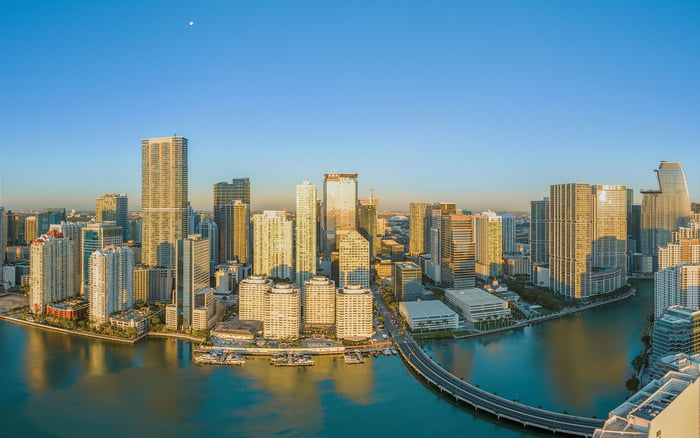
That concentration is structural. Miami-Dade offers the broadest menu of ultra-luxury inventory: skyline product in Brickell and Downtown, oceanfront lifestyle in Miami Beach, and privacy-forward enclaves in the northern coastal corridor. It also aligns with an ownership format international buyers often prefer: the luxury condominium.
Luxury condos have represented a majority share of international purchases in Miami, a pattern that reflects the realities of global ownership. Condos can be easier to lock-and-leave, simpler to staff, and more straightforward to insure and maintain than a large single-family compound. They also consolidate amenities and service-particularly compelling for buyers who split time among multiple global bases.
In Brickell, that is where architectural presence and lifestyle infrastructure converge. Buildings that operate like private clubs often outperform, especially when they deliver a deliberate arrival experience, resident programming, and credible long-term service. For buyers exploring the new generation of luxury towers, 888 Brickell by Dolce & Gabbana captures the neighborhood’s shift toward fashion-forward branding and statement interiors.
For high-net-worth families, real estate is rarely only real estate. It can also be a component of a broader asset-location plan. Florida’s lack of state income tax is a well-known draw for those evaluating domicile decisions, and the state’s homestead protections can offer meaningful creditor protection for a qualifying primary residence, subject to eligibility and exceptions.
The sophistication is in the sequencing. Many buyers start with a discretionary second home that also serves as a lifestyle anchor. Over time, the relationship with the state can deepen: longer stays, children’s schooling considerations, and eventually a more formal domicile posture for those who can and wish to pursue it. This is one reason the market often favors turnkey residences with strong building management-they let a buyer test-drive an area with minimal operational burden.
In Miami Beach, a more intimate oceanfront product can be the right entry point for a family that wants privacy over scale. 57 Ocean Miami Beach is emblematic of that boutique, design-led approach where the building itself is part of the appeal, not merely the view.
South Florida’s next phase is increasingly defined by brand partnerships and cross-border developer narratives. A Saudi-linked luxury developer publicly announced plans to invest $300 million in U.S. luxury real estate, targeting Miami among other markets, and signaled an intent to finance the expansion using a mix of equity and debt. Notably, the same company has stated it aims to sell at least half of its U.S. units to U.S. residents while also attracting international buyers, underscoring how Miami’s luxury demand is now a blend of domestic migration and global capital.
Branded residences succeed when the brand is more than a logo. The strongest projects align design, service standards, and lifestyle programming so the owner’s experience feels curated rather than merely expensive. That mirrors what many Middle Eastern buyers already understand from global hospitality: consistency is a luxury.
In the coastal corridor north of Miami Beach, the branded and amenity-rich proposition often pairs with a desire for security and discretion. Armani Casa Sunny Isles Beach speaks to buyers who want design pedigree and an effortless, managed lifestyle that still feels private.
The ultra-prime tier in Miami continues to record meaningful volume, including dozens of $10 million-plus transactions in a single quarter and year-over-year growth in deal count. That kind of activity is less about “hot market” energy and more about what scarcity does to decision-making.
In super-prime purchasing, the negotiation is often about certainty: certainty of views, certainty of long-term neighborhood character, certainty of building governance, and certainty that the asset will remain difficult to replace. Buyers with global options tend to choose the property that feels inevitable rather than merely attractive.
A common pattern follows: when prime inventory is limited, buyers will pay for what reduces compromise. That can mean a higher floor for uninterrupted water, a smaller building for privacy, or a more established neighborhood for predictability.
While every family office and principal has unique requirements, a few preferences appear consistently in high-end cross-border buying.
First is a strong bias toward turnkey condition. Even when a buyer plans a future renovation, immediate usability and low-friction ownership carry real value. Second is a preference for buildings with a credible service culture, not just amenities. Third is a focus on privacy and arrival, including discrete access points and thoughtful security.
Finally, there is often an emphasis on holding power. Many Middle Eastern investors are not seeking quick flips. They are looking for asset durability, the ability to enjoy the property, and the option to pass it through generations.
This is where certain submarkets continue to earn loyalty. In Bal Harbour, scarcity and prestige remain core. In Miami Beach, lifestyle is immediate. In Brickell, convenience and global connectivity are compelling. In Palm Beach County, a quieter, legacy-oriented profile can appeal to buyers who prefer a more residential rhythm. For a refined West Palm address that still feels connected, Alba West Palm Beach offers a modern condominium alternative in a market that increasingly caters to ultra-affluent newcomers.
Miami’s luxury development ecosystem has also been marketed to buyers seeking residency-linked investment pathways. This is not the dominant motive for every international purchaser, but it is a persistent parallel lane in the market’s global narrative.
For families weighing multiple jurisdictions, any program that pairs capital deployment with potential residency outcomes can influence timing and structure. The key is to apply the same rigor used for any luxury real estate decision: sponsor quality, project fundamentals, and realistic expectations around timelines.
For buyers, Middle Eastern capital’s history in South Florida offers a useful lens: trophy assets and best-in-class locations tend to hold attention, and service-forward living is increasingly the expectation rather than the upgrade.
For sellers and developers, the takeaway is equally direct. The most compelling offerings are the ones that reduce friction and elevate certainty: clean governance, precise disclosures, and a product that reads as globally legible. In a market shaped by both domestic wealth migration and international liquidity, excellence is what travels.
Why do Middle Eastern buyers consider South Florida at all? Many value the U.S. for political stability, a transparent legal system, and investor protections.
Are Middle Eastern buyers a large share of South Florida’s foreign demand? They have represented a meaningful portion in prior periods, including a double-digit share in 2019.
Which county draws most international luxury dollars in South Florida? Miami-Dade has accounted for the majority of foreign-buyer dollar sales in the region.
Do international buyers mostly want condos or single-family homes in Miami? Luxury condominiums have been the dominant property type for international buyers in Miami.
How common are all-cash purchases among international buyers in Florida? All-cash buying is more common in Florida than the national international-buyer average.
Is Florida’s lack of state income tax relevant to luxury real estate decisions? Yes, it can influence domicile planning and broader asset-location strategy for high earners.
What are homestead protections, and why do they matter? Florida homestead protections can offer significant creditor protection for a qualifying primary residence.
What types of trophy assets have Middle Eastern institutions bought locally? Publicly disclosed deals have included high-profile luxury hotels in Bal Harbour and Miami Beach.
Is branded luxury living growing in Miami? Yes, brand partnerships and international developer strategies are shaping new luxury supply.
Is residency-linked real estate investing part of the Miami market? It is actively marketed alongside luxury development, though it is not the only buyer motivation.
To compare the best-fit options with clarity, connect with MILLION Luxury.
If branded residences are on your mind — as a home or as an allocation — we would be glad to share what we are seeing, privately.
Begin a quiet conversation