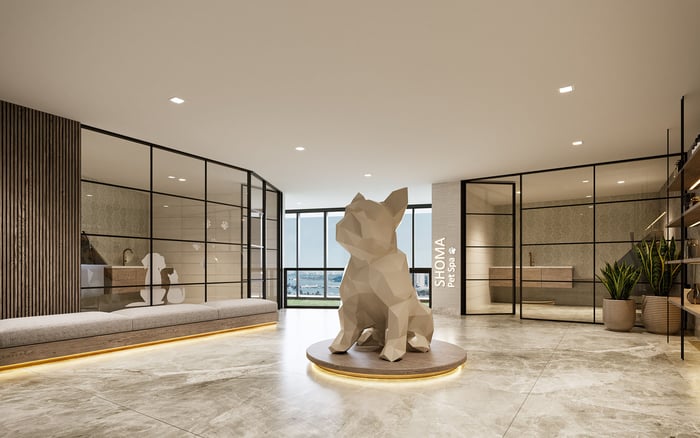
A practical 2026 guide for Miami Design District buyers navigating service animal rules in luxury retail, dining, galleries, and residential settings.

The Miami Design District is a concentrated expression of South Florida luxury: fashion, design, architecture, art, dining, and polished retail arranged within a walkable urban setting. For buyers who spend meaningful time in the neighborhood, service animal policy is not a peripheral detail. It shapes daily access, restaurant routines, gallery visits, private appointments, and the way a nearby residence functions after closing.
The central point is simple, but often misunderstood: public-access rules for boutiques, restaurants, showrooms, hotels, galleries, and similar destinations are different from residential accommodation rules inside condominium and rental housing. A buyer evaluating the Design District lifestyle should understand both. The most refined buildings and retail environments handle the issue quietly, consistently, and without theatrical scrutiny.
For businesses open to the public, federal disability-access rules generally require that a service animal accompany a person with a disability in the areas where customers are permitted. In this setting, a service animal is a dog individually trained to do work or perform tasks for a person with a disability. The task is the defining element. A dog whose sole function is comfort or emotional support does not qualify as a service animal under the public-access standard.
There is also a limited rule for miniature horses individually trained to assist a person with a disability. Public accommodations must consider reasonable modifications for them, using practical factors such as size, control, and safety. In a dense luxury retail environment, that assessment is highly contextual, but it should not be dismissed reflexively.
Restaurants and other food-service businesses generally must allow service animals in public dining areas, even when ordinary animal restrictions would otherwise apply. That includes the polished dining rooms, cafés, and hospitality spaces that make the district part of a buyer’s weekly orbit.
When the animal’s role is not obvious, staff may ask only two questions: whether the animal is required because of a disability, and what work or task the animal has been trained to perform. That narrow script matters in luxury settings, where over-screening can quickly turn an elegant encounter into a legal and reputational problem.
Staff may not ask about the person’s disability. They may not require medical documentation, training papers, a special identification card, or a demonstration of the animal’s task. A service animal also is not required to wear a vest, identification tag, or particular harness. A polished property culture should train reception, valet, security, restaurant hosts, and sales associates to apply the same standard without improvisation.
Control is the counterweight. A service animal must be under the handler’s control, typically by harness, leash, or tether, unless those devices interfere with the animal’s work or the person’s disability prevents their use. A business may ask that the animal be removed only if it is out of control and the handler does not take effective action, or if the animal is not housebroken. Even then, the person must still be given the opportunity to obtain goods or services without the animal present.
Allergies and fear of dogs are not valid reasons to deny access or refuse service to a person using a service animal. The more sophisticated response is operational separation where appropriate, not exclusion.
Florida law also protects the right of a person with a disability to be accompanied by a service animal in public accommodations. It permits the same practical inquiries: whether the animal is a service animal required because of a disability, and what tasks the animal has been trained to perform.
Florida also addresses knowing and willful misrepresentation of entitlement to a service animal. For buyers, the takeaway is not suspicion. It is clarity. Legitimate access should be treated with discretion, while casual misuse of the service-animal label can carry consequences.
Inside residential communities, the analysis shifts. Fair-housing accommodation rules use the broader concept of assistance animals, which may include service animals as well as other animals that provide disability-related assistance or therapeutic emotional support. That is why a condominium’s pet policy, weight limit, breed language, or no-pets rule does not answer the whole question.
Housing providers may not charge pet fees or deposits for approved assistance animals because those animals are not treated as pets under fair-housing accommodation rules. A building may request reliable disability-related information when the disability or disability-related need is not readily apparent, but generic internet certificates or registrations alone do not establish that need.
For a Design District-oriented buyer, this belongs in due diligence. Ask how the association or management office processes accommodation requests, who reviews them, how privacy is protected, and whether front-desk teams understand the distinction between guests in public areas and residents seeking housing accommodations. In buyer shorthand, priorities such as pets, dog access, new construction, Brickell connectivity, Miami Beach proximity, and Wynwood culture should be translated into specific questions about policy, access, and building culture.
The strongest approach is to separate lifestyle preference from legal entitlement. A pet-friendly residence may still mishandle assistance-animal requests. A no-pets building may still be required to consider a reasonable accommodation. A restaurant may dislike animals in the dining room, yet still be required to allow a trained service animal in customer areas.
Before signing, review the condominium declaration, rules and regulations, pet policy, guest policy, and accommodation procedure. Ask whether the building imposes ordinary pet fees and whether those fees are waived for approved assistance animals. Confirm how service animals are treated in lobbies, elevators, amenity decks, parking areas, and private dining spaces. For ultra-premium buyers, the goal is not confrontation. It is predictability.
In 2026, the most valuable residences near the Design District will not be defined only by finishes, terraces, concierge language, or proximity to dinner reservations. They will also be judged by how intelligently they manage access, privacy, and dignity.
What is a service animal under public-access rules? It is a dog individually trained to do work or perform tasks for a person with a disability.
Does an emotional support dog qualify as a service animal in a boutique? Not if its sole function is comfort or emotional support. Public-access rules require task training.
Can a Design District restaurant refuse a service animal because of health rules? Generally, no. Service animals must usually be allowed in public dining areas.
Can staff ask for a service-animal certificate? No. Staff may not require documentation, special identification, training papers, or a task demonstration.
What two questions may staff ask? They may ask whether the animal is required because of a disability and what task it is trained to perform.
Does a service animal need a vest? No. Public-access rules do not require a vest, tag, or specific harness.
When can a business ask that a service animal be removed? Only if the animal is out of control and not effectively handled, or if it is not housebroken.
Are allergies or fear of dogs valid reasons to deny access? No. Businesses should manage the situation without excluding the person using the service animal.
Are housing assistance animals the same as retail service animals? Not always. Housing rules can cover a broader category of assistance animals tied to disability-related need.
Can a condominium charge a pet fee for an approved assistance animal? No. Approved assistance animals are not treated as pets for fair-housing accommodation purposes.
For a tailored shortlist and next-step guidance, connect with MILLION.
If branded residences are on your mind — as a home or as an allocation — we would be glad to share what we are seeing, privately.
Begin a quiet conversation