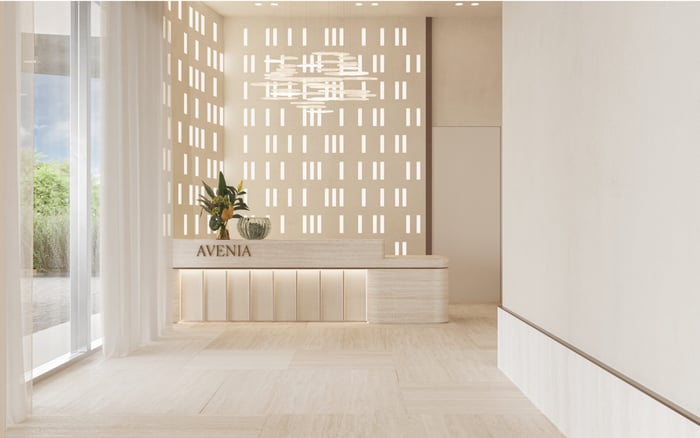
A practical comparison of Four Seasons Residences Coconut Grove and Avenia Aventura through the lens of absent-owner security, package handling, maintenance access, and written service protocols.

For the South Florida buyer who travels frequently, maintains multiple homes, or spends long periods abroad, the practical distinction between Four Seasons Residences Coconut Grove and Avenia Aventura is not simply architecture, finishes, or prestige. It is what happens when the owner is not there.
That is where lock-and-leave living becomes more than a lifestyle phrase. It becomes a set of procedures: who can access the residence, how deliveries are received, how staff respond to an emergency, how quickly an owner is notified, and whether the building’s written rules match the buyer’s actual travel pattern.
Both Four Seasons Residences Coconut Grove and Avenia Aventura belong in that conversation. Each may appeal to a buyer seeking a polished residential environment with less day-to-day friction than a single-family home. But the disciplined buyer should not treat branding, location, or newness as a substitute for operational certainty.
Four Seasons Residences Coconut Grove naturally carries a strong hospitality association in the mind of a buyer. That can be appealing for an owner who values service culture, discretion, and a refined residential setting. Yet the most important questions are not emotional. They are procedural.
A buyer should ask how staff handle owner absence, how keys or digital credentials are controlled, how vendor access is authorized, and what authority the building has in an emergency. If a housekeeper, art handler, installer, or repair technician needs access while the owner is traveling, the question is not whether the building feels capable. The question is how permissions are recorded and enforced.
This is especially important in Coconut Grove, where many buyers are drawn to privacy, tree canopy, waterfront proximity, and a more residential rhythm within Miami. A Coconut Grove purchase may feel intimate and protected, but condominium operations still need to be confirmed in writing. The elegance of the address does not replace the association rules.
For an Avenia Aventura buyer, the lock-and-leave test should focus on clarity around packages, maintenance access, security procedures, and owner notifications. Aventura is a natural fit for buyers who want convenience, access, and a polished residential base without the daily involvement a detached home may require. But convenience depends on execution.
The key issue is whether the building’s systems match the buyer’s life. A resident who is away for a long weekend has different needs from one who leaves for six weeks. A seasonal owner has different expectations from a full-time occupant. A frequent international traveler may need stronger notification protocols, more explicit vendor authorization rules, and a clear understanding of what happens after hours.
In a second-home or investment conversation, Avenia Aventura should be evaluated not only for how it looks when occupied, but for how it performs when vacant. That includes front desk procedures, package protocols, access-control practices, maintenance coordination, and communication standards.
Package handling is often treated as a back-of-house detail. For lock-and-leave buyers, it is a core amenity.
High-value deliveries, refrigerated items, retail shipments, design samples, wine, documents, and signature-required packages all require more than a generic receiving area. Buyers should ask how deliveries are logged, where they are stored, who signs for them, what happens if an item requires refrigeration, and whether the owner receives prompt notice.
The question is not whether a building receives packages. Most do. The more useful question is how the building handles exceptions. What if a delivery arrives after hours? What if the owner is out of the country? What if a package is oversized, fragile, valuable, or time-sensitive? What if multiple vendors deliver items for an installation while the residence is unoccupied?
Neither Four Seasons Residences Coconut Grove nor Avenia Aventura should be presumed superior on package handling without confirmed building documents. The buyer’s task is to compare written procedures, not impressions.
Maintenance access is one of the least glamorous topics in luxury real estate, but it is among the most consequential. In South Florida, a small leak, humidity issue, HVAC failure, or power interruption can become far more serious when an owner is not physically present.
The practical buyer should ask how vacant residences are monitored during prolonged absences, storms, and power interruptions. They should also understand what happens if water intrusion is suspected, if a neighbor reports an issue, or if building staff detect a condition that may require immediate entry.
The essential questions are direct: Who can enter my residence? Under what circumstances? Is owner authorization required every time? How is access documented? Are vendors required to provide insurance? Who reserves the service elevator? Who remains responsible for supervising the work?
For new-construction buyers in particular, early ownership can involve punch-list items, installations, deliveries, window treatments, audio-visual work, and design coordination. Even in a beautifully conceived building, the operational friction of access can shape the ownership experience.
Security in a lock-and-leave residence is not limited to cameras, controlled entry, or staff visibility. Those features may matter, but the absent owner needs documented decision-making.
A buyer should ask how keys, fobs, digital credentials, and temporary access permissions are issued and revoked. If a vendor is approved for one visit, does that approval expire? If a family office or assistant coordinates access, how is that authority documented? If an emergency occurs, who decides whether staff may enter the residence?
The best comparison between Four Seasons Residences Coconut Grove and Avenia Aventura is therefore not a simplistic question of which is more luxurious. It is which property gives the owner clearer systems for security, deliveries, maintenance, and emergency response.
For some buyers, the strongest fit may be the building whose management communicates with exceptional precision. For others, it may be the building whose rules are more flexible for staff, vendors, and estate managers. The right answer depends on the owner’s lifestyle, risk tolerance, and need for control.
Before committing to either residence, a buyer should request the relevant operating policies and association rules. The review should include after-hours emergencies, water intrusion, vendor insurance requirements, elevator reservations, package handling, vacant-unit monitoring, key control, staff authority to enter units, and owner notification procedures.
These questions are not signs of mistrust. They are signs of serious ownership. In the ultra-premium market, discretion and confidence often come from knowing exactly how unglamorous situations are handled.
A buyer comparing Four Seasons Residences Coconut Grove and Avenia Aventura should also consider who will manage the residence in practice. Will the owner personally approve every vendor? Will a family office be involved? Will an interior designer need repeated access? Will packages arrive daily, seasonally, or mostly during move-in? Will the owner be reachable during international travel?
The strongest lock-and-leave choice is the one where the building’s written systems align with those realities.
Is Four Seasons Residences Coconut Grove automatically better for lock-and-leave living? Not automatically. Buyers should separate brand expectations from confirmed condominium operating rules and written procedures.
Is Avenia Aventura suitable for an absent owner? It can be evaluated as a lock-and-leave candidate, but the buyer should confirm package, access, maintenance, and notification protocols.
What is the most important lock-and-leave question? Ask what happens when the owner is away for weeks or months and an issue requires access, action, or notification.
Why does package handling matter so much? High-value, refrigerated, oversized, and signature-required deliveries can create risk if logging, storage, and notification procedures are unclear.
What should buyers ask about maintenance access? They should ask who may enter the residence, when authorization is required, and how vendor access is documented.
How should buyers evaluate security? Security should be judged by documented access controls, key policies, staff authority, and owner notification procedures.
What South Florida risks should absent owners consider? Storms, humidity, leaks, HVAC issues, and power interruptions can escalate quickly when a residence is vacant.
Should buyers rely on verbal assurances? No. Written policies and association rules are more useful than informal expectations during due diligence.
Can a family office or assistant coordinate access? Possibly, but the buyer should confirm how third-party authority is documented and limited by building rules.
What is the practical buyer takeaway? Choose the residence whose operating systems best match your travel pattern, communication needs, and tolerance for delegation.
To compare the best-fit options with clarity, connect with MILLION.
If branded residences are on your mind — as a home or as an allocation — we would be glad to share what we are seeing, privately.
Begin a quiet conversation