A discreet field guide to how $10M-plus buyers are structuring purchases in a higher-rate world, why new development lending still matters, and what the latest trophy comps signal for 2026.
South Florida’s ultra-luxury market has not “returned to normal.” It has reset to a higher baseline and held it. The pandemic surge created a step change in behavior, and 2021 became the reference year for $10M-plus demand across Miami-Dade, Broward, and Naples. That benchmark continues to echo into 2025 and 2026, even as the market absorbs higher borrowing costs and a more selective buyer.
Today’s best buyers are not chasing headlines. They are underwriting a lifestyle decision with the same discipline they apply to capital allocation: minimize public friction, prioritize privacy, and preserve liquidity options. That posture helps explain why South Florida can still produce outsized comps while feeling quieter at street level.
A small set of widely covered trophy trades continues to shape perception. Miami has seen a Star Island sale reported at $120M, described as a Miami-Dade residential price record. Florida also led national luxury headlines with a $101.5M Miami estate sale that topped the most expensive U.S. home sales list in late 2025. Add a publicly reported $85M Bay Point waterfront estate sale that set a neighborhood record.
These deals matter, not because they are broadly repeatable, but because they establish the psychological ceiling for nearby submarkets, signal where generational wealth is comfortable holding capital, and create a comp halo that can support new construction pricing.
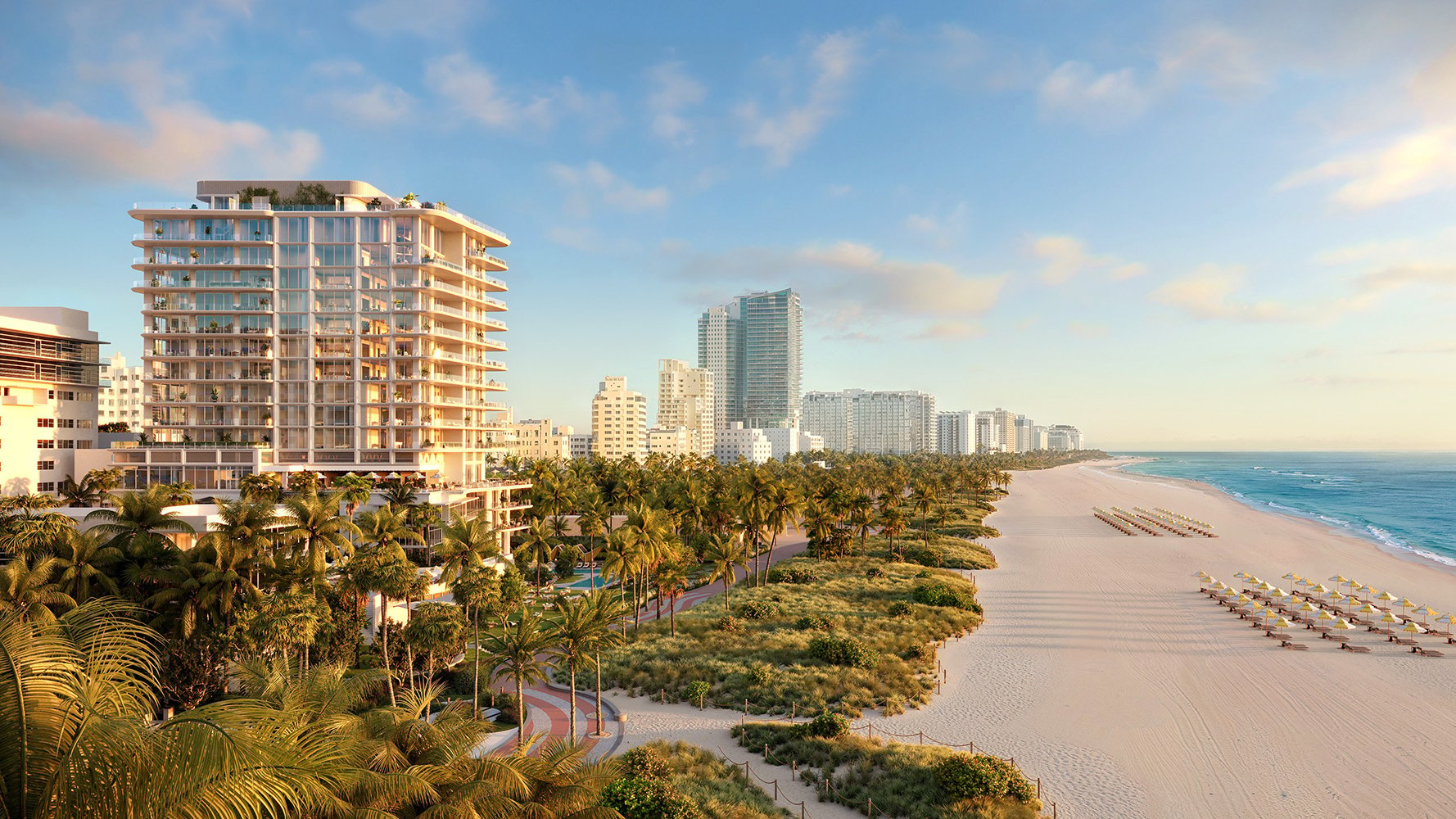
On the ground, the purchasing criteria around Miami Beach and adjacent enclaves is shifting toward outcomes: discretion, service, and durability of design rather than pure square footage. That is the context for a new wave of branded and design-forward buildings competing for mindshare, including Five Park Miami Beach, where the proposition is as much about daily experience and the amenity ecosystem as it is about the residence.
Florida’s 30-year fixed mortgage rates have sat in the mid-6% range, a meaningful departure from 2020 to 2021. Even so, the ultra-luxury segment is not purely rate-driven. One reason is simple: cash remains common at the top.
In Palm Beach County, November 2025 data showed cash representing 56.5% of condominium sales and 41.4% of single-family sales. While this is not a direct proxy for the $10M-plus tier, it reflects the negotiating posture that dominates luxury: buyers can remove financing contingencies, sellers can choose certainty over marginal price, and sophisticated purchasers can decide later whether to re-lever.
This is where the conversation moves from “Can I qualify?” to “What is the cleanest way to preserve capital and flexibility?” For buyers who treat real estate as both lifestyle and balance-sheet architecture, financing is often a liquidity tool first and a cost-of-capital decision second.
In the current environment, financing creativity shows up in underwriting and collateral strategy, not gimmicks. Several structures appear regularly in South Florida luxury transactions, with terms that vary by lender, especially outside the agency world.
Asset depletion mortgages are one example. Instead of relying primarily on W-2 income or tax returns, borrowers may qualify by converting liquid assets into a monthly “income” figure using lender formulas. Underwriting commonly applies haircuts by asset type, often giving more credit to cash accounts than to retirement assets, and dividing by a set term such as 360 months to determine qualifying monthly income.
Self-employed buyers often explore bank statement (non-QM) loans. These typically use 12 to 24 months of consecutive statements to calculate qualifying income rather than pay stubs and tax returns. In a region full of entrepreneurs and investment principals, this can align underwriting more closely with real-world cash flow.
For larger loan needs, super-jumbo mortgages operate outside standard jumbo frameworks. These are generally non-agency and often portfolio-held loans designed for multi-million-dollar balances, where flexibility can be meaningful but also highly lender-specific.
Collateral strategy is another lever. Cross-collateral structures can use equity in other properties to support a new loan, with liens placed across multiple assets. The goal is often not leverage for its own sake. It is liquidity preservation, avoidance of forced sales, and optionality across an investment portfolio.
A related tactic is delayed financing: closing with cash, then completing a cash-out refinance shortly afterward to recapture liquidity, subject to documentation and guideline constraints. Done correctly, it pairs the negotiating power of an all-cash offer with a post-closing balance-sheet reset.
One of the more underappreciated signals in a luxury cycle is whether sophisticated lenders are still underwriting major development risk. In 2025, South Florida’s five largest construction loans totaled more than $3B, an explicit indicator that large-scale capital remains engaged.
A record-setting $772M construction loan for Related Ross’s 10 and 15 CityPlace in West Palm Beach was described as the largest construction loan in Florida history. For residential buyers, the relevance is directional: it reflects institutional conviction in the region’s long-term demand curve, even amid broader uncertainty.
In the condo category, the headline was a $630M construction financing package for Bentley Residences in Sunny Isles Beach, a 62-story branded tower. For a buyer evaluating new construction, disclosed financing of this size can influence perceived execution risk and delivery confidence.
The takeaway is not that every project is “safe.” It is that capital markets are still selectively rewarding scale, sponsorship, and product that matches global luxury expectations. In Sunny Isles, for example, Bentley Residences Sunny Isles sits at the intersection of branded demand and the area’s established appetite for statement oceanfront living.
International demand is not a footnote in South Florida. In an 18-month period ending June 2025, international buyers purchased 49% of South Florida new-construction, pre-construction, and condo conversion units, with the majority of global demand coming from Latin America. That participation is structural: it affects absorption, shapes amenity programming, and reinforces South Florida’s identity as a gateway market.
The closing infrastructure is evolving alongside that demand. Crypto-funded closings have moved from novelty to repeatable mechanics in the luxury segment, supported by maturing escrow workflows and professional counterparties.
A widely reported example often cited locally is a $22.5M lower-penthouse purchase at Arte in Surfside using cryptocurrency. Regardless of the buyer’s motivations, the broader implication is speed. When funds are verified and the closing team is coordinated, timelines compress and certainty improves.
For buyers drawn to Surfside’s boutique quiet and architectural restraint, Arte Surfside exemplifies limited-supply product where privacy and execution certainty can compete with price as primary differentiators.
The 2026 market rewards a specific posture: decisive, well-advised, and structurally flexible.
First, underwrite the asset like an operator. In a market that has reset upward, the question is less “Will prices fall?” and more “How resilient is my exit?” Buyers are increasingly pressure-testing durability across cycles: location scarcity, quality of management, and the tangible value of service.
Second, separate the home from the financing structure. A clean offer can secure the property; an optimized capital stack can be built after closing. This is where delayed financing, portfolio super-jumbo options, and cross-collateral conversations become relevant.
Third, treat pre-construction as a contract, not a mood. With international participation materially influencing absorption, buyers should focus on sponsor strength, disclosed lending confidence, and realistic timelines. Strong outcomes tend to follow disciplined contract review and a conservative view of carry costs.
Finally, remember that immigration programs and real estate are not interchangeable. The EB-5 Immigrant Investor Program requires either a $1,050,000 investment or $800,000 in a Targeted Employment Area (TEA), plus the creation of at least 10 full-time U.S. jobs. A home purchase alone does not qualify. For international buyers, that distinction prevents expensive misunderstandings.
In Miami Beach, these priorities often converge in buildings where service, brand, and daily experience are integral to value. Setai Residences Miami Beach is frequently discussed in that context: less as “inventory,” more as a lifestyle platform with a consistent standard.
Is the $10M-plus market slowing down in 2026? It has become more selective, but activity remains anchored to a higher post-2021 baseline.
What did 2021 change in South Florida ultra-luxury? It established a new reference point for $10M-plus volume across key counties that continued into 2025 and 2026.
Do higher mortgage rates matter at the top? Yes for cost-of-capital, but many buyers use cash or portfolio strategies that reduce rate sensitivity.
Why do cash offers still win? They reduce execution risk for sellers and can shorten timelines by removing financing contingencies.
What is delayed financing in plain terms? You close with cash, then refinance shortly after to recapture liquidity, subject to lender rules and documentation.
How does an asset depletion mortgage work? A lender converts qualifying assets into a monthly income figure using formulas, often with asset-type haircuts.
What are bank statement loans used for? They commonly help self-employed borrowers qualify using 12 to 24 months of bank statements instead of tax returns.
Are super-jumbo loans the same as jumbo loans? They are typically non-agency, portfolio-style loans designed for very large balances, with lender-specific flexibility.
Can cryptocurrency be used to buy luxury real estate here? Yes. Crypto-funded closings are increasingly executed through established closing workflows when counterparties are aligned.
Does buying a luxury home qualify someone for EB-5? No. EB-5 requires a qualifying investment amount and job creation, and a home purchase alone does not qualify.
For a discreet, strategy-first approach to South Florida luxury real estate, connect with MILLION Luxury.
If branded residences are on your mind — as a home or as an allocation — we would be glad to share what we are seeing, privately.
Begin a quiet conversation