A discreet, buyer-forward guide to how pre-construction deposits typically work in Fort Lauderdale, comparing a boutique river-adjacent condo with a large-scale branded waterfront resort community. We outline commonly marketed deposit schedules, escrow considerations under Florida’s condominium framework, and practical diligence steps that can help protect liquidity and expectations from contract through closing.

In South Florida, pre-construction deposits are more than a procedural step. They are a buyer’s earliest liquidity commitment-and they set the tone for the entire purchase: how much capital is tied up, for how long, and under what conditions it may or may not come back.
Fort Lauderdale is particularly nuanced because today’s inventory spans both boutique buildings set near established neighborhoods and ambitious, waterfront, hospitality-driven transformations. Those categories often come with very different deposit rhythms. In practice, deposit cadence tends to track developer risk, construction complexity, and the scope of the amenity promise.
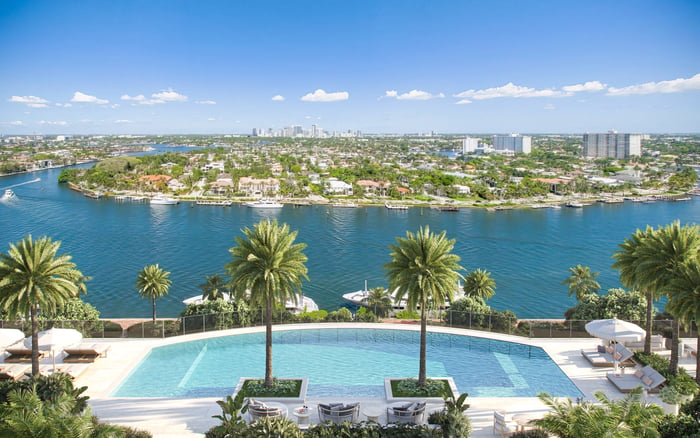
Two current examples illustrate the range: Sixth & Rio Fort Lauderdale at 501 SE 6th Avenue in the Rio Vista area near the New River, and St. Regis® Residences Bahia Mar Fort Lauderdale on the Bahia Mar site at 801 Seabreeze Boulevard along the Intracoastal, across from the beach. One is an eight-story, 94-residence boutique condominium; the other is a multi-tower, branded, mixed resort and residential environment described as a roughly $2 billion transformation.
Florida buyers will often hear “your deposit is in escrow” early-sometimes within minutes of the first conversation. That’s useful shorthand, but it’s incomplete. For pre-construction condominiums, deposits are typically handled through escrow structures consistent with Florida’s condominium framework. The more consequential issue is not simply where funds sit, but what the contract says about when-and under what conditions-the deposit becomes non-refundable.
A sophisticated buyer treats the purchase agreement as the first due diligence document. Clauses that warrant close attention include:
If a buyer cannot close, deposit-loss risk can be meaningful depending on the agreement language-and disputes often hinge on default and cure mechanics. This isn’t alarmism. It’s the reality that a deposit is designed to drive performance, and the contract governs when that incentive becomes a consequence.
From a deposit perspective, Sixth & Rio is commonly marketed with a simplified structure: 30 percent due at contract and 70 percent due at closing. Some marketing materials also show an alternate staged approach-20 percent at contract, plus 10 percent at the start of construction, with the balance at closing. The buyer takeaway is less about which version appears most often and more about one principle: the purchase agreement controls, and the exact triggers should be confirmed.
Why does this simplicity appeal to certain buyers?
The tradeoff is just as real. Concentrating a large deposit at contract can provide clarity and certainty, but it can reduce flexibility if liquidity is tied to other transactions or market timing.
For buyers who want a Fort Lauderdale point of comparison in the boutique-to-lifestyle segment, the city also offers other high-end options like Andare Residences Fort Lauderdale, which can help contextualize where Sixth & Rio sits in terms of scale and neighborhood feel.
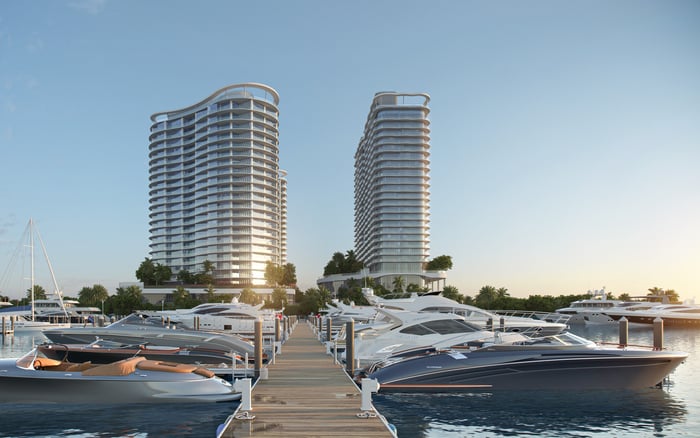
St. Regis® Residences Bahia Mar Fort Lauderdale is planned on a 39-acre Bahia Mar site along the Intracoastal. The plan is commonly described as a three-tower project: two 23-story private residential towers plus a 24-story resort and condo-hotel tower. The private residential towers are marketed as 80 units per tower, for 160 private residences total, with additional residences and hotel rooms in the resort tower.
Design and brand expectations are central here. The project is marketed with architecture by Arquitectonica and interiors by Tara Bernerd & Partners. Private residences are marketed as 3 to 5 bedrooms plus den, roughly 2,600 to 3,550 square feet with large terraces. Select penthouses are marketed with private pools. Pricing is marketed from about $5 million and up for private residences, while resort residences are marketed from about $2.6 million and up.
Deposit structure in this environment is often more layered. A commonly marketed schedule totals 40 percent: 15 percent at contract, 15 percent at groundbreaking, 10 percent at top-off, with the balance due at closing. For buyers, this milestone cadence can be compelling because it connects additional capital calls to visible progress. Still, milestones are contractual definitions-not emotions. “Groundbreaking” and “top-off” depend on how the agreement defines them and can be subject to schedule shifts. Buyers should confirm how milestones are defined, how notice is delivered, and what documentation is required.
The amenity narrative also matters. St. Regis Bahia Mar is marketed with extensive amenities including a marina reported at 250 slips and a deeded beach club concept. When the amenity scope is expansive, milestone deposits can also signal the broader construction and operational choreography the development is undertaking.
In the Fort Lauderdale branded-luxury context, it can be useful to compare expectations to established beachfront, service-driven communities such as Four Seasons Hotel & Private Residences Fort Lauderdale or wellness-and-service-led projects like Auberge Beach Residences & Spa Fort Lauderdale, even when deposit schedules are not identical.
A deposit schedule is a subtle form of communication. It reflects how a developer balances sales velocity, construction financing, and buyer commitment.
For Sixth & Rio, the commonly marketed 30 percent at contract signals an emphasis on early commitment with a straightforward path to closing. It can suit buyers who prefer fewer milestone events and are comfortable committing capital upfront.
For St. Regis Bahia Mar, the layered 40 percent across contract, groundbreaking, and top-off suggests a longer arc with multiple checkpoints. This may suit buyers who prefer capital calls tied to progress and who accept that milestone timing can move.
Neither posture is inherently “better.” The right structure depends on your liquidity profile, your tolerance for timeline variability, and your plan for how you intend to use the residence.
At this level, buyers tend to move past headline percentages and focus on questions that reveal how the transaction performs under stress. Consider:
These questions are especially important in milestone-based schedules, where notice can arrive and trigger a sizable capital call on a compressed timeline.
Luxury buyers increasingly treat pre-construction deposits as an element of portfolio design. A deposit isn’t just money earmarked for real estate; it’s capital temporarily removed from other opportunities.
If your strategy is to hold a Fort Lauderdale residence as a long-term lifestyle base, the deposit can be viewed as a disciplined path to a specific address and amenity set. If your strategy is to preserve optionality, you may prefer a schedule that defers larger capital calls to later stages.
Location intent also matters. A New River-adjacent residence can read as discreet, neighborhood-forward Fort Lauderdale living. A Bahia Mar address reads as a waterfront resort ecosystem, with the layered service expectations that branding implies.
For buyers tracking other South Florida new-construction benchmarks while assessing Fort Lauderdale, it can also be helpful to look at a different market’s deposit culture, such as 2200 Brickell, to see how schedule complexity can vary by submarket and product type.
Are pre-construction condo deposits in Florida typically held in escrow? Yes, deposits are generally handled through escrow structures consistent with Florida’s condominium framework, but the contract defines the practical protections.
What is the commonly marketed deposit schedule for Sixth & Rio Fort Lauderdale? It is commonly marketed as 30% at contract and 70% at closing, though some materials show a staged 20% plus 10% structure.
What is the commonly marketed deposit schedule for St. Regis® Residences Bahia Mar Fort Lauderdale? A commonly marketed schedule totals 40%: 15% at contract, 15% at groundbreaking, 10% at top-off, and the balance at closing.
Does “groundbreaking” or “top-off” always occur on a predictable date? No, milestone timing can shift, so buyers should confirm definitions, notice requirements, and documentation in the purchase agreement.
Can you lose your deposit if you cannot close? Potentially yes, depending on whether the deposit has become non-refundable and what the contract says about default and cure provisions.
Is a simpler deposit schedule always safer for buyers? Not necessarily; simplicity can improve predictability, but it can also concentrate capital earlier and reduce flexibility.
How big is Sixth & Rio as a project? It is a boutique, eight-story condominium planned for 94 residences near the New River in the Rio Vista area.
How is St. Regis Bahia Mar structured as a development? It is planned as three towers, including two private residential towers and a resort/condo-hotel tower on the Bahia Mar site.
What size and pricing are marketed for St. Regis Bahia Mar private residences? Private residences are marketed as 3-5 bedrooms plus den, roughly 2,600-3,550 sq ft, with pricing marketed from about $5M+.
What is the single most important document for confirming deposit terms? The purchase agreement, because marketing language can vary while the contract controls timing, triggers, and refundability.
For a confidential assessment and a building-by-building shortlist, connect with MILLION Luxury.
If branded residences are on your mind — as a home or as an allocation — we would be glad to share what we are seeing, privately.
Begin a quiet conversation