For Singapore-based families considering Bal Harbour, private school timing and domicile planning should be treated as one integrated relocation strategy, not two separate checklists.
For a Singapore-based family considering Bal Harbour, the purchase is rarely just about an ocean view. It is about continuity: children entering the right academic environment, parents establishing a credible residential pattern, and a household functioning smoothly across time zones, calendars, and jurisdictions. At this level of the market, the address becomes part of a larger family architecture.
The strongest transitions begin with one premise: private school planning and domicile planning should not be handled in separate silos. They touch the same questions. Where will the family actually live during the school year? How often will parents travel? Which home will serve as the true center of domestic life? How will staff, drivers, tutors, visitors, and extended relatives use the property?
Bal Harbour is appealing because it offers a discreet residential atmosphere with access to the ocean, luxury retail, and the broader Miami Beach corridor. Yet the right home may sit just beyond a strict village boundary, particularly when the family prioritizes school commute, building privacy, or a quieter daily rhythm. That is why many searches begin in Bal Harbour and naturally widen to Surfside, Bay Harbor Islands, Miami Beach, and, for certain families, Fisher Island.
Private school placement is often the first true constraint. Families relocating from Singapore are accustomed to strong academic standards, structured extracurricular expectations, and international peer groups. In South Florida, the question is not simply which school is prestigious. It is whether the child’s grade level, admissions timing, commute pattern, language support, sports schedule, and social transition all fit the family’s intended residence.
A beautiful residence can become impractical if it turns every weekday into a logistical negotiation. Morning traffic, afternoon activities, sibling schedules, and parental travel days all matter. A family with younger children may value a shorter, more predictable school run over a marginally larger terrace. A family with older students may prioritize access to athletics, arts, and social life across a wider radius.
This is where the home search becomes more exacting. Residences such as Rivage Bal Harbour can suit buyers who want a Bal Harbour identity while remaining close to the coastal corridor. Nearby, Oceana Bal Harbour may appeal to families seeking an established oceanfront context with a polished residential feel. The point is not to select the building first. It is to test each building against the school-day reality.
For international families, domicile should be approached with counsel before assumptions are made. It is not merely a mailing address or a signature on closing documents. It is a broader pattern of life: where a family spends meaningful time, where children are enrolled, where household routines are centered, and how the family’s affairs are organized.
School enrollment can become an important practical signal because it anchors the family to a calendar. If children attend school in South Florida, the residence must support more than occasional holidays. It must be livable on Monday mornings, resilient during exam weeks, and suitable for parent meetings, birthday weekends, visiting grandparents, and household management.
This is why buyers should resist separating the legal conversation from the real estate conversation. A domicile plan that points to South Florida, paired with a property that functions only as a seasonal pied-a-terre, may create friction. Conversely, a residence chosen for daily life can make the broader transition feel coherent.
Bal Harbour carries a particular signal: refined, compact, ocean-oriented, and intentionally understated. For some families, that is exactly the desired identity. For others, the better answer may be one step south in Surfside, across the water in Bay Harbor Islands, or within a more private enclave.
Surfside is often considered by buyers who want a gentler residential tone while preserving proximity to Bal Harbour. The Delmore Surfside and The Surf Club Four Seasons Surfside enter the conversation when a family wants beachfront living with a quieter approach to daily life. Bay Harbor Islands can be relevant for buyers who prefer a boutique, neighborhood feeling near the water, especially when school logistics are central to the search.
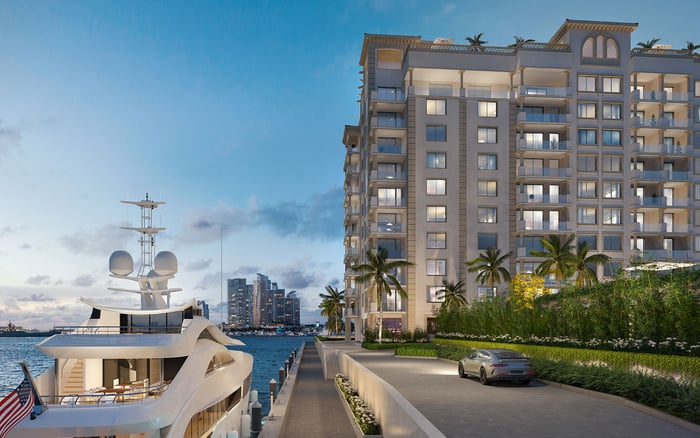
For families whose priority is privacy and separation, Fisher Island may be considered as a different proposition altogether. The Residences at Six Fisher Island speaks to buyers who want an enclave experience, though that choice requires a particularly careful review of commute tolerance and household operations.
The labels matter less than the lived fit. For Singapore-based families, the practical question is how each location supports school rhythm, household privacy, and a credible South Florida residential pattern.
The first test is time. If the family is serious about aligning school and domicile, the home should be available and operational before the academic year becomes demanding. Renovation plans, furniture lead times, building move-in rules, and staff onboarding all affect whether the property can genuinely support the transition.
The second test is privacy. Families moving from Singapore often value discretion, controlled access, and a service culture that does not require constant explanation. In South Florida, that can mean evaluating lobby flow, elevator configuration, valet protocol, package handling, visitor management, and how the building performs during high season.
The third test is resilience. A residence that works for two adults on a winter visit may not work for a full household during the school year. Consider storage, secondary bedrooms, study areas, service access, parking, pet policies, and the ability to host visiting family without disrupting children’s routines.
The fourth test is optionality. A family may begin with one school, then adjust as children mature. A parent may need faster airport access. A grandparent may spend longer periods in residence. The right property should not solve only the first six months; it should remain elegant as family needs change.
The best buyers do not ask, “Which building is the best?” They ask, “Which address makes our life legible?” That question is especially important for families moving from Singapore, where education, tax planning, and household discipline are often handled with long-range precision.
In South Florida, the same discipline is rewarded. Begin with counsel, admissions timing, and a clear sense of how many months the family intends to live locally. Then evaluate the residence through the lens of daily use. Oceanfront glamour is meaningful, but only if it supports the school run, the family calendar, and the credibility of the broader domicile plan.
Bal Harbour can be an exceptional anchor for this transition. The strongest purchase, however, is the one that aligns lifestyle, education, privacy, and intention without strain.
Should Singapore buyers choose a school before choosing a residence? In most cases, school planning should begin first because it shapes commute, timing, and daily family rhythm.
Does buying in Bal Harbour automatically establish domicile? No. Domicile is a broader legal and lifestyle analysis that should be reviewed with qualified counsel.
Can a nearby Surfside residence still work for a Bal Harbour-focused family? Yes, if it supports the desired school commute, privacy standard, and household routine.
Why does school enrollment matter in a domicile conversation? It can help demonstrate where family life is actually centered during the academic year.
Should buyers prioritize oceanfront living or school proximity? The right answer depends on children’s ages, commute tolerance, and how the home will be used.
Is Bay Harbor Islands relevant for private school families? It can be, particularly for buyers seeking a quieter neighborhood feel near Bal Harbour and Surfside.
How early should families begin the relocation process? Early enough to coordinate admissions, legal planning, purchase timing, furnishing, and move-in logistics.
Is Fisher Island practical for school-age children? It may be for some families, but commute structure and household staffing should be reviewed carefully.
What building features matter most for relocating families? Privacy, access control, parking, storage, study space, and service flow often matter as much as views.
Can one residence serve as both a second home and domicile anchor? Possibly, but the family’s actual use pattern and planning objectives should be aligned from the start.
When you're ready to tour or underwrite the options, connect with MILLION.
If branded residences are on your mind — as a home or as an allocation — we would be glad to share what we are seeing, privately.
Begin a quiet conversation