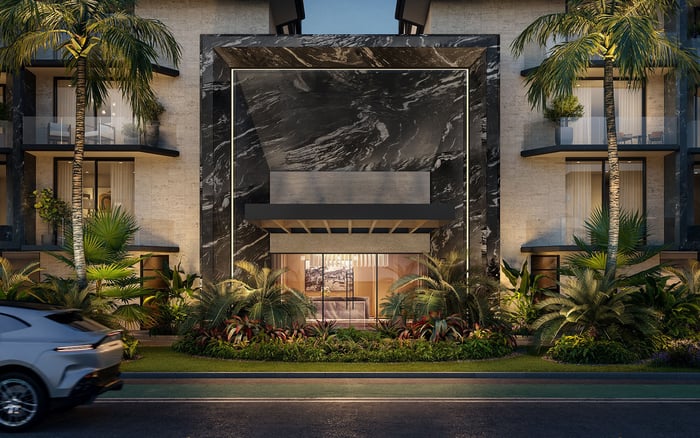
A buyer-focused guide to evaluating spa-floor residences at Shore Club Private Collections Miami Beach through access, circulation, service capacity, privacy, and resale durability.

Shore Club Private Collections Miami Beach sits within one of South Florida real estate’s most emotionally charged categories: the branded, resort-inflected oceanfront residence. It is positioned as the ultra-luxury residential component within the redevelopment of the historic Shore Club oceanfront site in South Beach, where the promise is not simply a condominium, but a layered life of design, hospitality, wellness, and beach culture.
That layering is precisely why a spa-floor residence warrants a more nuanced review. The question is not whether proximity to the spa is desirable. For many buyers, it is. The more serious question is whether that proximity remains private, quiet, and service-rich when residential, hotel, wellness, and beach-club uses converge on a compact Miami Beach oceanfront site.
For buyers filtering by Miami Beach, oceanfront, beach access, new construction, and resale, the spa floor should not be evaluated as a static floor plan. It should be evaluated as an operating environment.
The first due-diligence question is elegantly simple: who has the right to enter the wellness facilities? An owners-only spa model creates a very different residential atmosphere from a mixed resort model where hotel guests, outside members, day visitors, or invited guests may also have access.
This distinction matters because the same beautiful amenity can feel private in one operating model and active in another. A treatment corridor used only by residents on a reserved basis is one experience. A wellness floor that also serves resort guests, visiting members, staff, service providers, and event programming is another.
A serious buyer should request the access categories in writing. Ask which users can enter, during which hours, under what reservation rules, and through which routes. The most important privacy protections are rarely expressed in renderings. They are usually embedded in the rules, declarations, staffing plans, and access controls that define daily use.
Elevator separation is one of the defining variables for a spa-floor residence. If residents, hotel guests, spa clients, staff, and service providers share the same vertical route, the floor can feel more public than its price point suggests. Even a limited number of non-residential users can change the mood of arrival when they appear outside residence entries, elevator lobbies, or amenity doors.
The key is not merely whether there is a private elevator. The key is whether the private residential route remains meaningfully separate from the wellness route at peak times. Buyers should ask how a resident returns home from the beach, how a hotel guest reaches a treatment room, how a therapist or attendant arrives for work, and how laundry, supplies, and service functions are handled.
In ultra-premium real estate, privacy is not only visual. It is acoustic, behavioral, and psychological. If the elevator lobby feels like a shared resort threshold, the residence may lose some of the calm that high-net-worth buyers expect.
Spa-floor crowding is often discussed as if it happens inside the spa. In practice, the most consequential crowding may occur just outside it. The path to saunas, steam rooms, treatment rooms, lounges, fitness areas, and relaxation spaces can become one of the most active horizontal circulation zones on the floor.
A spa-adjacent residence offers obvious convenience. It can reduce friction between home, treatment, fitness, and recovery. For a wellness-focused owner, that daily ease may be one of the residence’s greatest privileges.
The tradeoff is exposure. A residence entry placed too close to an amenity door may experience more foot traffic, voices, scent, staff movement, and incidental visibility than a buyer expects. This is where floor-plan review becomes granular. Look for buffers between private doors and spa doors, turns in the corridor that limit sightlines, acoustic separation, controlled access points, and discreet resident-only routes.
The best spa-floor units capture the convenience of wellness adjacency while preserving the psychological feel of a private residential floor.
Spa crowding is not only a design issue. It is an operational issue. Staffing, reservation rules, treatment-room capacity, user mix, guest policies, and peak-use management all shape the experience.
A quiet weekday walkthrough can be misleading. Miami Beach has a pronounced rhythm, and a spa that feels serene midweek may become materially busier during holidays, weekends, and major event periods. In those moments, service consistency becomes the tell. Are appointments still available? Are lounge areas calm? Are attendants proactive? Are residents prioritized when demand rises?
Buyers should ask for the operating assumptions behind the wellness program. How are peak periods handled? Are there blackout periods for outside users? Are residents offered preferred booking rights? Is there a membership structure, and if so, what rights attach to it? Can the spa host events or brand programming? These questions are not inhospitable. They are appropriate for a residence whose value is partly tied to the quality of its amenity experience.
The resale impact of a spa-floor residence depends on how future buyers interpret the location. One buyer may see privileged access to a wellness sanctuary. Another may see proximity to a shared amenity with potential traffic. Both readings can be rational, which is why the details matter.
A spa-floor residence is likely to command the strongest long-term reception when it solves three problems at once: it shortens the distance to wellness, preserves quiet arrival, and limits contact with non-residential circulation. If the unit feels like a private home that happens to be close to world-class wellness, the location can be an advantage. If it feels like a residence placed beside a resort corridor, the adjacency may require a discount in the mind of a future buyer.
For Shore Club Private Collections Miami Beach, the buyer’s task is to separate the romance of the spa concept from the mechanics of daily living. The luxury is not merely having the spa nearby. The luxury is not having to think about who else is passing by your door.
Before committing to a spa-floor residence, ask for the complete picture of access, circulation, and operations. Confirm whether residential elevator banks are separated from hotel or spa elevators. Review how staff, vendors, therapists, and service providers reach the wellness level. Study whether corridor geometry protects residence entries from spa traffic. Ask where guests wait, where attendants circulate, and how busy periods are managed.
Then test the answer against your own lifestyle. A buyer who uses the spa daily may accept a more active floor in exchange for convenience. A buyer who prizes silence, discretion, and pure residential separation may prefer a unit farther from the amenity core. Neither choice is inherently superior. The right answer depends on whether the operating model matches the buyer’s definition of privacy.
In a branded resort-residence context, the most desirable spa-floor homes are those that deliver wellness convenience without asking the owner to absorb the public energy of the resort.
Is a spa-floor residence automatically more valuable? Not automatically. Value depends on whether future buyers see the location as privileged wellness adjacency or exposure to shared-amenity traffic.
What is the first question to ask about spa-floor crowding? Ask who can access the spa, including owners, hotel guests, outside members, day visitors, staff, and service providers.
Why does elevator separation matter so much? Shared vertical circulation can make a private residence feel more public, especially if non-residential users arrive on the same floor.
Can a quiet showing be misleading? Yes. A spa may feel calm midweek but become busier during holidays, weekends, and major Miami Beach event periods.
What physical features help protect privacy? Private residential elevator banks, acoustic separation, controlled access points, discreet routes, and buffered residence entries are key mitigants.
Should buyers ask about spa operating rules? Yes. Access categories, guest policies, membership rights, event programming, and peak-use management should be reviewed carefully.
Is spa proximity useful for wellness-focused owners? It can be. Close access reduces travel time between the home, treatment rooms, fitness areas, and relaxation spaces.
What is the main tradeoff of living near the spa? The tradeoff is potential exposure to foot traffic, sound, and privacy leakage near amenity entrances and active corridors.
How should a buyer evaluate service quality? Ask whether staffing and treatment-room capacity are planned for peak resort periods, not only average demand.
What makes the best spa-floor unit? The strongest unit combines wellness convenience with the calm, controlled arrival of a truly private residential floor.
To compare the best-fit options with clarity, connect with MILLION.
If branded residences are on your mind — as a home or as an allocation — we would be glad to share what we are seeing, privately.
Begin a quiet conversation