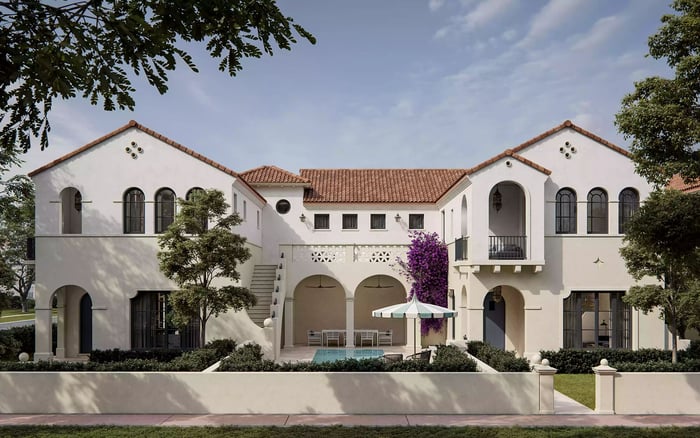
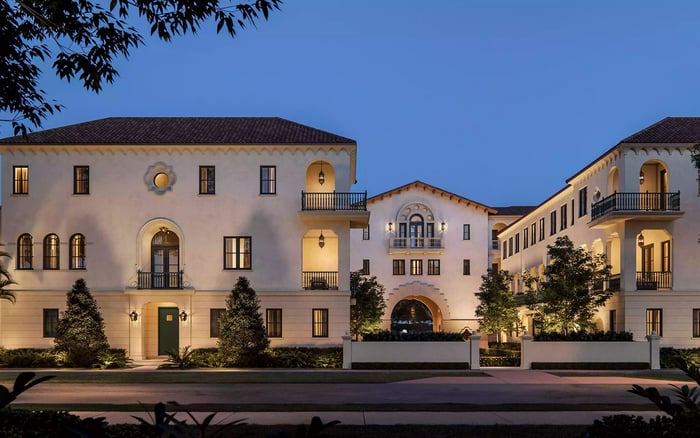
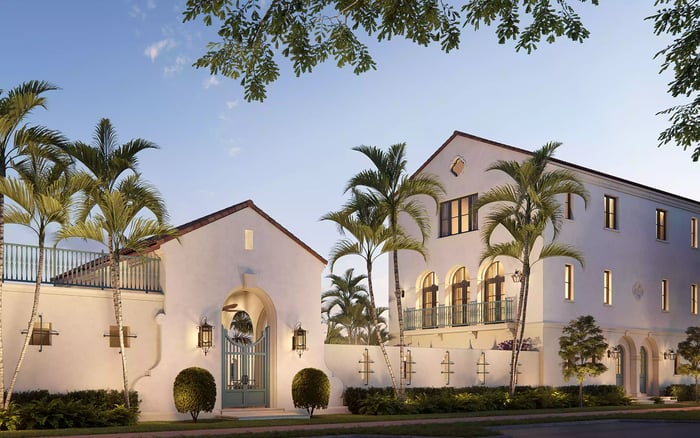
In Coral Gables, the line between civic life and residential quiet is increasingly drawn by landscape. This editorial compares two distinct approaches to outdoor design at Ponce Park Coral Gables and The Village at Coral Gables, focusing on how public plazas and private parks shape daily routines, security, value, and long-term livability for luxury buyers.
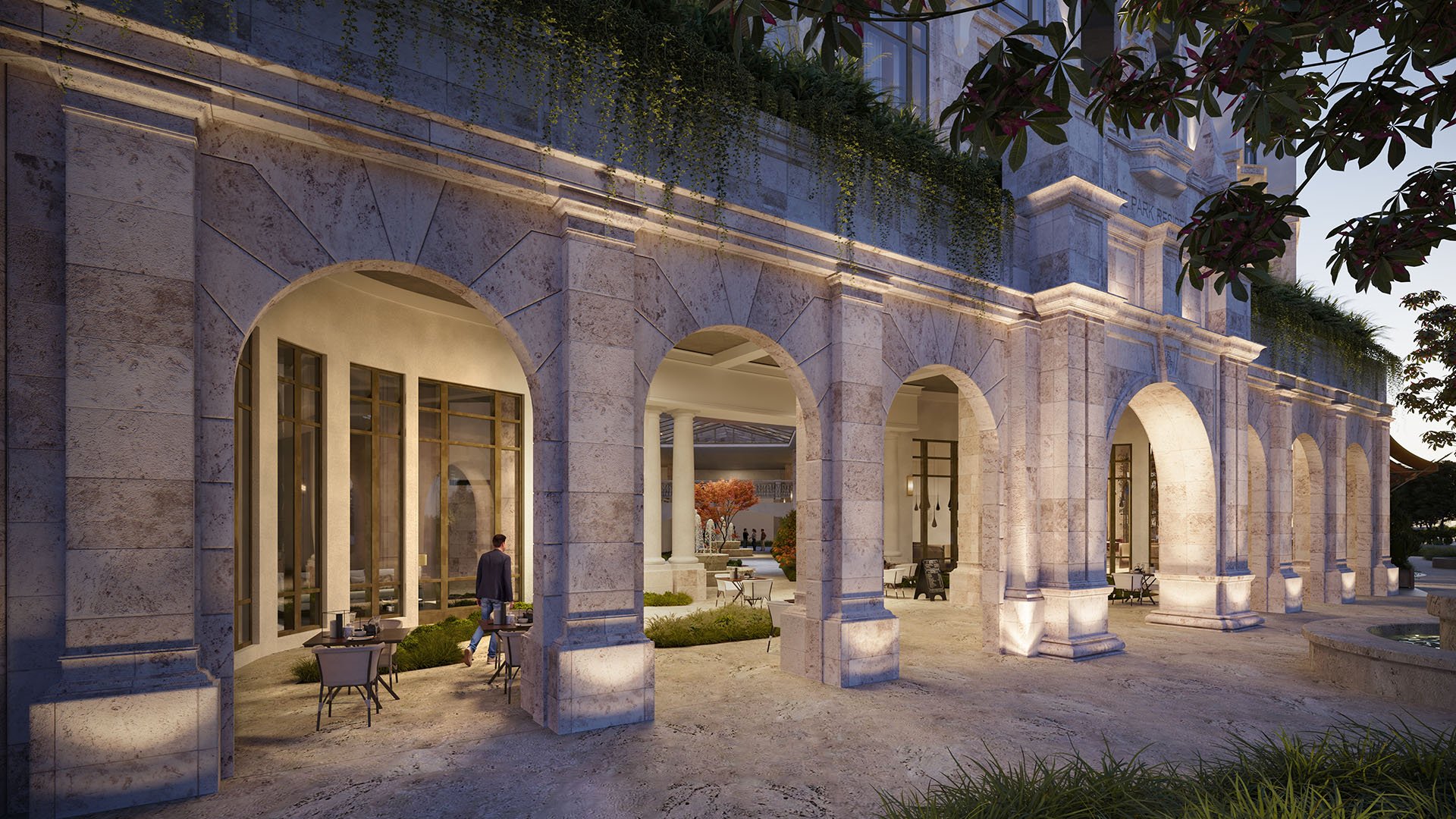
Luxury buyers in Coral Gables are not simply purchasing square footage. They are purchasing a calibrated lifestyle: the freedom to step into a lively, designed public realm when desired-and to retreat into controlled, resident-only green space when the day calls for quiet.
That calibration is increasingly shaped by landscape architecture and ground-plane planning. A public plaza can operate like an outdoor lobby for the neighborhood, drawing energy toward retail, cafés, and the social cadence that makes a district feel complete. A private park can function like an extension of the home-a place where children can roam, dogs can decompress, and residents can take a call under a canopy without the friction of a truly public setting.
This is the essential lens for comparing Ponce Park Coral Gables and The Village at Coral Gables: not which is “better,” but which choreographs the transition from city to sanctuary in a way that matches how you actually live.
The strongest mixed-use and luxury residential environments don’t treat “public” and “private” as a binary. They design an outdoor continuum.
At one end is the civic edge: sidewalks, street trees, storefront rhythm, and a plaza that signals welcome. In the middle is the semi-public threshold: courtyards, colonnades, and controlled entry points that quietly communicate, “You can pass through, but you’re being guided.” At the far end is the resident-only landscape: internal gardens, private lawns, and shaded seating that feels embedded in the building’s social fabric.
When a development sequences this well, the plaza reads as an amenity rather than a liability. When it doesn’t, the plaza can feel like the building’s front yard was given away-leaving residents with the proximity, but not the benefit.
In a project that leans into a public plaza, the plaza does more than offer seating and greenery. It becomes an address-maker. It frames the approach, creates photogenic arrival moments, and gives the street level a sense of permanence.
For residents, that can translate into effortless daily living: meeting a friend without coordinating access, taking a short walk that still feels “within” your environment, or absorbing Coral Gables energy without having to drive to find it. The plaza approach also supports spontaneous, low-commitment social life-an advantage many part-time residents value.
The tradeoff is straightforward: true public space is, by definition, not curated solely for residents. Sound travels. Peak-hour foot traffic is real. Weekend activity can feel adjacent rather than contained. In this model, luxury is delivered at the edges-landscaping that absorbs noise, subtle grade changes, water or planting that creates distance, and residential entries that don’t open directly onto the busiest plane.
Done correctly, the plaza reads like an outdoor salon for the neighborhood, while still allowing residents to move through it with a sense of control.
A private-park-forward strategy is often the more intuitive expression of luxury: resident-first green space, predictable use patterns, and a clearer relationship between what you pay and what you receive.
Private parks and internal gardens tend to excel at the unglamorous realities that drive long-term satisfaction. They can be shaped around residents’ routines without negotiating public expectations. They support quieter mornings, private fitness habits, and family life-without the feeling of “performing” at the street level.
Operationally, private landscapes are also easier to hold to a consistent standard. When access is controlled, wear patterns are more predictable, and management can enforce rules that keep the environment refined.
The risk is different: if private green space turns too inward, the project can feel detached from Coral Gables rather than integrated with it. For buyers who want walk-out vibrancy, a fully internalized park may read as an amenity you admire from above-not a place you naturally use day to day.
Luxury buyers are often less concerned with whether a space is labeled “public” or “private” than with how boundaries are executed.
Strong boundaries are rarely aggressive. They’re layered. Consider the elements that can separate a public plaza from a private park without resorting to overt fencing:
Setbacks and planting depth that create distance between seating zones and residential glazing.
Elevation shifts that subtly discourage direct cut-throughs.
Lighting design that keeps public edges bright and legible while allowing resident gardens to feel softer.
Entry sequences that feel gracious but unmistakably controlled.
In both Ponce Park Coral Gables and The Village at Coral Gables, buyers should evaluate the everyday choreography: Where do you enter? Where does a guest wait? Where does a delivery arrive? Where do you walk a dog at night? The “integration” question becomes highly practical when you picture the micro-moments that repeat hundreds of times a year.
In South Florida luxury, outdoor environments often communicate value faster than many interior finishes. A strong landscape plan signals long-term stewardship. A weak one can read as short-term marketing.
Public plazas tend to signal place-making and desirability at the district scale. They can help a project feel like a destination, which can support resale because the address becomes part of a broader story.
Private parks tend to signal exclusivity and consistent living conditions. They appeal to buyers who prioritize predictability, quiet, and family-friendly routines.
The strongest projects often blend both impulses: public-facing elegance that contributes to Coral Gables, paired with resident-only gardens that feel like a private estate stitched into the city.
For a parallel, consider how other South Florida neighborhoods treat the ground plane as a lifestyle asset. In Brickell, a tower like 2200 Brickell is often evaluated not just on interiors, but on how it manages the transition between high-energy streets and calmer resident spaces. The principle is the same-even if Coral Gables expresses it in a more classical register.
When choosing between a plaza-integrated environment and a private-park-forward environment, clarity comes from honest self-assessment.
A public plaza tends to suit:
Buyers who like to be “in” the neighborhood, not just near it.
Second-home owners who want effortless social energy without hosting.
Residents who value walkability as part of daily identity.
A private park tends to suit:
Primary residents who want calm, routine, and a controlled environment.
Families who need outdoor space that feels safe and familiar.
Buyers who view landscape as an extension of the home, not the city.
Neither preference is more sophisticated. They are simply different definitions of ease.
On-site, the differences reveal themselves quickly if you know what to watch.
Acoustics at the edge. Stand where a living room might be and listen. A well-designed plaza edge should feel buffered.
Visibility and sightlines. Can you see into resident-only areas from public seating? In luxury, privacy is often a matter of angles.
Where the “best” benches are located. If the most comfortable seating is public, residents may feel like guests in their own environment. If all the best moments are private, the street level may feel underpowered.
Programming and scale. A plaza that is too large can feel exposed. A private park that is too small can feel token.
After-hours behavior. Imagine evenings, not just a perfect afternoon. Lighting, access control, and adjacency to entrances matter.
For additional context, it can help to notice how other coastal luxury environments protect serenity while remaining connected to the outside world. In Miami Beach, for instance, buildings like 57 Ocean Miami Beach are often judged by how their outdoor amenities feel secluded even when the neighborhood is active. The lesson for Coral Gables is not stylistic, but strategic: privacy is designed, not declared.
Coral Gables has an inherent advantage in this debate: it’s a place that expects you to be outdoors. Streets are meant to be experienced at a slower pace. Shade, proportion, and a sense of civility are part of the local luxury code.
That makes plaza integration especially potent when executed with restraint. It also makes private parks more meaningful, because a garden here can feel like a true outdoor room rather than a decorative leftover.
If your lens is long-term livability, the better choice is the one that makes you walk more, drive less, and feel calmer-without trying.
For buyers comparing other South Florida submarkets, Bay Harbor and barrier-island living offer another perspective on public versus private outdoor life. A boutique setting like Cora Merrick Park underscores how smaller-scale residential experiences can still lean into walkability while keeping the resident realm tightly controlled.
Is a public plaza a benefit or a drawback for luxury owners? It can be a benefit if the project designs strong buffers and private entries; it becomes a drawback when noise and foot traffic sit too close to residences.
Do private parks usually feel more “luxury” than public plazas? Often yes, because access and maintenance are controlled-but a well-designed plaza can still elevate the address and the daily experience.
What is the biggest design risk with plaza-forward projects? Weak boundaries, where public activity visually or acoustically intrudes on resident spaces.
What is the biggest design risk with private-park-forward projects? Overly inward planning that feels disconnected from the neighborhood’s walkable culture.
How can buyers assess privacy during a showing? Pay attention to sightlines from public seating to lobbies and ground-floor glazing, plus where landscaping creates real depth.
Does plaza integration affect resale appeal? It can, because buyers often pay for a sense of place; however, many will still prioritize quiet and controlled access.
Are private parks only valuable for families? No. They also support fitness routines, remote-work breaks, and a calmer daily cadence for any household.
Do these outdoor strategies change how you entertain? Yes. Plazas support casual meetups and spontaneous gatherings, while private parks favor quieter hosting and resident-only socializing.
What matters more: size of the green space or its design? Design usually matters more-especially buffering, shade, seating comfort, and how directly it connects to resident circulation.
Can a project successfully combine a public plaza and private parks? Yes. The best outcomes create a layered sequence from civic life to resident-only gardens, without abrupt transitions.
When you're ready to tour or underwrite the options, connect with MILLION Luxury.
If branded residences are on your mind — as a home or as an allocation — we would be glad to share what we are seeing, privately.
Begin a quiet conversation