A discreet buyer's guide to evaluating state-income-tax savings, residency planning, and luxury property selection when relocating from Paris to Coral Gables.
For a Paris-based buyer, the move to South Florida is rarely a simple change of address. It is a strategic decision that can touch tax residency, family rhythm, capital preservation, schooling, privacy, and the way a household wants to live day to day. Coral Gables sits at the center of that conversation because it offers a rare combination: mature residential fabric, a civic identity shaped by architecture and landscaping, and quick access to Miami’s broader cultural and financial ecosystem.
State-income-tax savings are often the first line item that draws attention, but they should never be evaluated in isolation. The more refined approach is to ask how a Florida residence fits within a complete life structure. That means coordinating tax counsel, immigration counsel where relevant, estate planning, banking, insurance, and real estate due diligence before choosing the property itself.
A shift from Paris to Florida can alter the way personal income, investment income, business distributions, and carried interests are modeled. For founders, executives, investors, and families with complex cross-border holdings, the appeal is not only what may be saved. It is also the predictability that comes from planning around a clearly defined residency strategy.
The key is sequencing. Buyers should first understand whether they can and intend to establish Florida as a true base, then determine how that decision interacts with existing obligations in France, Europe, or other jurisdictions. A property purchase may support a broader residency narrative, but it does not replace the legal and factual work needed to support that position.
This is where discretion matters. A sophisticated buyer will usually model several scenarios: a full relocation, a partial relocation, a second-home posture, or a future transition over several years. Each carries different implications for spending, travel, household staffing, schooling, and the kind of property that makes sense.
Coral Gables is not Miami’s loudest address, which is precisely why many international buyers consider it. The city’s appeal is rooted in scale, streetscape, and atmosphere. Homes sit within a more composed setting than the high-rise waterfront corridors, while still remaining connected to business districts, private clubs, dining, aviation, and cultural programming across Miami-Dade.
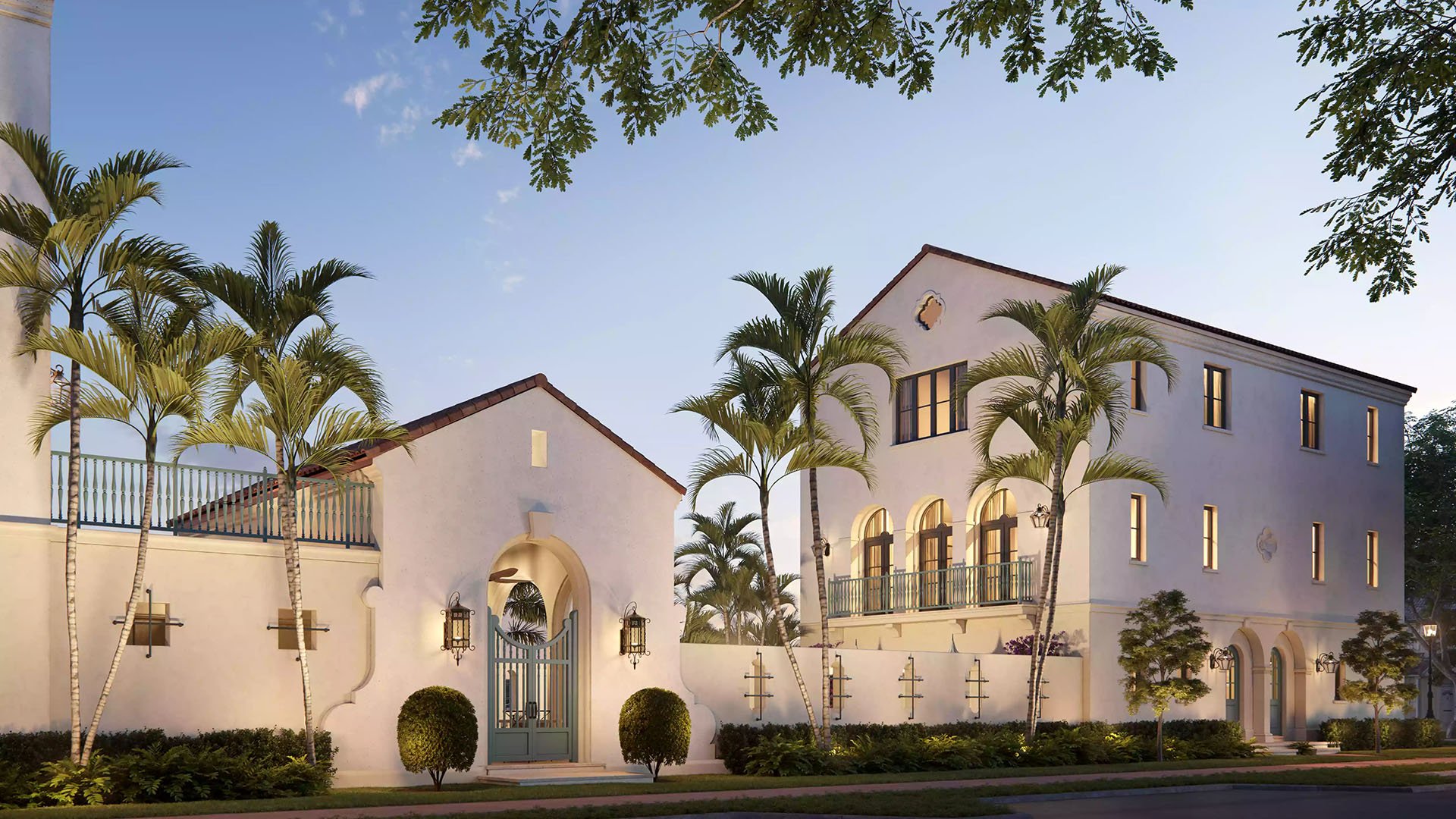
For a Paris household accustomed to walkable neighborhoods, gardens, formal dining, and a strong sense of place, Coral Gables can feel intuitive. The architecture is often more residential than theatrical. The luxury is in the tree canopy, the courtyards, the privacy walls, and the ability to host family life without sacrificing access.
New development has added another layer to the market. Buyers who want Coral Gables without the maintenance profile of a large single-family estate may look at residences such as Ponce Park Coral Gables, where the attraction is the ability to remain within the Gables lifestyle while simplifying ownership. Others may be drawn to The Village at Coral Gables for a more neighborhood-oriented interpretation of luxury living.
A buyer motivated by state-income-tax savings should resist choosing a property only for aesthetics. The home has to function as evidence of life, not merely as an asset. That can include where the family sleeps, entertains, receives guests, stores personal effects, holds memberships, enrolls children, and organizes household routines.
For some buyers, that points to a single-family residence in Coral Gables with a deep garden, staff accommodations, and formal entertaining rooms. For others, a lock-and-leave condominium in Coral Gables or nearby Coconut Grove may be more consistent with travel patterns. The goal is not to own the largest residence, but to own the residence that truthfully reflects how the family will live.
Coconut Grove often enters the comparison because it offers a more tropical, waterfront-adjacent sensibility while preserving a village-like rhythm. A buyer weighing Coral Gables against Grove living might study Four Seasons Residences Coconut Grove, particularly if service, brand standards, and simplified ownership are priorities.
The Paris buyer’s decision is often a balance between serenity and access. Coral Gables offers domestic calm, while Brickell offers density, finance, dining, and a vertical lifestyle closer to a global business district. The question is not which is superior, but which better supports the buyer’s residency and lifestyle narrative.
A family relocating with children may prefer Coral Gables as the primary address and use Brickell as a business and dining corridor. A principal who spends significant time in meetings, banking, or aviation may consider a secondary city residence or choose a condominium that reduces commute friction. In that context, properties such as St. Regis® Residences Brickell can be part of the broader comparison, particularly for buyers who value services, views, and a more urban lock-and-leave format.
From an investment perspective, the discipline is to separate lifestyle premium from financial underwriting. State-income-tax savings may increase purchasing power or operating comfort, but the property still needs to be judged on location, scarcity, build quality, maintenance burden, association structure, resale depth, and long-term fit.
Before signing, buyers should align the real estate decision with professional advice. That includes modeling tax residency, reviewing treaty considerations with qualified counsel, understanding immigration constraints if applicable, and ensuring banking and transfer logistics are settled before a competitive offer is made.
Insurance should also be addressed early. South Florida ownership can involve wind coverage, flood considerations, association reserves, and maintenance obligations that vary significantly by property type. A newly built condominium may simplify certain responsibilities, while a historic or estate-style Coral Gables home may require a more hands-on approach.
It is useful to frame the decision in three layers: the household plan, the asset plan, and the exit plan. If all three are aligned, state-income-tax savings can become a powerful accelerant. If they are not aligned, savings on paper may be diluted by friction, uncertainty, or a property that does not support the buyer’s real life.
The most successful Paris-to-Coral Gables moves are not reactive. They are deliberate. The buyer understands why Florida matters, how Coral Gables supports the family’s desired rhythm, and what type of property reinforces the overall strategy. Tax savings may open the door, but livability keeps it open.
For globally mobile families, the best residence is the one that feels inevitable after the planning is complete: legally coherent, emotionally appealing, operationally simple, and architecturally worthy of the next chapter.
Can a Paris buyer purchase in Coral Gables before finalizing tax residency? Yes, but the purchase should be coordinated with tax and legal counsel so the property supports, rather than complicates, the broader plan.
Is state-income-tax savings enough reason to move to Florida? It can be a meaningful factor, but it should be weighed alongside family needs, business obligations, estate planning, and lifestyle fit.
Does buying a home automatically establish Florida residency? No. A home can support a residency position, but daily life, documentation, time spent, and professional guidance are also important.
Why do French buyers often consider Coral Gables? Coral Gables offers privacy, mature landscaping, architectural character, and access to Miami without the intensity of denser urban districts.
Should buyers choose a condo or single-family home? The right choice depends on travel patterns, staffing, maintenance appetite, privacy needs, and whether the home will be used daily.
How does Coconut Grove compare with Coral Gables? Coconut Grove feels more tropical and bay-oriented, while Coral Gables is more formal, garden-led, and residential in tone.
Where does Brickell fit into the decision? Brickell is useful for buyers who want proximity to finance, restaurants, and vertical city living, either as a primary or secondary base.
What should buyers review before making an offer? They should review tax planning, immigration matters, insurance, association documents, maintenance obligations, and long-term resale logic.
Can state-income-tax savings increase purchasing power? Potentially, but buyers should model the full cost of ownership rather than converting projected savings directly into price.
What is the best way to shortlist comparable options for touring? Start with location fit, delivery status, and daily lifestyle priorities, then compare stacks and elevations to validate views and privacy.
For a discreet conversation and a curated building-by-building shortlist, connect with MILLION.
If branded residences are on your mind — as a home or as an allocation — we would be glad to share what we are seeing, privately.
Begin a quiet conversation