A discreet, buyer-oriented comparison of Palm Beach County and the Hamptons at the top of the market: demand, supply scarcity, negotiation dynamics, and the practical realities that shape ownership.
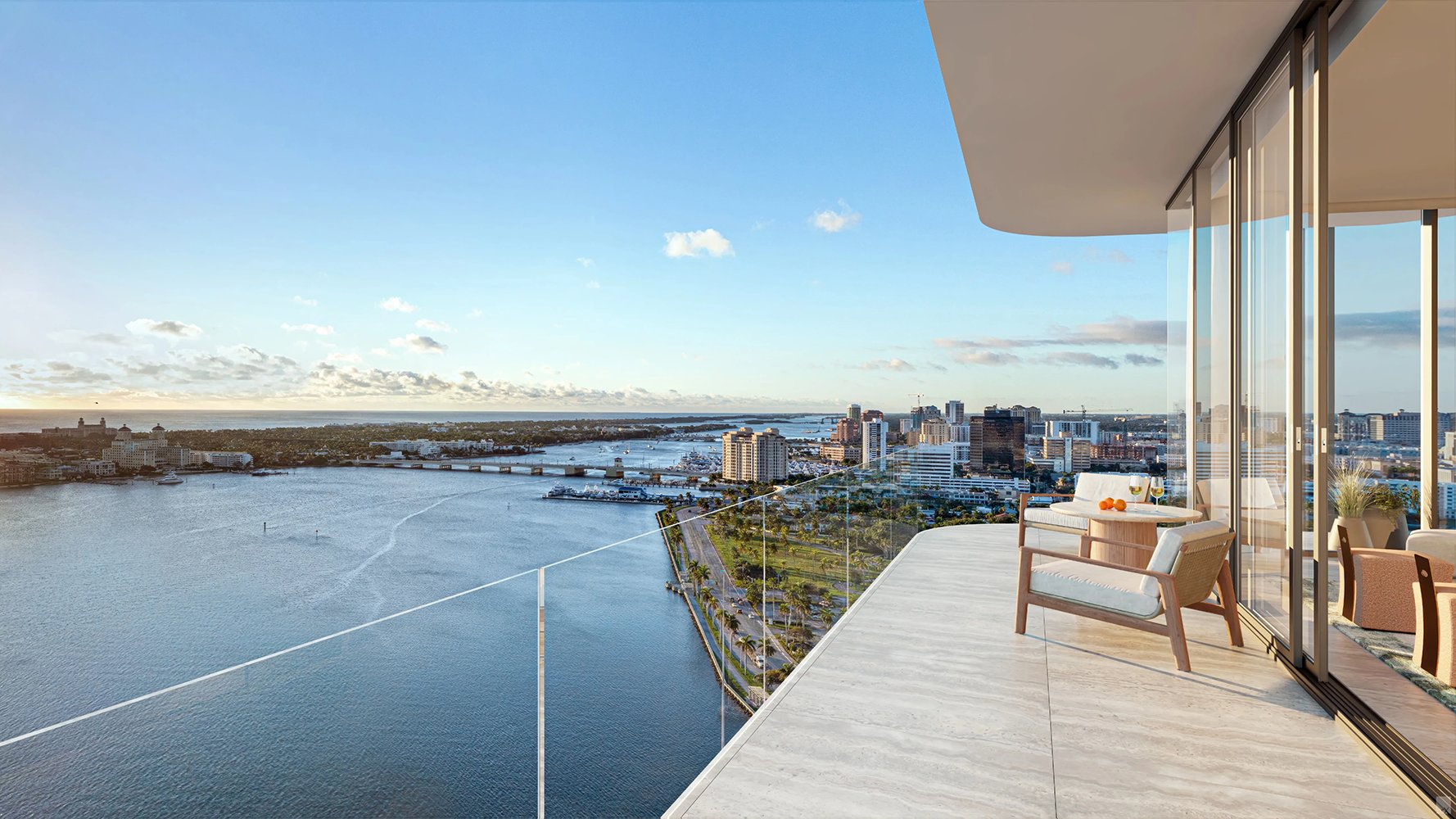
Ultra-luxury buyers do not choose between Palm Beach County and the Hamptons on weather alone. The decision is more architectural than atmospheric. One market is designed around year-round utility, persistent in-migration, and daily-life infrastructure. The other is designed around seasonal ritual, social cadence, and proximity to Manhattan.
In 2026, the comparison feels sharper because both regions are resilient at the top, yet they react differently when conditions tighten. Palm Beach County is sending volume signals that look less like a post-pandemic afterglow and more like a second act, with high-end liquidity that continues to function. The Hamptons is also re-accelerating, but with a texture that reads more balanced than the bidding-war headlines of prior years.
For South Florida buyers, the advantage is optionality. You can pursue legacy scarcity on Palm Beach Island, or you can underwrite West Palm Beach as a next-generation urban-waterfront play with a longer arc of luxury appreciation.
At the top of the market, Palm Beach County was projected to log roughly 426 ultra-luxury home sales at $10 million and above in 2025, close to the pandemic-era peak of 444 in 2021. That is not the profile of a market that is stepping away from the ultra-high-end. It reads as a market that has normalized into meaningful liquidity at the top.
Broader momentum matters because it supports the entire luxury ecosystem: move-up buyers, discretionary second-home demand, and the capital base that makes new development feasible. In late 2025, total residential sales in Palm Beach County reportedly rose 19.7% year over year in November to 1,706 transactions, with single-family sales up 19% to 1,001. Condo and co-op sales were also up, rising 20.7% to 705 units, alongside a condo median price reported around $320,000, up 3.2% year over year. The median single-family price in that same month was reported near $605,000, up 0.8% year over year.
Those numbers are not proxies for trophy assets, but they do speak to something ultra-luxury buyers track closely: the market’s ability to absorb volume without unraveling on price. When liquidity exists across tiers, confidence at the top tends to persist.
A second structural advantage is how frequently transactions are insulated from rate sensitivity. Cash purchases were described as common in Palm Beach County, including both condos and single-family homes. In practical terms, that shifts the market’s center of gravity away from the cost of capital and toward lifestyle timing, tax planning, and portfolio allocation.
For buyers, that distinction matters. In a cash-forward environment, leverage is rarely achieved by waiting for broad-based softening. It is more often achieved through precision: identifying the right asset, understanding replacement cost and condition, and executing cleanly when the opening appears.
Palm Beach Island behaves like an editioned object. Coverage has characterized the island as having only about 2,200 single-family homes in total, a finite baseline that shapes everything from pricing psychology to time-on-market.
Inventory has also been described as extraordinarily thin at times, including periods entering peak season when the number of homes for sale dropped below roughly 45. Scarcity at that level changes negotiation in a very specific way. Buyers can still win on terms, speed, and certainty, but they rarely win by assuming the market will “come to them” on turnkey quality or perfect pricing.
In this environment, the best opportunities often arrive through timing and readiness rather than a public discount narrative. If you are targeting a narrow slice of inventory, you are competing on execution as much as on price: proof of funds, disciplined inspections, and the ability to close when the seller’s next move depends on it.
Scarcity also refines what “value” means. A home can be expensive and still be mispriced relative to condition, layout, or the practical cost of getting it to a buyer’s standard. Conversely, a correctly priced, well-presented offering on the island can feel untouchable because there are so few true substitutes.
For ultra-luxury buyers, the operating assumption is simple: on Palm Beach Island, selection is the constraint. The strategic question is not whether inventory will appear, but whether you will be positioned to act when the right one does.
The most compelling 2026 storyline may be that West Palm Beach is no longer merely adjacent to Palm Beach. It is increasingly its own luxury thesis.
One widely reported measure shows luxury home sale prices in West Palm Beach increasing about 187.3% over the past decade to a median around $4.04 million as of an October 2025 snapshot. That is not incremental appreciation. It reads as a re-rating, suggesting that the market’s definition of “luxury” has expanded and that prime product has been repriced accordingly.
The demand backdrop is frequently framed through the “Wall Street South” narrative, alongside broader wealth migration. One report states Palm Beach County gained more than 13,000 new residents in 2022, bringing $7.2 billion in new income. Another reported data point describes New York contributing about $9.8 billion to Florida’s record $39.2 billion net adjusted gross income inflow from 2020 to 2021. Whether you view these as trendlines or as confirmation of what you already see on the ground, the implication is the same: year-round buyers underwrite year-round amenities.
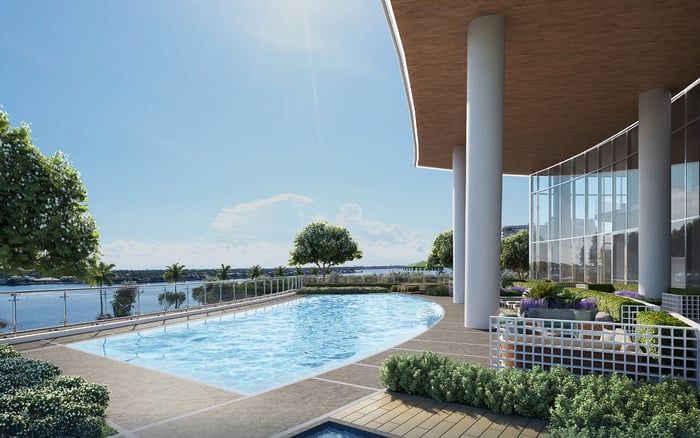
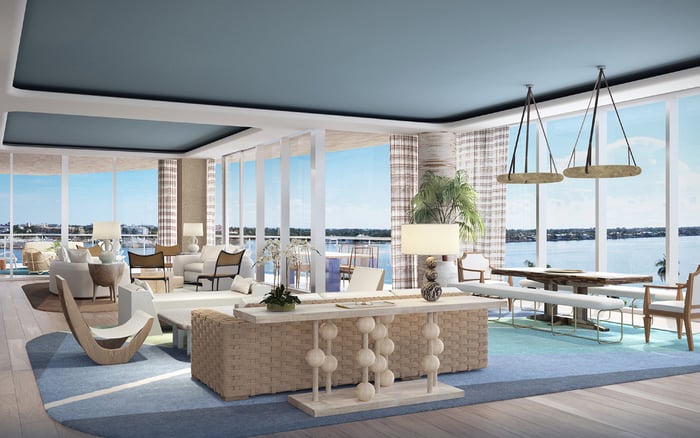
That matters because new residential offerings in West Palm Beach can feel less like “inventory” and more like curated lifestyle infrastructure. Buyers who want a modern lock-and-leave home with service sensibilities often start their tour at Mr. C Residences West Palm Beach, where the brand cue is hospitality-forward living. Along the waterfront, The Ritz-Carlton Residences® West Palm Beach speaks to buyers who value a globally legible service standard and a more managed ownership experience. For those drawn to contemporary design in a residential format that reads refined rather than performative, Alba West Palm Beach is often part of the conversation.
Even within the West Palm Beach luxury rise, the buyer’s real question is micro-location. Views, walkability, and your preferred daily rhythm can matter as much as finishes. For a more boutique, address-driven approach along Flagler, Forté on Flagler West Palm Beach and Shorecrest Flagler Drive West Palm Beach tend to resonate with buyers who prioritize the waterfront corridor and a quieter sense of arrival.
The strategic takeaway is that West Palm Beach is now evaluated on its own merits. Buyers are no longer asking whether it “counts.” They are underwriting which building, which exposure, which level of service, and which ownership profile aligns with how they actually live.
The Hamptons remains the archetype of a high-status seasonal market, and in 2026 it is showing renewed energy. Reported Q1 2026 figures place the median sale price above $2 million for the first time, alongside 423 home sales, an increase of about 85.5% from 228 in Q1 of the prior year.
That rebound does not automatically translate into peak-era frenzy. Listing inventory was described as up around 10% in Q1 2026 to roughly 1,200 listings, and the share of bidding wars was reported to have eased from about 15% to 11%. From a buyer’s perspective, that suggests a market that remains competitive, yet one where disciplined underwriting and deal structure can matter again.
At the top end, a 2025 recap reported major growth in $10 million plus activity, including year-over-year gains of 43% in the $10 million to $20 million band and 33% above $20 million. The highest trades still set the tone. A widely covered record single-parcel sale reported that Len Blavatnik bought 408 Further Lane in East Hampton for around $115 million in July 2025.
The Hamptons also offers a useful lesson for South Florida buyers who assume trophy assets never bend. Iconic properties can still transact at meaningful discounts from prior asks when the market needs to clear. “Mylestone” at 700 Meadow Lane reportedly sold in 2023 for $112.5 million after being marketed at much higher prices. Celebrity inventory can also illustrate the reality of price discovery, as Realtor.com tracked multiple price cuts tied to Alec and Hilaria Baldwin’s Amagansett home.
What this tells sophisticated buyers is not that the Hamptons is fragile. It is that even prestigious seasonal markets can develop a gap between aspiration and execution, particularly when inventory expands and buyers regain room to be selective.
A common misconception about trophy markets is that negotiation disappears. In reality, negotiation becomes more specific.
In early 2026, a notable Palm Beach trophy transaction was widely reported: a neoclassical estate at 1460 N. Lake Way sold for about $72 million, described as a discount from a prior $95 million ask. The lesson is not that Palm Beach is “soft.” The lesson is that even in supply-constrained markets, pricing still must clear the buyer’s view of replacement cost, condition, and timing.
For buyers, the most productive leverage is rarely blunt. It is usually found in controllables, the parts of a deal that reduce seller risk without sacrificing buyer protection:
For sellers, the message is equally specific. The best-priced, best-presented, turnkey properties can still trade like scarce objects. Anything with deferred maintenance, idiosyncratic design, or unclear operating realities may invite re-trading, extended timelines, or a smaller buyer pool than expected.
In 2026, leverage is less about “getting a deal” and more about knowing where the market is negotiable. Condition, readiness, and operational clarity can be the deciding factors, even when an address is exceptional.
South Florida’s luxury proposition remains compelling, but it comes with an ownership reality that sophisticated buyers address upfront. Formal hurricane preparedness programs and storm protocols are commonly part of estate management, and they can translate into recurring operating costs and ongoing decision-making.
This is not a reason to avoid the market. It is a reason to treat ownership as a system. The most effortless experience is typically created by aligning architecture, building standards, and management readiness. The more turnkey the home or residence, the more predictable the operational side can be.
In comparison, the Hamptons carries its own practical burdens, but the climate question in Florida is unique in that it can influence timelines, insurance frameworks, and the cadence of seasonal preparation. For buyers choosing between a year-round base and a seasonal retreat, operating friction is not background noise. It is part of the investment thesis.
For many ultra-luxury owners, the highest form of value is not only the property itself, but also the confidence that the property can be operated predictably. In a market where serenity is part of the appeal, disciplined planning is what protects it.
The cleanest way to choose between these markets is to define intent first, then let aesthetics refine the shortlist.
If your intent is year-round living, Palm Beach County’s strength is the combination of sustained high-end demand and an expanding set of luxury residential options that support daily life. West Palm Beach, in particular, reads as a market where prime product has already re-rated, yet still benefits from ongoing cultural and business momentum.
If your intent is a seasonal legacy retreat, the Hamptons offers an enduring social rhythm and an address vocabulary that remains globally understood. The recent rebound in sales activity and the reported rise in inventory suggest that buyers who move with patience and decisiveness may find more room to negotiate than during the most constrained periods.
If your intent is diversification, the two markets can complement each other. Palm Beach can function as an operationally efficient base, while the Hamptons remains a summer-specific asset with its own liquidity profile at the top.
The final note is straightforward. Ultra-luxury buyers are increasingly paying for certainty, not just prestige. Whether that certainty comes from scarcity on Palm Beach Island, the compounding trajectory of West Palm Beach, or the seasonal stature of the Hamptons, the winning strategy is to buy the asset that best matches your calendar and your tolerance for operational complexity.
Is Palm Beach County still active above $10 million? Yes. Palm Beach County was projected to log about 426 home sales at $10 million and above in 2025, near the 444 peak reported for 2021.
What makes Palm Beach Island so hard to buy in? Supply. Coverage has characterized the island as having about 2,200 single-family homes total, and inventory has been described as dropping below roughly 45 homes for sale at times.
Is West Palm Beach truly “luxury” now, or just adjacent to it? It is increasingly a destination market. One widely reported measure shows West Palm Beach luxury home sale prices up about 187.3% over the past decade, to a median around $4.04 million.
Has the Hamptons cooled, or is it rebounding? Reported Q1 2026 figures show a rebound in sales volume and a median above $2 million, alongside inventory rising to around 1,200 listings and a lower share of bidding wars.
Do trophy properties still negotiate? They can. A widely covered example is the reported sale of 1460 N. Lake Way for about $72 million after a prior $95 million ask.
For confidential guidance on South Florida luxury real estate, visit MILLION Luxury.
If branded residences are on your mind — as a home or as an allocation — we would be glad to share what we are seeing, privately.
Begin a quiet conversation