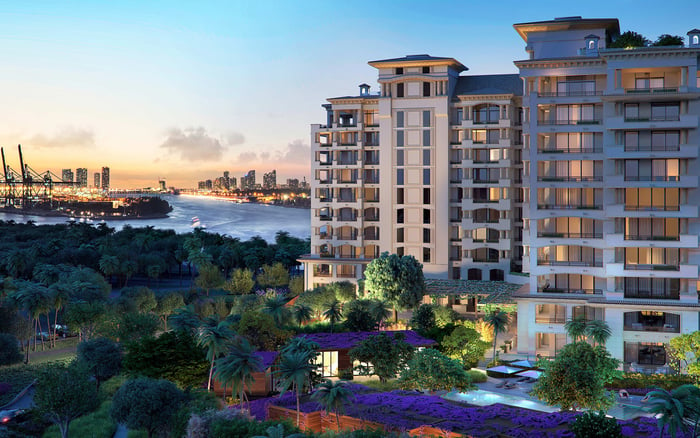
A discreet buyer’s guide to evaluating airport access at Palazzo del Sol through the lens of school schedules, family logistics, private aviation, luggage handling, traffic variables, and written confirmation.

For family buyers considering Palazzo del Sol, airport access should be evaluated as a daily-life system, not a single optimistic travel-time claim. The right question is not simply how quickly a car can reach an airport on a quiet afternoon. It is how reliably the household can move children, luggage, strollers, pets, staff, and visiting relatives through departure and arrival days without friction.
That distinction matters in the ultra-premium South Florida market, where international travel, second-home ownership, school calendars, and private aviation often overlap. A residence feels effortless only when the transfer sequence works at the exact moments a family needs it: early-morning school breaks, delayed evening returns, holiday weekends, summer storms, and peak winter-season traffic.
For many searches, the shorthand may be Palazzo del Sol Fisher Island, but the diligence should extend beyond the address. Fisher Island privacy, Miami Beach access, private-school calendars, second-home travel patterns, and pets can all change how airport access feels in practice. The most sophisticated buyers will ask for proof, process, and contingency planning before treating airport convenience as a settled advantage.
Family buyers should ask Palazzo del Sol’s sales team or management for documented average drive times to Miami International Airport, Fort Lauderdale-Hollywood International Airport, and Palm Beach International Airport. The request should be precise. Ask for times during school drop-off windows, evening rush hour, Friday afternoons, Sunday returns, holiday departures, and peak winter-season travel.
A single quoted time is not enough. Families should ask whether the estimate reflects recent traffic conditions, whether it includes vehicle staging and loading time, and whether it changes when multiple suitcases, car seats, or a pet carrier are involved. For households with children, usable travel time begins when the family leaves the residence and ends when everyone is inside the terminal, FBO, or pickup area.
It is also worth asking for the most common airport route options from the property. Buyers should understand whether a typical route depends on a single causeway, bridge, tunnel, ferry sequence, or congested arterial road. If one link in the route becomes compromised, the household should know the alternative before closing, not during a delayed flight.
Airport access at this level is inseparable from school-day logistics. A family that travels frequently may need to coordinate morning departures with school drop-off, nanny schedules, after-school activities, tutors, sports practices, and weekend birthday commitments. Buyers should ask how airport transfers tend to perform during those overlapping windows.
The question becomes especially important for families with children in different schools or on different dismissal schedules. A Friday afternoon departure can feel very different from a midweek business flight. A late Sunday arrival can affect Monday morning readiness. If airport access is part of the purchase rationale, it should be tested against the family’s actual calendar rather than an abstract map.
Buyers should request clarity on whether peak travel periods materially affect timing. School holidays, major local events, bridge openings, storms, flooding, road closures, and seasonal visitor traffic can all alter the experience. The aim is not to eliminate uncertainty. It is to understand how the building helps families manage it.
Luxury buyers often assume that a refined residential environment will smooth airport transfers automatically. That assumption should become a checklist. Ask whether the building provides airport-transfer coordination, house-car service, valet staging, luggage handling, child-seat availability, or preferred black-car vendors. If any of these services are offered, ask whether they are included, reserved separately, subject to availability, or handled by outside vendors.
Families should also ask how vehicles are staged before departure. Can airport-transfer vehicles wait on-site without blocking resident access? Is there a covered arrival or departure area? Can children wait indoors until the car is ready? Is there staff support for strollers, pets, garment bags, skis, golf clubs, or oversized luggage?
The answers matter because the most elegant residence can still create friction if the family is standing curbside in heat, rain, or late-night fatigue. For buyers with young children, aging parents, or frequent guests, the final fifty feet of the transfer can be as important as the drive itself.
For households that use private aviation, airport access should be evaluated separately from commercial terminal access. Buyers should ask which fixed-base operators residents typically use and whether the building has preferred transportation arrangements to those terminals. They should also ask whether the transfer team understands the difference between a commercial drop-off, an FBO arrival, a tarmac-side schedule, and a crew-coordinated departure.
The inquiry should include timing, vehicle type, luggage handling, and privacy expectations. If a family is returning late with sleeping children, pets, or substantial luggage, the building’s arrival process should be able to absorb that complexity quietly. If the household travels with household staff, security, or medical needs, those requirements should be discussed before any reliance is placed on general concierge language.
Private aviation users should not assume that proximity to an airport produces a superior door-to-door experience. The relevant measure is the full sequence from residence to aircraft, including vehicle staging, route reliability, and coordination with the selected FBO.
Airport access can be valuable, but buyers should also ask whether aircraft noise is noticeable inside residences, on balconies, at the pool, or in children’s bedrooms. This is not a question to answer from a brochure or a single daytime tour. Families should request any available acoustic documentation, window-rating information, or resident-experience guidance before relying on assumptions.
The best test is experiential. Visit at different times if possible. Stand in the rooms where children will sleep, study, and play. Spend time outside if outdoor living is central to the family’s lifestyle. Ask whether noise varies by weather, flight path, season, or time of day. A household that is highly sensitive to sound should treat this as core diligence, not a minor finishing detail.
The same logic applies to privacy. Families that prize serenity should ask how airport-related movement intersects with the property’s arrival court, valet areas, elevators, and service circulation. The goal is to understand not only what can be heard, but what can be felt in the rhythm of the building.
The most important airport-access questions often involve disruption. Buyers should ask whether the building has backup plans for severe weather, flooding, road closures, major local events, and unusually heavy traffic. They should also ask how early-morning and late-night pickups are coordinated, particularly for families returning from international flights with children.
A useful answer should be operational, not merely reassuring. Who makes the call if the preferred route is compromised? Can the concierge coordinate revised pickup times? Are drivers allowed to wait on-site? How are families notified if staging areas are temporarily constrained? What happens if multiple residents are departing at the same time for holiday travel?
Before making airport access a purchase assumption, buyers should ask whether any official property materials make airport-access claims and request those claims in writing. In a market where convenience is often implied, written confirmation helps distinguish lifestyle aspiration from dependable service.
Should family buyers rely on a quoted airport drive time? No. Ask for documented averages across school drop-off, rush hour, weekends, holidays, and peak seasonal traffic.
Which airports should buyers ask about? Ask about Miami International Airport, Fort Lauderdale-Hollywood International Airport, and Palm Beach International Airport if all are relevant to the household.
Should private aviation be evaluated separately? Yes. FBO transfers have different timing, privacy, vehicle, and coordination requirements than commercial terminal drop-offs.
What building services should families confirm? Confirm airport-transfer coordination, valet staging, luggage help, child-seat availability, house-car policies, and preferred driver arrangements.
Why does vehicle staging matter? Staging determines whether children, pets, and luggage can wait securely and comfortably without disrupting resident circulation.
Should buyers ask about alternative routes? Yes. Families should understand whether airport routes depend on vulnerable links such as bridges, causeways, tunnels, or congested roads.
How should school schedules factor into airport access? Buyers should test departures and returns against school drop-offs, activities, nanny schedules, and weekend commitments.
Is aircraft noise a necessary diligence item? Yes. Ask about noise inside residences, on balconies, at the pool, and in children’s bedrooms.
What should buyers ask about late-night arrivals? Ask whether concierge and valet teams can coordinate late pickups, luggage handling, and smooth arrivals with tired children.
Should airport-access claims be put in writing? Yes. Any property-specific claim that affects the purchase decision should be confirmed in writing before closing.
When you're ready to tour or underwrite the options, connect with MILLION.
If branded residences are on your mind — as a home or as an allocation — we would be glad to share what we are seeing, privately.
Begin a quiet conversation