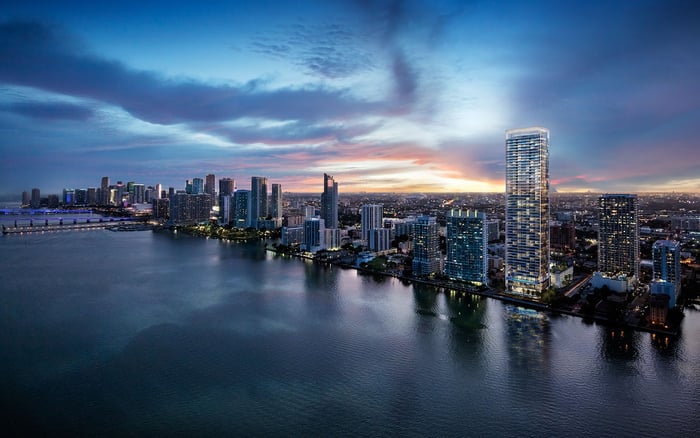
A discreet buyer’s guide to comparing Midtown Miami and Edgewater through the lens of privacy, from arrival sequence and amenity flow to sightlines, service culture, and daily rhythm.
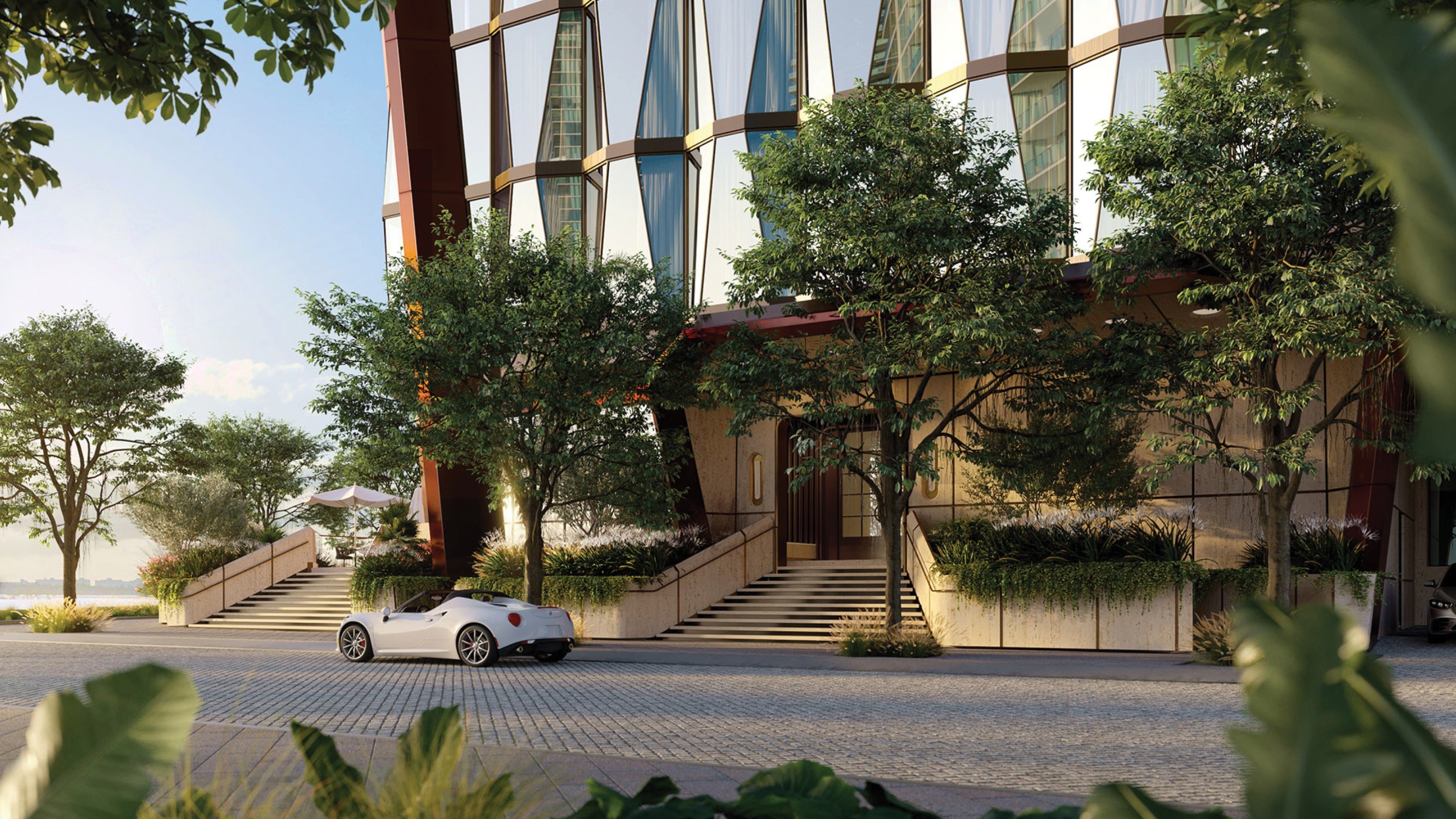
Privacy in Miami is rarely a simple matter of which address sounds more exclusive. For the ultra-premium buyer, the more revealing question is how a home receives you, shields you, and lets daily life unfold without unnecessary friction. That is why the comparison between Midtown Miami and Edgewater calls for a more exacting read than a simple neighborhood preference.
Both can appeal to buyers who want proximity to the cultural, design, dining, and business energy of the urban core. Yet privacy expresses itself differently in each setting. In one building, it may come from a low-profile lobby and a controlled arrival sequence. In another, it may come from height, setback, elevator programming, or a floor plan that clearly separates entertaining spaces from private rooms.
The most sophisticated buyers do not ask, “Which neighborhood is private?” They ask, “Where is privacy engineered into the daily experience?” That question turns the search from a map exercise into a lifestyle audit.
Midtown Miami can suit a buyer who values discretion through convenience. Its appeal is not necessarily seclusion in the traditional estate sense. It is the ability to move through the day with a measure of anonymity, surrounded by an active urban fabric where residents, guests, shoppers, and professionals blend into the area’s natural rhythm.
For some owners, that is a meaningful form of privacy. A high-profile buyer may prefer a setting where presence is not automatically conspicuous because the neighborhood already carries a steady pulse. The right residence can support a life in which errands, appointments, dining, and social meetings are absorbed into ordinary movement rather than staged as destination moments.
Still, privacy in Midtown Miami depends heavily on the building. A buyer should study how the entrance is positioned, whether valet or drop-off areas feel exposed, how guests are screened, and whether amenities create unwanted overlap between residents and visitors. A beautiful residence can lose its sense of sanctuary if every arrival feels public or every elevator ride feels socially demanding.
In this context, boutique scale may be attractive when it reduces circulation and creates a more residential atmosphere. Yet boutique does not automatically mean private. A smaller building with a visible lobby can feel less discreet than a larger one with better choreography. The difference is execution.
Edgewater tends to enter the privacy conversation differently. Buyers often examine how vertical living, outlook, and arrival sequence can create separation from the intensity of the city below. The key is not simply elevation. It is whether the residence feels protected once the door closes, and whether the approach to that door is properly controlled.
The challenge is that exposure can be both a luxury and a liability. Wide views, glass, terraces, and dramatic entertaining rooms may be desirable, but they also make sightlines a serious consideration. A residence can feel visually spectacular while still requiring thoughtful window treatment, furniture placement, lighting strategy, and a clear understanding of what neighboring buildings may see.
For Edgewater, the private buyer should look closely at elevator configuration, amenity adjacency, service access, garage movement, and whether staff, guests, deliveries, and residents cross paths too often. A building with strong service choreography can feel calm even in an active district. A building without it can feel less composed, regardless of price point.
This is where new construction deserves careful reading. New construction can bring current thinking around access, amenities, and residential programming, but buyers should not assume every new tower solves privacy equally. The question is whether privacy has been designed as a core experience or added as a marketing phrase.
For privacy-minded buyers, the arrival tells the truth. Before discussing finishes or views, study what happens in the first three minutes of coming home. Is the entrance easy to identify without feeling overly exposed? Does the porte cochere, valet, or lobby experience feel composed? Can a resident arrive with guests, family, or staff without creating a spectacle?
This arrival test is especially important when comparing Midtown Miami and Edgewater because both settings can offer urban energy. The difference lies in how a building filters that energy. A polished lobby is not enough. The path from car to elevator, the way front desk staff manage recognition, the separation between resident and guest circulation, and the treatment of deliveries all shape the sense of privacy.
For buyers who entertain often, the arrival test should extend to guests. A private home is not only private for the owner. It is gracious for invited company, intuitive for close friends, and contained enough that a dinner party does not feel like a public event before it begins.
The best privacy is often hidden in the plan. Split bedrooms, buffered primary suites, service corridors, powder room placement, and the distance between elevator foyer and living areas all matter. In a high-end residence, privacy is not merely acoustic or visual. It is social.
A buyer comparing the two neighborhoods should ask how the home performs at different times of day. Can one person take a work call while another entertains? Can staff move without crossing the main living room? Is there a graceful place for packages, luggage, flowers, or catering to pause before entering the home? These details determine whether a residence feels effortless or constantly managed.
Terraces and glass walls should be evaluated with the same discipline. A view may be memorable, but the more revealing the architecture, the more important the interior strategy becomes. Privacy-conscious buyers should consider daytime sightlines, evening illumination, and the relationship between indoor living spaces and nearby residences.
Midtown Miami may resonate with buyers who want urban access, a less ceremonious daily rhythm, and a setting where discretion is achieved through movement rather than distance. It can be particularly compelling for those who prefer to participate in the city without feeling defined by a trophy address.
Edgewater may appeal to buyers who want the feeling of lift, outlook, and a stronger threshold between home and street. It can be compelling for those who see privacy as a combination of controlled entry, vertical separation, and carefully managed exposure.
Neither choice is universally superior. A residence in Midtown Miami can feel more private than one in Edgewater if it has better entry control, quieter amenities, and a more thoughtful plan. Conversely, an Edgewater home can deliver a stronger sense of retreat if the building is calibrated around resident movement and sightline control.
Many buyers also benchmark against Wynwood, Downtown, and Brickell, not because those areas answer the same privacy question, but because they help clarify tolerance for activity, density, formality, and access. The exercise is less about choosing the quietest district and more about defining the right type of privacy.
A serious buyer should walk the building at different times, not only during a prepared showing. Morning departures, evening returns, weekend guest flow, and amenity usage can reveal how the property actually behaves. Ask how many access points exist, how guests are announced, how elevators are assigned, and where service providers enter.
Inside the residence, stand where daily life will happen. Sit in the primary bedroom. Look from the kitchen toward the elevator entry. Observe whether the terrace feels serene or performative. Listen for hallway sound. Imagine a quiet night, a family visit, a catered event, and a normal weekday. Privacy is proven through repetition, not first impressions.
The most successful purchase is not necessarily the most secluded. It is the one where the owner feels in command of visibility, access, and pace. In a city built around presence, that level of control is its own form of luxury.
Is Midtown Miami more private than Edgewater? Not automatically. Privacy depends on the specific building, floor plan, arrival sequence, and resident circulation.
Is Edgewater better for buyers who want a quieter home? It can be, if the building manages access, amenities, and sightlines well. The address alone does not guarantee calm.
What is the first privacy feature to evaluate? Start with the arrival sequence. How you move from car to residence often reveals the building’s true level of discretion.
Does a higher floor always mean more privacy? No. Height can help with separation, but sightlines, elevator access, and neighboring exposure still matter.
Are boutique buildings always more discreet? Not always. Boutique scale can reduce traffic, but poor lobby placement or exposed access can weaken privacy.
Should new construction be prioritized for privacy? New construction may offer current design thinking, but each building must be evaluated on its actual access and service logic.
How important is the elevator layout? Very important. Elevator programming affects who you encounter, how guests arrive, and how private the residence feels.
Can an active neighborhood still feel private? Yes. A well-designed residence can create privacy through controlled entry, careful planning, and interior separation.
What should buyers compare beyond Midtown Miami and Edgewater? Wynwood, Downtown, and Brickell can help clarify how much activity, formality, and access a buyer truly wants.
What is the best way to decide between the two? Walk the building, study the plan, and evaluate privacy during real daily conditions rather than relying on reputation.
For a confidential assessment and a building-by-building shortlist, connect with MILLION.
If branded residences are on your mind — as a home or as an allocation — we would be glad to share what we are seeing, privately.
Begin a quiet conversation